Lagarde's press conference was the main event: ING's four scenarios indicate significant two-way risks for the euro.
2026-09-10 10:24:08
On Thursday (September 10) in early Asian trading, the euro traded in a narrow range around 1.1635 against the US dollar. The European Central Bank (ECB) will announce its September policy decision later today, with the market widely expecting a 25 basis point rate hike to 2.5%, which would be the second rate hike this year. The US August Producer Price Index (PPI) will be released later that day. ING's four-scenario framework released before the decision provides a clear conclusion: regardless of the wording, a 25 basis point rate hike is locked in. The real determinant of the euro's direction will be the policy guidance released by Lagarde at her press conference. 
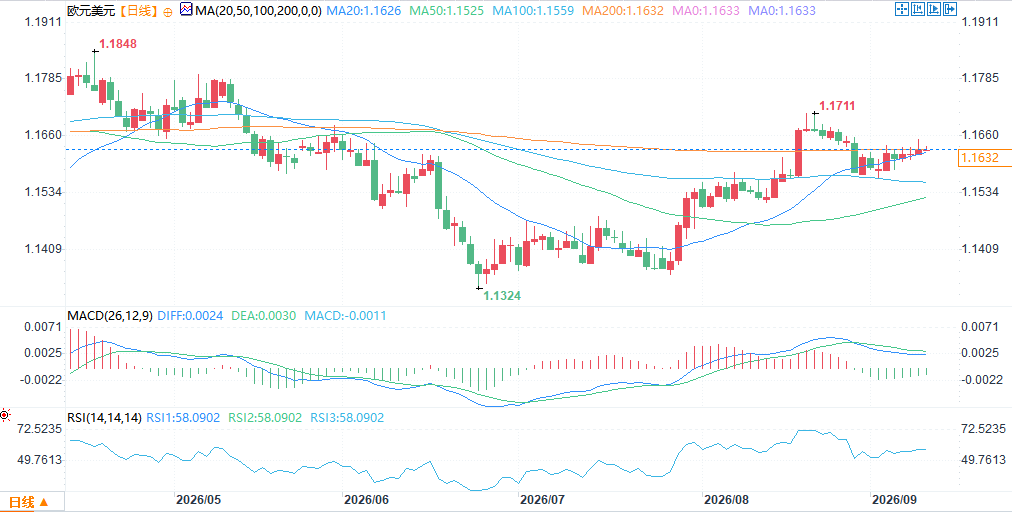 (Euro/USD daily chart, source: FX678) At 10:22 Beijing time, the euro was trading at 1.1637/38 against the US dollar.
Interest rate hike "almost locked": Market focus has shifted from interest rate decision to wording and forecasts
The European Central Bank's (ECB) rate hike decision on Thursday has been fully priced in by the market. Driven by the ongoing US-Iran conflict and rising energy prices, the Eurozone's inflation rate rebounded to above 3% in August. The swap market fully priced in a 25 basis point rate hike, raising the deposit rate from the current 2.25% to 2.5%. A prominent global macro chief noted, "A September rate hike looks almost certain. Inflation remains high and should remain sticky in the coming months before gradually declining in the second half of next year." Analysis from Scotiabank strategists further reinforces this assessment. The bank points out that the euro's fundamentals remain supportive – ECB interest rate expectations have strengthened due to the latest round of oil price increases, reflecting "the ECB's greater sensitivity to energy price risks in the current environment." The bank expects Thursday's rate hike to be a "hawkish one," with ECB President Lagarde releasing updated forecasts and signaling continued concerns about upside risks. A further 25 basis point rate hike in December has also been priced in by the market. The rate hike itself will have limited marginal impact on the euro; the real variable lies in how Lagarde describes the subsequent path.ING's Four-Scenario Framework: From 1.150 to 1.168, the wording determines the euro's final price.
ING's scenario framework, released prior to the decision, broke down the market impact of the meeting into four possibilities, each including a 25 basis point rate hike, but with drastically different effects on the euro and German 10-year bond yields: ① Extremely dovish scenario: The ECB raises rates while signaling a prolonged pause and expressing concern about bond market conditions. This corresponds to a euro/dollar exchange rate close to 1.150 and a German 10-year bond yield of approximately 3.30%. ② Dovish rate hike (ING baseline scenario): Inflation forecasts are slightly revised upwards, but the overall risk balance remains largely unchanged; growth forecasts improve, but downside risks persist; policymakers only slightly respond to market pricing, retaining all options. This corresponds to a euro/dollar exchange rate of approximately 1.157 and a German 10-year bond yield of approximately 3.35%. ③ Neutral scenario: The ECB acknowledges the new upside risks to inflation from the escalating situation in the Middle East, while believing that growth risks are more balanced after improved forecasts, and signals that rate hikes may still be possible in the coming months. The corresponding exchange rate is approximately 1.163 against the US dollar, and the yield on 10-year German government bonds is approximately 3.40%. ④ Most hawkish scenario: The ECB acknowledges that the impact of inflation may be greater than initially expected, necessitating continued policy action, while significantly revising its growth forecasts upward and explicitly hinting at further rate hikes in October and beyond. The corresponding exchange rate is approximately 1.168 against the US dollar, and the yield on 10-year German government bonds is approximately 3.45%. Currently, the euro and the yield on 10-year German government bonds are at 1.161% and 3.40% respectively, closest to ING's neutral scenario. This means the market is already pricing in "rate hikes accompanied by stronger rhetoric," and if the actual outcome falls at either end of the range, it could trigger greater volatility than expected.US PPI data released on the same day: another key variable in the direction of the US dollar.
In contrast to the near-certainty of a rate hike by the European Central Bank, the direction of US monetary policy remains highly uncertain. Thursday's release of the August PPI data will be the first inflation test before Friday's CPI data. The market expects overall PPI to rise 5.3% year-on-year in August (previous value 4.7%), and core PPI to rise 4.6% year-on-year (previous value 4.2%). If the data is higher than expected, it will strengthen market bets on a 25 basis point rate hike by the Federal Reserve next week—currently, federal funds futures are pricing in a roughly 60% probability of a rate hike—potentially providing significant support for the dollar and putting pressure on the euro. If the data is moderate, it may solidify market expectations that the Fed will hold rates steady, opening up further upside potential for the euro.Summarize
The euro is currently consolidating narrowly against the dollar around 1.1635. The market's focus has shifted from the interest rate decision itself to Lagarde's rhetoric and the latest economic forecasts, as the 25 basis point rate hike by the European Central Bank has already been fully priced in. ING's four-scenario framework provides clear reference points: the euro/dollar pair is likely to fall between 1.150 and 1.168, and the German 10-year bond yield is likely to range between 3.30% and 3.45%, with the current price closest to the neutral scenario. If the ECB releases dovish signals or expresses concerns about the bond market, the euro may come under pressure and fall; if it clearly hints at a further rate hike in October, the euro could challenge 1.168. The US PPI data released on the same day is another key variable for the dollar's direction. (Euro/USD daily chart, source: FX678) At 10:22 Beijing time, the euro was trading at 1.1637/38 against the US dollar.
- Risk Warning and Disclaimer
- The market involves risk, and trading may not be suitable for all investors. This article is for reference only and does not constitute personal investment advice, nor does it take into account certain users’ specific investment objectives, financial situation, or other needs. Any investment decisions made based on this information are at your own risk.