The most hawkish voice ahead of the Bank of Japan's September meeting: A statement from the Bank of Japan indicates that Japan is no longer in deflation and that real interest rates need to move out of negative territory as soon as possible.
2026-09-10 10:36:08
On Thursday (September 10) during the Asian session, the USD/JPY pair traded in a narrow range, currently hovering around 153.45, remaining within its lows since February 18. The latest hawkish comments from Bank of Japan (BOJ) policy board member Kazuyuki Masu are providing potential support for the yen. Masu stated on Thursday that given the still-loose financial conditions, the BOJ expects to continue raising interest rates, specifically highlighting the inflation risks posed by oil prices, food prices, producer prices, and a weak yen. These comments, coming ahead of the BOJ's policy meeting on September 17-18, further reinforced market expectations of a rate hike at that meeting. Masu's remarks provided some support for the yen because they signaled that the committee was not merely reacting to energy headlines, but rather building a broader basis for policy normalization. 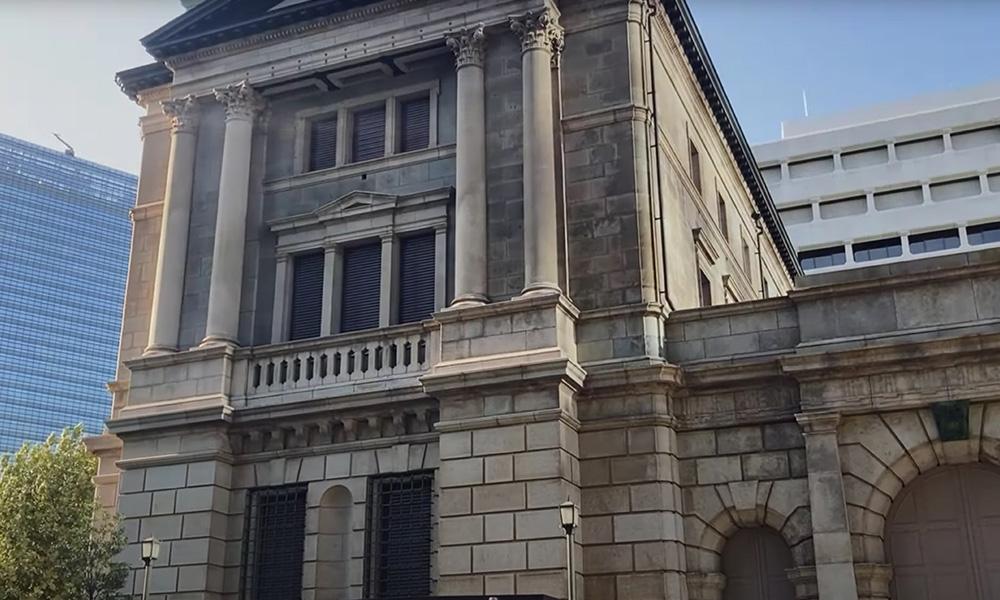
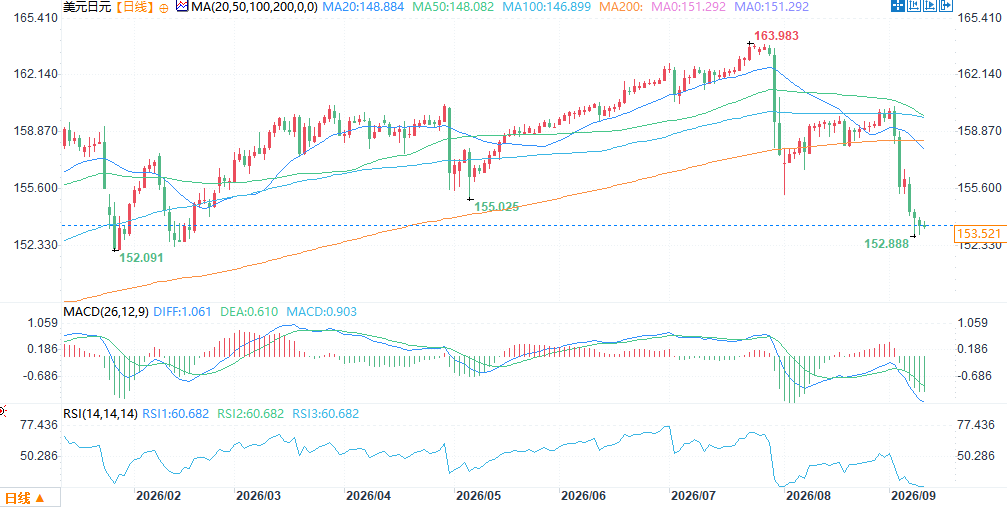 (USD/JPY daily chart, source: FX678) At 10:34 Beijing time, USD/JPY was trading at 153.58/59.
Who is Masuda: A Hawkish Voice on the Committee
Yoichi Masaki will join the Bank of Japan's board of directors in July 2025. Previously, he served as chief financial officer at Mitsubishi Corporation, a seat traditionally reserved for corporate executives. He is widely considered one of the more hawkish members of the current board. He voted to keep interest rates unchanged at the April meeting, but stated in May that the Bank of Japan should raise rates as soon as possible without clear signs of an economic slowdown. Therefore, his comments on Thursday were a continuation of his previous stance rather than a change.Key takeaways: Underlying inflation is nearing 2%, and policy rates are approaching the neutral range.
Masuda stated that Japan's core inflation remains below the central bank's 2% target, but is quite close. He emphasized that given the still-loose financial conditions, the Bank of Japan is expected to continue raising interest rates. The pace and timing of these rate hikes will depend on the likelihood of achieving the central bank's baseline inflation forecast, while closely monitoring oil prices, AI-related demand, and exchange rate fluctuations. He explicitly stated that the most important consideration is to avoid core inflation significantly exceeding the 2% target. Regarding the current rise in energy costs, he acknowledged that the increase in fuel and chemical prices may be a one-off shock, but could also have a broader impact through distribution costs. He specifically warned that cost increases triggered by the Middle East conflict could push up overall prices in a more sustained trend, rather than being a temporary phenomenon.Several pressure points worth noting
Masuda listed several sources of inflationary pressure that need close monitoring: the recent 7% increase in producer prices is noteworthy —this could transmit to consumer inflation more significantly than historically has . Food prices are expected to accelerate again —he described this as potentially crucial to the long-term inflation outlook . The weak yen has a greater impact on inflation than in the past —therefore it needs close attention. He also stated that there are currently no signs that the recent interest rate hikes are suppressing corporate financing willingness, and he is watching for signs that corporate investment may be overheating.Policy framework: Japan is no longer in deflation, and real interest rates need to move out of negative territory as soon as possible.
At the policy framework level, Masuda stated that Japan is no longer in deflation, and the Bank of Japan must move real interest rates out of negative territory as soon as possible. With policy rates approaching the central bank's estimated neutral range, he said the central bank needs to carefully monitor price, employment, and financial conditions. He warned that if inflation accelerates, the Bank of Japan may be forced to raise interest rates at a faster pace than currently anticipated. Furthermore, he mentioned another long-standing issue facing the Bank of Japan—which maturity range of Japanese government bonds should be held when considering the desired balance sheet size.Summarize
Masuda's remarks sent a clear hawkish signal: core inflation is approaching the 2% target, financial conditions remain loose, real interest rates must move out of negative territory as soon as possible, and the weak yen and producer price transmission effects on inflation are stronger than before. These statements further solidified market expectations for an interest rate hike at the Bank of Japan's September 17-18 meeting. The most market-sensitive signal was his warning that "if inflation accelerates, the Bank of Japan may be forced to raise interest rates at a faster pace"—meaning that from now until the meeting and the release of economic data thereafter, there will be higher market pricing sensitivity. For the yen, Masuda's comments provided marginal support, but whether the yen can hold onto its gains still depends on the coordination of subsequent data and central bank communication. (USD/JPY daily chart, source: FX678) At 10:34 Beijing time, USD/JPY was trading at 153.58/59.
- Risk Warning and Disclaimer
- The market involves risk, and trading may not be suitable for all investors. This article is for reference only and does not constitute personal investment advice, nor does it take into account certain users’ specific investment objectives, financial situation, or other needs. Any investment decisions made based on this information are at your own risk.