US-Canada trade tensions escalate again: tariff list adjustments + import bans + procurement restrictions, but analysts say the impact will be "limited."
2026-09-10 11:04:07
On September 8, Canada's retaliatory tariffs on approximately $20 billion worth of U.S. goods officially took effect. On the same day, the White House announced a new round of retaliatory measures against Canada, encompassing import bans, adjustments to the tariff list, and restrictions on government procurement, marking a further escalation of the U.S.-Canada trade friction. In its latest research report, RBC Capital Markets quantitatively analyzed the specific content, actual impact, and future trend of the new U.S. measures. The core conclusion is that the impact of this round of measures on the overall Canadian economy is limited; what is truly alarming is the potential for the trade friction to escalate further into a retaliatory cycle covering a larger share of trade. 
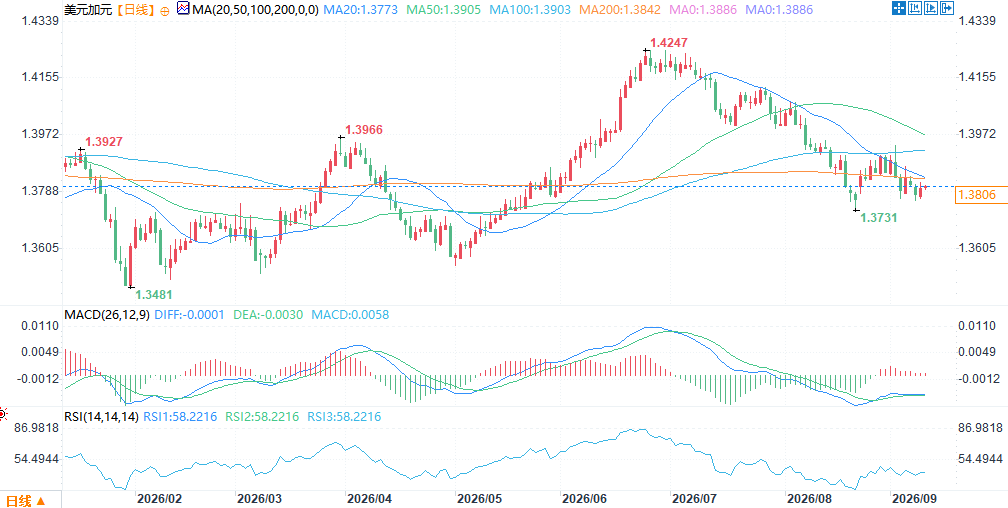 (USD/CAD daily chart, source: EasyForex) At 11:01 Beijing time, USD/CAD was trading at 1.3804/05.
What does the new measure include?
The measures introduced by the US in this round mainly include three aspects: First, adjusting the list covering the 50% import tariff. The list of 50% import tariffs, implemented in August under Section 338 of the Tariff Act of 1930, was updated, adding 110 Canadian products to the US while removing about 10 products. The import value of the added and removed products is roughly equivalent—in 2025, the US imports of the 10 removed products are estimated at approximately $1.73 billion, while imports of the 110 newly added products are estimated at approximately $1.85 billion. In terms of dollar value, the impact of the list adjustment on Canadian trade as a whole is basically neutral. Second, imposing import bans on some products already covered by the 50% tariff. 68 products, including alcoholic beverages, dairy products, and certain motorcycles, will be completely banned from import starting September 29. This is an escalation, but because these products were already subject to the 50% tariff, many were already too expensive for US importers, so the marginal impact is relatively limited—of course, the impact on the specific exporting companies targeted is still significant. Third, restricting access for Canadian companies to the US government procurement market. Trump stated on social media that he would push to remove Canadian products from the U.S. General Services Administration's "Multiple Award Schedule" (the federal government's procurement marketplace platform) in response to the "Buy Canada" preference introduced into Canadian federal government procurement rules and restrictions imposed by some provinces on the purchase of U.S. products. This platform involves approximately $50 billion in government procurement spending annually, but this represents a limited percentage compared to the nearly $800 billion in new contracts committed by the U.S. federal government by 2025. It's important to note that approximately 80% of non-defense government spending occurs at the state and local levels, making the direct impact of federal-level cuts on Canadian businesses relatively manageable.Actual impact assessment: 5% trade share, strong local pain but limited overall impact.
Calculations by the Royal Bank of Canada show that the Section 338 tariffs currently only affect about 5% of US imports from Canada in US-Canada trade, causing significant disruption to the targeted industries, but with limited impact on the overall economy. The real risk lies not in the current measures themselves, but in whether they will escalate into a retaliatory cycle covering a larger share of trade. Looking at the composition of this round of measures, the list adjustments are roughly balanced, the import bans mainly target products already covered by high tariffs, and the actual scale of procurement restrictions is limited—all these point to one conclusion: this round of escalation is within a "controllable range" and has not yet evolved into a full-blown trade confrontation.The interplay between escalating trade frictions and diverging central bank policies
The impact of the new round of US tariffs on the USD/CAD exchange rate needs to be examined within the context of the Bank of Canada's policy stance and trade risks. Currently, the USD/CAD is trading around 1.3800. From an interest rate perspective, the Bank of Canada maintained its benchmark interest rate at 2.25% for the seventh consecutive time on September 2nd. However, Governor Macklem explicitly stated that "inflation risks are skewed to the upside" and indicated that if inflation remains excessively high, "policymakers are prepared to raise borrowing costs multiple times." This statement was interpreted by the market as a hawkish signal, and the Canadian dollar initially received support after the decision. However, the renewed escalation of trade tensions has put downward pressure on the Canadian dollar—Canada's retaliatory tariffs on approximately $20 billion worth of US goods officially took effect on September 8th, and the US subsequently introduced a new round of retaliatory measures. The Bank of Canada also warned that the escalation of the US-Canada trade dispute could threaten the country's nascent economic recovery or prompt businesses to postpone investment and hiring decisions. Overall, the USD/CAD is currently caught in a tug-of-war between the Bank of Canada's hawkish stance supporting the Canadian dollar and the escalating trade tensions suppressing it. If the trade situation between the US and Canada deteriorates further, the Canadian dollar may come under pressure and test above 1.39; conversely, if the Bank of Canada signals a stronger rate hike due to inflationary pressures, the Canadian dollar is expected to receive some support.Summarize
The US's new round of retaliatory tariffs against Canada appears to be a series of frequent actions—adding tariffs to the list, imposing import bans, and restricting government procurement access—but after quantitative analysis, their actual economic impact is relatively mild. The Section 338 tariffs cover only 5% of trade, the adjustments to the tariff list are roughly balanced in terms of amount, the marginal impact of the import bans is weakened by the pre-emptive implementation of the 50% tariff, and the actual scale of the government procurement restrictions is also limited. The core conclusion is that the current measures represent a relatively mild escalation, not the beginning of a full-blown trade confrontation. The real risk that requires continued attention is whether the two sides will expand the conflict to areas covering a larger share of trade—this scenario has not yet occurred, but it remains the biggest uncertainty regarding the future direction of US-Canada trade relations. (USD/CAD daily chart, source: EasyForex) At 11:01 Beijing time, USD/CAD was trading at 1.3804/05.
- Risk Warning and Disclaimer
- The market involves risk, and trading may not be suitable for all investors. This article is for reference only and does not constitute personal investment advice, nor does it take into account certain users’ specific investment objectives, financial situation, or other needs. Any investment decisions made based on this information are at your own risk.