With the yen rising to around 153, is a 3% yield on bonds a quieter warning sign?
2026-09-10 17:42:07
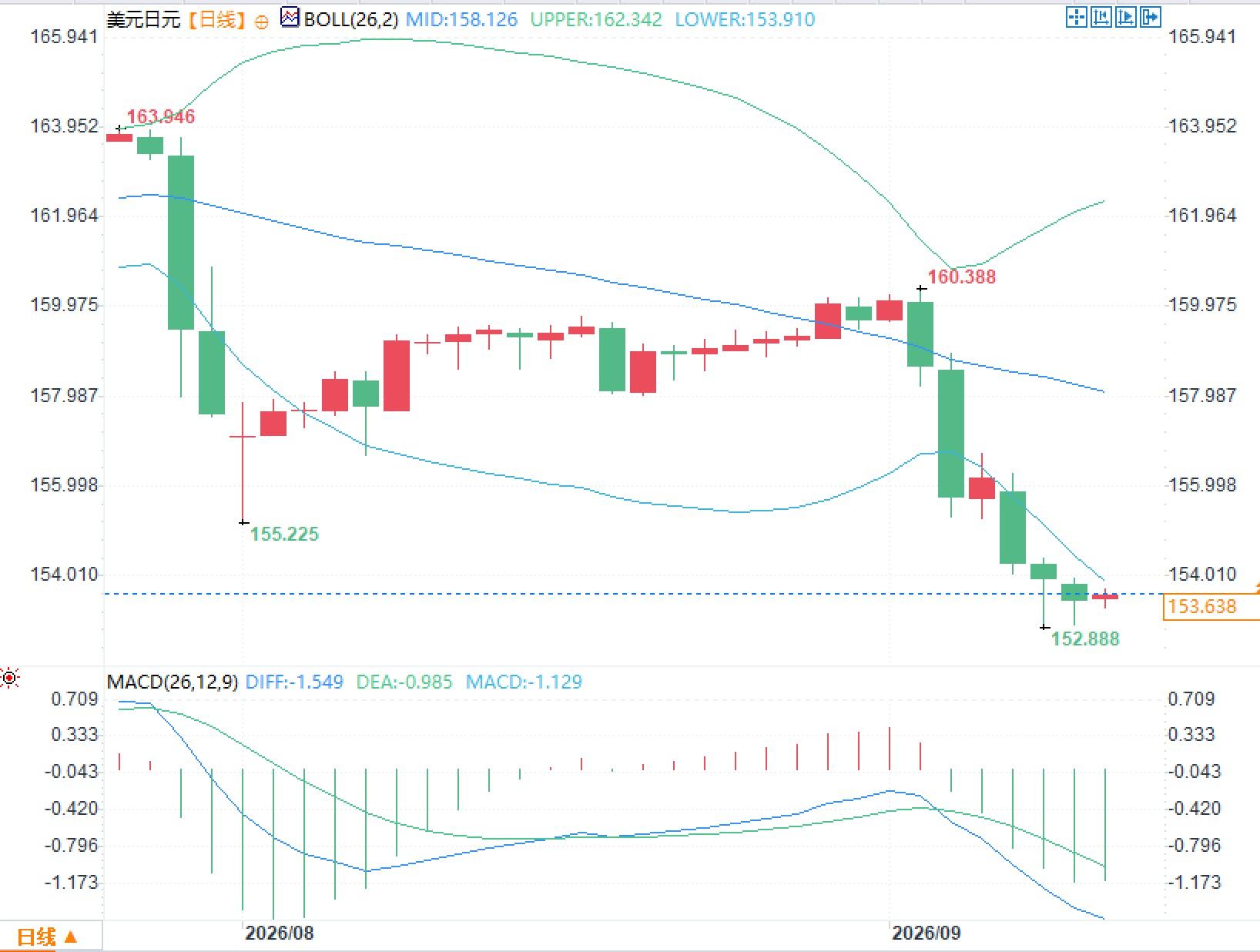
On Thursday, September 10th, the USD/JPY exchange rate hovered around 153.5, while the yield on 10-year Japanese government bonds remained in its multi-decade highs, having recently risen above 3% before falling back to approximately 2.91%. The market has priced in the Bank of Japan's (BOJ) policy meeting on September 17th and 18th as a crucial juncture in its policy path. Recently, Policy Board member Masuzu suggested that to complete the normalization of monetary policy, the policy rate needs to be further raised; if inflation accelerates, there is a risk of "having to implement rapid interest rate hikes." Limited exchange rate fluctuations after the remarks indicate that pricing is more focused on the wording of the meeting statement, outlook report, and the governor's press conference, rather than the individual member's speech itself. Meanwhile, external communication is also changing the information structure of trading positions. US Treasury Secretary Scott Bessant recently stated that he has "a fairly clear understanding" of the BOJ's potential next moves, placing foreign exchange intervention and policy path within the same narrative. From July 30th to August 26th, the Japanese Ministry of Finance disclosed foreign exchange intervention totaling 15.3993 trillion yen, including coordinated operations with the US. Intervention alters immediate liquidity and volatility, while the interest rate path determines whether interest rate spreads and real interest rates can continue to converge. The combination of these two factors is the core logic behind the current simultaneous repricing of the yen and Japanese government bonds. 
With underlying inflation approaching the target, policy discussions have shifted from "whether to exit" to "how to avoid falling behind."
Zeng Hezhi anchored his assessment on underlying inflation. He stated that price trends are very close to 2%, and financial conditions remain relatively loose; therefore, "the Bank of Japan will continue to raise policy interest rates and adjust the degree of monetary easing." "The most important thing going forward is to ensure that the underlying inflation rate does not significantly exceed 2%." He also indicated that to complete normalization, "it is certain that further increases in policy interest rates are necessary." Japan's July composite CPI rose 1.9% year-on-year, core CPI excluding fresh food rose 1.8%, and core-core CPI excluding fresh food and energy rose 1.9%. In Tokyo's August leading indicators, excluding fresh food, the year-on-year increase was 1.8%, and excluding fresh food and energy, it was 2.0%. Food prices remained around 3.5% year-on-year, while price increases in services and household goods expanded, indicating that cost transmission to end consumers has not stopped. Following the Middle East conflict which pushed up fuel and chemical prices, transportation costs and fertilizer prices are further spreading to the food chain; Zeng Hezhi views this as a risk that could turn from a temporary shock into a sustained trend. More crucial for traders is the real interest rate. Japan's policy rate has been guided to 1.0% since June, a level not seen in approximately 31 years. However, relative to the inflation trend of nearly 2%, the short-term real interest rate remains negative. As stated by Zeng Hezhi, Japan is no longer in deflation, and the negative real interest rate "should be addressed as soon as possible." The policy rate remains below the Bank of Japan's estimated neutral interest rate range (market reports suggest approximately 1.1% to 2.5%), and a prolonged period below this level would be interpreted as persistently loose financial conditions. Therefore, the meaning of normalization is quite specific: pushing nominal interest rates to the lower end of the neutral range, allowing for two-way policy adjustments, rather than treating a single rate hike as the end of a cycle.Loose financial conditions are described as a source of risk, and rapid interest rate hikes are a scenario rather than a promise.
The most attention-grabbing sentence in the report wasn't "continue to raise interest rates," but rather the conditional statement: financial conditions remain accommodative, and if inflation accelerates on this basis, "a rapid increase in policy rates may be unavoidable." This is risk scenario management, not a preview of the pace of a single meeting. When asked about the possibility of a 50 basis point increase, he emphasized that a prudent approach should be taken to raising funding costs; when asked about the decision next week, he stated, "We don't know what decision will be made next week," and that subsequent meetings would be assessed separately. This statement shifted the market focus from "to raise or not to raise rates" to "how to write the path after the increase." Currently, the unsecured overnight interbank lending rate target is around 1.0%, and the market generally considers 25 basis points, guiding it to around 1.25%, as the baseline scenario. What truly has pricing significance is: whether the statement reiterates "continue to raise policy rates," whether the outlook report revises upward the underlying inflation path, and whether the press conference describes the impact of the Middle East conflict, import prices, and exchange rates on prices as upside risks. If the communication emphasizes "avoiding falling behind the curve," subsequent meeting intervals may be interpreted as shorter; if it emphasizes that the impact of cumulative interest rate hikes on businesses and households still needs to be observed, pricing will revert to meeting-by-meeting. Domestically, Japan's demand side has not provided evidence that "interest rate hikes have significantly suppressed financing." Zeng Hezhi points out that while fixed wages have increased by about 3%, real wages have turned positive, and corporate financing intentions have not shown a significant contraction; instead, there is a need to be wary of "potential overheating" in equipment investment. For bond and interest rate option traders, this means that supply shocks and demand transmission may overlap: while external costs raise prices, if wage and price setting behaviors become entrenched, the probability of underlying inflation overshooting will increase. The proposal for rapid interest rate hikes is precisely to illustrate that if real interest rates are not brought out of negative territory now, the available policy space will be even narrower later.Intervention alters volatility; interest rate path repricing; spreads and duration
The foreign exchange and bond markets have already partially priced in the above logic. The yen has rebounded from nearly 164 in July to around 153.5 currently; the yield on 10-year Japanese government bonds touched around 3.00% to 3.02% in early September, near a 30-year high, and is currently around 2.91%. The intervention of approximately 15.4 trillion yen from July to August, a record for a single period, served to provide counterparties when the exchange rate fluctuated disorderly, reduce immediate volatility, and demonstrate the authorities' coordination capabilities to the market. Bessant linked coordinated intervention with "asymmetric information about Japan's policy path," reinforcing external attention, but the Bank of Japan's statutory objective remains price stability. The exchange rate enters the CPI through import prices; a weak exchange rate amplifies the transmission of fuel, food, and intermediate inputs. Interest rates, on the other hand, affect aggregate demand and inflation expectations through real interest rates, credit conditions, and term premiums. Stefan Unrik, head of the rating agency, commented that when Yoshiyuki Souwa joined the Board of Deliberations last year from a trading company, he held a more centrist stance, but his recent statements have become more direct, and the speech itself is "another signal moving towards interest rate hikes." He also believes that the Bank of Japan's adjustment pace is usually slow, and it is more likely that the intervals between rate hikes will be shortened, rather than a significant increase in the pace at a single meeting. This assessment is consistent with the board member's own stance of "cautious increases and decisions made step by step," and also explains why the yen remained almost stable after the speech: directional information has already been priced in, and incremental information is in the pace and risk statements.Meeting Observation Checklist: Definitions, Neutral Interest Rate, and Risk Sections
The key takeaways from the Bank of Japan's meeting next week are concentrated in three areas. First, whether the policy statement will retain the phrase "the policy rate will continue to be raised based on economic, price, and financial conditions" will determine whether the path beyond 1.25% remains unfinished. Second, the density of statements regarding the neutral and real interest rates. If policy committee members generally emphasize that the policy rate remains below the neutral range and that negative real interest rates need to be corrected as soon as possible, volatility at the front and middle of the yield curve will increase. Third, the risk section in the price outlook: will demand related to semiconductors and artificial intelligence, crude oil and grain prices, and the impact of exchange rates on import prices be cited as reasons for upward revisions to underlying inflation? Zeng Hezhi also points out an easily overlooked technical detail: pushing the policy rate into the estimated neutral range is to retain flexibility for "rapid adjustments in both directions based on economic conditions." After normalization approaches the lower edge of the neutral range, meeting communications will resemble risk management more than a one-way exit narrative. Market participants are already discussing whether the October meeting might again include this path, but this depends on how the September statement defines "financial conditions remain accommodative." Price data, the implementation of wage negotiations, and import prices and enterprise price passing on will be frequently verified variables between the two meetings.- Risk Warning and Disclaimer
- The market involves risk, and trading may not be suitable for all investors. This article is for reference only and does not constitute personal investment advice, nor does it take into account certain users’ specific investment objectives, financial situation, or other needs. Any investment decisions made based on this information are at your own risk.