The Houthis' northward advance and capture of key Red Sea cities has brought global oil prices to another critical juncture.
2026-09-10 18:06:08
On Thursday (September 10), international oil prices suddenly rose during Asian and European trading sessions, rebounding after hitting a low. WTI crude oil is currently trading at $97.80, up 1.8%, after falling as much as -0.7% at one point during the session. The Houthi rebels in Yemen continue their attacks on Saudi Arabia, having captured the strategically important Red Sea city of Muhammad, a crucial city on the Bab el-Mandeb Strait. Pakistan's confirmation of its military deployment in Saudi Arabia, along with other significant variables, has completely shifted Middle East geopolitical risks from the Strait of Hormuz alone to the Bab el-Mandeb Strait and Saudi Arabia's energy hinterland, creating a highly risky situation with both straits under pressure. Although the straits are not completely cut off, and the shortage of marine fuel supply has eased somewhat from its peak in March and April, the combination of multiple geopolitical risks has completely shattered market expectations of a de-escalation of the conflict and a decline in oil prices. The lack of substantial progress in negotiations between the US and Iran, coupled with the escalation of the nuclear issue, further amplifies tail risks in the energy market. 
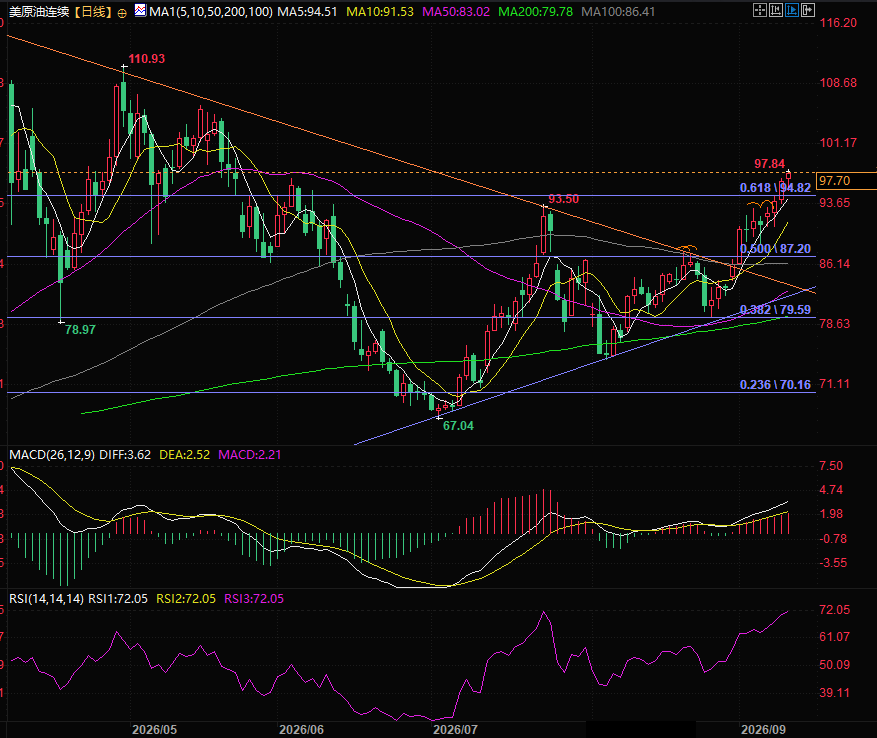 (WTI futures daily chart, source: EasyTrade) At 18:00 Beijing time, WTI crude oil is currently trading at $97.60 per barrel.
Key new variable: Houthi control of the key town of Muha, drastically increasing the risk of blockading the Bab el-Mandeb Strait.
The most unexpected development in the current Middle East situation comes from a strategic breakthrough in Yemen: the Houthi rebels have successfully seized control of Muha, a key city on the Red Sea coast. A quick map search reveals its crucial location at the chokepoint of the Bab el-Mandeb Strait. This military advance was not a sudden event. Although the Houthis have suffered setbacks on some fronts, this offensive possesses immense regional strategic influence, fundamentally altering the risk landscape of Red Sea shipping. Muha, situated at the northern end of the Bab el-Mandeb Strait, is a core pivot controlling the shipping route from the Red Sea to the Indian Ocean. The Houthis' control of the city means they are only one step away from completely blocking the Bab el-Mandeb Strait. As a regional armed group supported by Iran, the Houthis' strategic advance significantly strengthens Iran's regional influence and offsets Iran's recent predicament of facing pressure on multiple fronts. Thus, two major energy chokepoints in the Middle East are simultaneously threatened: the Strait of Hormuz is disrupted by the US-Iran conflict, while the Bab el-Mandeb Strait is effectively controlled by the Houthis. The combined pressure from these two straits on the global energy supply chain significantly exacerbates uncertainty in the global security situation and the oil market. Previously, the market generally held optimistic expectations, with Trump publicly stating on the 9th that he anticipated the US-Iran conflict would gradually cool down after the US midterm elections, and international oil prices would subsequently decline. However, the Houthi rebels' capture of Mohammad and their continued escalation of the conflict in the Red Sea and with Saudi Arabia directly overturned this prediction. The low-intensity conflict in Yemen, long overlooked by the market, has become a key force reshaping the Middle East regional landscape and influencing oil price trends, leading to a renewed increase in geopolitical risk premiums.Regional conflict continues to escalate: Saudi Arabia suffers repeated airstrikes, Pakistan's defense intervention is poised to begin.
Geopolitical risks in the Middle East continue to escalate, with Yemen's Houthi rebels launching intensive attacks on key southern Saudi cities for two consecutive days. Turki al-Maliki, a spokesman for the Saudi-led coalition, announced on the 9th that the Houthis used ballistic missiles and drones to attack multiple locations, including Khamis Mushait, Abha, and Jazan, targeting Saudi national assets and core infrastructure. The coalition immediately stated it would respond forcefully. The previous day, Houthi forces had already raided civilian and economic facilities in Saudi cities such as Abha, Jazan, and Najran, injuring 73 civilians, including women and children, and causing significant damage to civilian and infrastructure infrastructure. The risk of spillover from the conflict has further increased. On the 10th, local time, the Pakistani Foreign Ministry officially confirmed for the first time that some Pakistani armed forces personnel had been deployed to Saudi Arabia to conduct military training and related logistical support. Pakistan stated that Pakistan and Saudi Arabia have long maintained deep bilateral defense cooperation and, based on the Mecca Mutual Defense Agreement, will continue to deepen regional defense cooperation. Currently, the supporting implementation mechanisms and cooperation framework of this framework agreement are still being finalized and improved. The core risk in the market lies in the possibility that if the war in Yemen continues to escalate and Saudi Arabia suffers sustained large-scale attacks, the defense agreement signed by Pakistan, Saudi Arabia, and Turkey may be formally activated. Pakistan is highly likely to directly intervene in the Yemeni conflict, which would escalate the Middle East conflict across the board and further destabilize the energy supply chain. Of course, we still believe that the possibility of Pakistan taking the initiative to intervene is low.Strait navigation: Traffic volume shrinks on both channels, putting pressure on energy transport corridors across the board.
The Strait of Hormuz carries approximately one-fifth of the world's crude oil and LNG shipments, making it a crucial choke point in the global energy system. Before the conflict, about 125 merchant ships transited the strait daily; the latest Kpler data shows that only six commodity vessels passed through the strait on Tuesday, far below the 10-day average of 12. Currently, limited passage remains on the Oman corridor south of the strait, with about 10-15 cargo ships crossing in both directions daily. Oil trade has not been completely disrupted, but navigation efficiency has been drastically reduced. The maritime conflict continues to escalate, with the US claiming to have destroyed five Iranian oil tankers, while Iran announced attacks on multiple merchant ships and US warships both inside and outside the strait. Although the US stated that its warships were not hit, there have been casualties among merchant ship crews in the Gulf region, and the UK Maritime Trade Office confirmed that merchant ships in the area have frequently been subjected to damaging fire attacks. Iran has expanded its strikes to include oil tankers around Bahrain and Kuwait, and the conflict has completely breached Iranian territorial waters and the core area of the strait, exposing merchant ships from the UAE, Bahrain, Kuwait, Iraq, and the Gulf of Oman to full risk. If attacks on merchant ships become commonplace, war risk premiums will surge, and large-scale ship rerouting and diversion of energy cargo will directly drive up oil prices. Meanwhile, the UAE continues to diversify its shipping strategy by expanding the ports of Fujairah and Hafekham, constructing the Abu Dhabi-Fujairah oil pipeline, and building a backup shipping system outside the Strait of Hormuz. This aims to reduce reliance on a single shipping route and enhance regional logistical resilience, but in the short term, it cannot replace the core shipping functions of the Straits of Hormuz and Bab el-Mandeb.Marine fuel and crude oil supply and demand: Supply pressure eases marginally, but structural bottlenecks remain prominent.
At the APPEC industry conference, shipping and fuel traders reported that the marine fuel market is gradually absorbing the previous supply shock, with the tight situation significantly easing compared to the earlier period. Rishi Nyati, General Manager of shipping company Emarat Maritime, stated that there are currently no significant obstacles to purchasing fuel oil and completing ship refueling, and the market situation is significantly better than the shortage period in March and April of this year. However, geopolitical risks have forced an overall increase in refueling costs. Data shows that the spot price of ultra-low sulfur fuel oil (VLSFO) in Singapore, the world's largest marine fuel supply center, is still more than 60% higher than before the war. Although it has fallen from the price peak in March, it remains at a high level. Max Tay, Head of Asian Heavy Fuel Products at trading firm Repsol, pointed out that the current market has sufficient overall marine fuel inventory and there is no global shortage. The core bottleneck is concentrated in the raw material blending process. The supply of blended raw materials adapted to different countries and ship specifications is unstable, making it difficult to quickly match the diversified market demand. The risk of regional and periodic small-scale supply shocks has not yet been eliminated. The regional market is showing significant divergence: bunkering operations at the Port of Fujairah in the UAE have only recovered to 40% of pre-war levels, with a slow pace of recovery; while the marine fuel business in Singapore remains stable, becoming a core supply support for the region.The nuclear crisis continues to escalate, and US-Iran negotiations make no substantial progress.
Beyond military confrontation, the Iranian nuclear issue continues to inject risk premiums into the market, further escalating the situation. The International Atomic Energy Agency (IAEA) Board of Governors formally referred the Iranian issue to the UN Security Council with 23 votes in favor and 3 against, marking the first major action in nearly 20 years. China, Russia, and Niger voted against, while eight countries abstained. IAEA monitoring data shows that Iran currently possesses approximately 440.9 kilograms of 60% enriched uranium. Although there is currently no evidence that Iran has assembled nuclear weapons, the combination of high-enriched uranium stockpiles, limited international inspections, and the expansion of underground nuclear facilities significantly increases regional nuclear risks. Iran refuted the IAEA resolution as politically biased, stating that the ongoing conflict makes it difficult to conduct inspections normally. Satellite monitoring data shows that construction activities at the "Gazelle Hill" underground nuclear facility near Natanz, Iran, accelerated significantly in 2026, with ongoing expansion projects including tunnel reinforcement, road paving, and spoil removal. This facility is buried hundreds of feet underground, making it difficult to destroy with conventional giant bunker buster bombs, and possesses extremely strong defensive capabilities. Currently, there is no concrete evidence confirming that the facility has uranium enrichment capabilities or that centrifuges have been relocated and deployed, but the strategic threat continues to escalate. The US has publicly threatened to strike the facility, and Iran has continued to strengthen its defenses, creating a dangerous cycle of "US deterrence - Iranian reinforcement - escalation of conflict." If a new military strike were to occur, shipping and energy infrastructure in the Gulf would suffer another severe blow. To date, the US and Iran have not initiated any substantive negotiations, and both sides continue to face pressure from military friction and nuclear maneuvering, while Trump continues to threaten to bomb the facility.Summary and Technical Analysis:
The core logic of the current crude oil market has been completely updated. The risks have escalated from a single US-Iran standoff in the Strait of Hormuz to a complex geopolitical crisis involving pressure on both the Strait of Hormuz and the Bab el-Mandeb Strait, attacks on Saudi Arabia, the reshaping of the Yemeni conflict, and multi-national defense competition. The market's previous expectation of a "de-escalation of the US-Iran conflict and a drop in oil prices by the end of the year" has been completely shattered in the short term by the Houthi strategic advance. However, the short-term supply and demand of marine fuel has improved marginally. In the medium to long term, shipping risks in the two straits, the development of the Yemeni conflict, the possibility of triggering the Saudi-Baghdad defense agreement, and the progress of the Iranian nuclear issue will continue to dominate the risk premium for crude oil. However, there remains significant uncertainty as to whether the Houthis will actually take decisive action to block shipping lanes. Technically, oil prices continue to rise along the 5-day moving average, but the market is currently mainly driven by news. Spontaneous selling was more prevalent in the morning, leading to wider price volatility and increased demand for adjustment. (WTI futures daily chart, source: EasyTrade) At 18:00 Beijing time, WTI crude oil is currently trading at $97.60 per barrel.
- Risk Warning and Disclaimer
- The market involves risk, and trading may not be suitable for all investors. This article is for reference only and does not constitute personal investment advice, nor does it take into account certain users’ specific investment objectives, financial situation, or other needs. Any investment decisions made based on this information are at your own risk.