Successive interest rate hikes supported the euro, but were ultimately crushed by oil prices.
2026-09-10 20:57:07
On Thursday (September 10), the European Central Bank announced a 25 basis point increase in each of the Eurozone's three key interest rates, in line with market expectations. It also projected a further 25 basis point rate hike in October. Just as the euro was poised for a rebound, oil prices accelerated their upward momentum, forcing the euro to break down further. The current core characteristics of the Eurozone economy are a rebound in imported inflation, resilient economic growth, ample market liquidity but insufficient domestic real investment, and a lack of stagflation. This provides key fundamental support for monetary tightening, while the economy is heavily influenced by energy prices. 
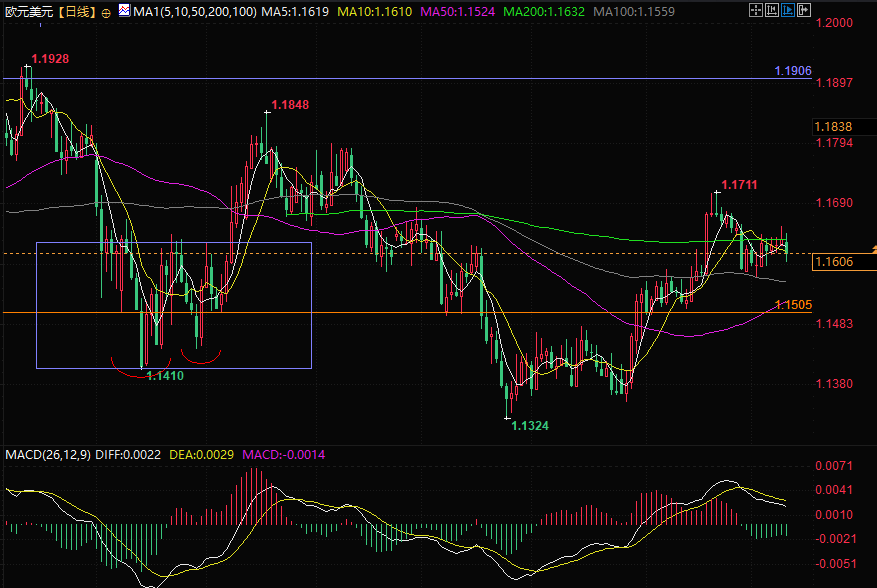 (Euro/USD daily chart, source: FX678) At 20:54 Beijing time, the euro/dollar exchange rate is currently 1.1604/05.
Domestic economic and inflation situation:
Regarding inflation, Eurozone inflation rose to 3.3% in August, significantly exceeding the policy target of 2%. This round of inflation was entirely driven by external energy shocks. Disrupted by geopolitical conflicts in the Middle East, international oil prices continued to rise, pushing regional energy inflation sharply higher. Core inflation and service sector inflation declined slightly, with no second-round transmission effect linked to wages and prices. This is a typical one-off imported inflation and has not yet formed an endogenous inflation spiral. On the growth front, the Eurozone economy has shown greater resilience than expected, with steady GDP growth in the second quarter, effectively offsetting external pressures such as geopolitical conflicts and weak external demand. The risk of recession has significantly decreased, and the economic fundamentals can withstand interest rate hikes. Structurally, the problem of ample funds but insufficient investment, as pointed out by Lagarde, remains prominent. While the Eurozone has ample savings and overall liquidity, funds have long circulated within the financial system, failing to effectively flow to innovative sectors such as digital and green industries. Weak domestic investment has also created Europe's unique advantage in cross-border financing.The core logic behind the interest rate hike: The main reason for the 25 basis point rate hike against the backdrop of imported inflation.
On September 10, the European Central Bank (ECB) simultaneously raised its three key interest rates by 25 basis points, bringing the deposit rate to 2.50%. Unlike conventional rate hikes aimed at combating endogenous inflation, this was a preventative monetary tightening in an environment of imported inflation, with three core rationales. First, it preemptively prevents the secondary spread of inflation. Although current inflation is caused by external energy shocks and has not yet spread across the entire region, geopolitical risks in the Middle East persist, and high oil prices may continue. If prices are allowed to rise unchecked, short-term imported shocks could easily solidify high inflation expectations in the market, eventually evolving into persistent endogenous inflation. The rate hike can lock in inflation expectations in advance and prevent the risk from spreading. Second, economic resilience provides policy space. The Eurozone's stable growth and lack of significant recessionary pressure have broken the policy dilemma under stagflation, allowing the central bank to prioritize its inflation target and confidently implement rate hikes. Third, it optimizes the structure and stabilizes cross-border capital. While the Eurozone has ample overall liquidity, a large amount of capital remains within the financial system and is unwilling to be invested in domestic real estate, resulting in long-term capital outflows. Interest rate hikes can increase yields on Eurozone domestic assets, effectively stabilizing existing funds, guiding capital back to the country, and improving the structural problem of idle funds. Meanwhile, the US AI industry boom is driving up the cost of dollar financing, making Europe a global financing haven with abundant liquidity. Interest rate hikes further solidify the attractiveness of euro assets and stabilize the regional capital landscape. Currently, internal divisions within the ECB persist, and the market generally bets on the possibility of further interest rate hikes this year.Summarize:
Overall, the Eurozone's current economic resilience is underpinned by a temporary external pressure from inflation. The core challenges lie in the energy crisis and the structural mismatch between liquidity and real investment. The ECB's signals of continuous interest rate hikes are primarily aimed at preventing the spread of inflation and optimizing the economic structure, rather than suppressing overheating of the domestic economy. Meanwhile, the euro-dollar exchange rate is influenced not only by central bank interest rate hikes but also by oil prices and capital migration caused by the dollar's credibility crisis. When the dollar's role as a reserve currency is questioned, there is an influx of funds into the euro, a key reason for the recent simultaneous rise in oil prices, gold prices, and the euro against the dollar. The euro will benefit from the narrowing interest rate differential and the continued strength of cross-border capital inflows. However, constrained by its disadvantages in energy trade and weaknesses in industrial innovation, its medium- to long-term appreciation potential is limited compared to the dollar's strong industrial fundamentals. Overall, the euro is expected to exhibit a volatile but generally strong trend, unlikely to sustain a sustained upward movement. (Euro/USD daily chart, source: FX678) At 20:54 Beijing time, the euro/dollar exchange rate is currently 1.1604/05.
- Risk Warning and Disclaimer
- The market involves risk, and trading may not be suitable for all investors. This article is for reference only and does not constitute personal investment advice, nor does it take into account certain users’ specific investment objectives, financial situation, or other needs. Any investment decisions made based on this information are at your own risk.