Will the price of US crude oil remain at a premium before the election?
2026-09-10 21:50:07
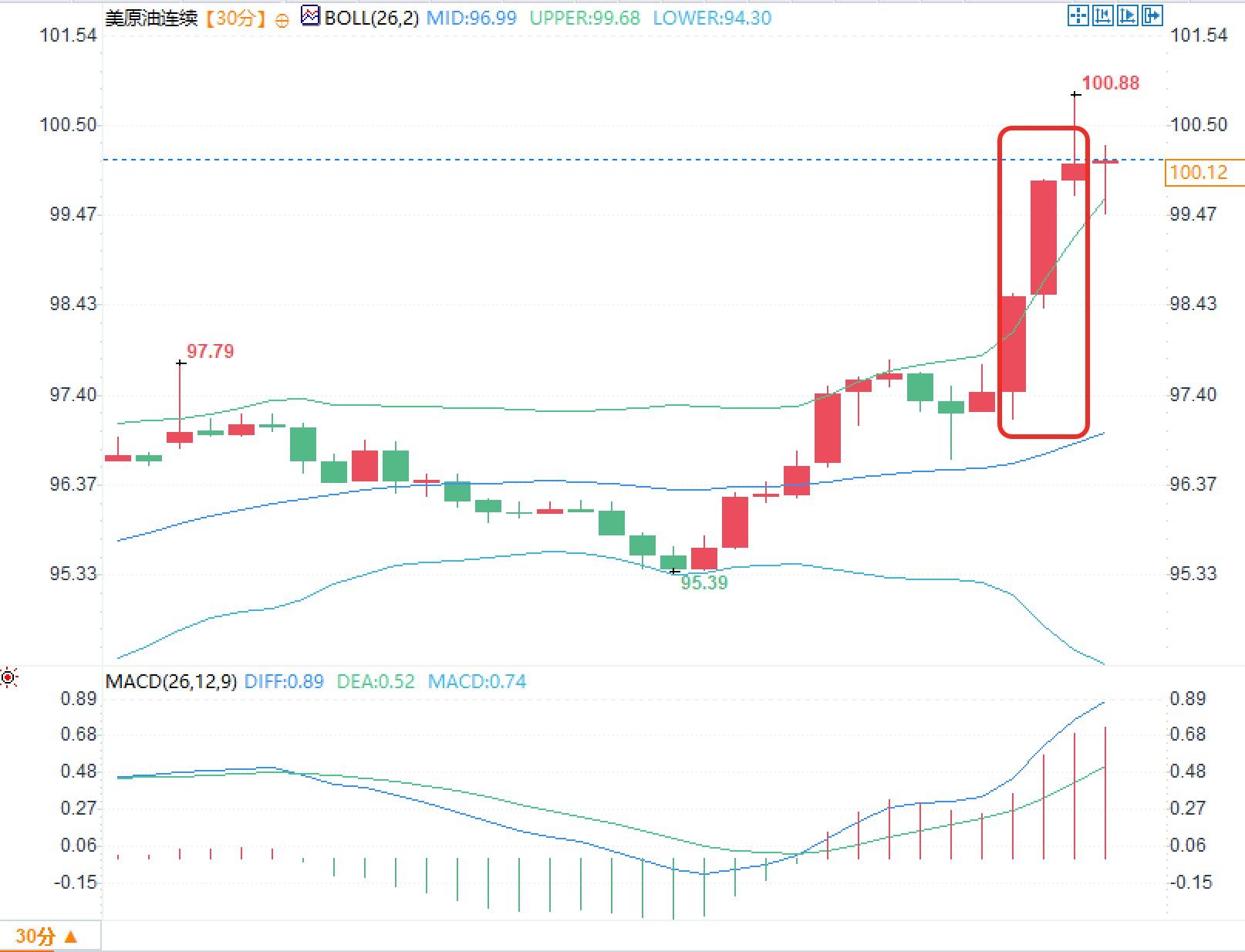
On Thursday, September 10th, US crude oil pushed the $100 mark back into the pricing center. Prices briefly touched $100.88 per barrel and are currently hovering around $100; Brent crude oil rose to around $105 per barrel simultaneously. This surge was not simply a short-term emotional impulse, but rather the market incorporating the duration of the US-Iran conflict, navigation restrictions in the Strait of Hormuz, and marginal changes in US commercial inventories into the risk premium. US President Trump recently told reporters that the conflict is expected to end after the November midterm elections, and that oil prices will not fall significantly until after the elections. Traders have thus postponed their previously short-term ceasefire expectations, and the near-end premium of the crude oil curve has risen again. Meanwhile, data released by the American Petroleum Institute showed that US crude oil inventories fell by 300,000 barrels in the week ending September 4th, less than the market expectation of 1.3 million barrels and significantly less than the previous week's 2.6 million barrel decline. The Energy Information Administration's official inventory data will be released in two batches that afternoon, Eastern Time. Slow inventory turnover cannot offset supply uncertainty caused by disrupted shipping routes. The 10-year US Treasury yield rose to around 4.87%, with energy inflation expectations and term premiums rising in tandem, creating cross-asset constraints. 
Time window repricing: Conflict duration becomes a core variable in pricing.
The key to this round of accelerated oil price increases lies in the market's reassessment of the timing of the ceasefire. Trump recently told the media that he believes the conflict will end immediately after the election because the other side cannot hold out much longer; at the same time, he stated that oil prices will fall immediately after the election, but a significant drop in gasoline prices may come later than the midterm elections. These statements pinpoint a timeline to after November 3rd, effectively acknowledging that at least another election cycle will be needed. Advisors have reportedly begun discussing the possibility of the conflict continuing beyond November, making the exit strategy unclear. Iran, on the other hand, has offered a hedging strategy. An unnamed senior Iranian official stated that if the US continues to attack its territory and infrastructure, Iran is prepared for a more intense conflict and a greater counterattack. Iranian parliamentary speaker Mohammad Bagher Ghalibaf, a key figure in the previous ceasefire negotiations, told lawmakers that the phase of proportional response has ended. With both sides simultaneously extending the duration of the conflict, oil pricing has shifted from event-driven shocks to term premiums. The conflict has entered its seventh month. After a period of relative calm was broken, the market no longer prices on a weekly basis, but instead recalculates the discount of the supply gap on a quarterly basis.Strait of Hormuz and Shipping Risks: How Contraction in Traffic Flow Reshapes Risk Premiums
The Strait of Hormuz is a crucial passage for the export of crude oil, condensate, and refined petroleum products from the Middle East. Before the conflict, the daily throughput was approximately 20 million barrels, accounting for about 20% of global oil consumption. Before the renewed conflict around August 30th, the strait's flow briefly rebounded to 8-9 million barrels per day. Economist Claudio Galimberti estimates that after the renewed fighting, the flow dropped to a minimum of about 2 million barrels per day, with a moving average of only 4-5 million barrels per day. Bypass pipelines cannot completely replace the strait: Saudi Arabia's east-west pipelines, the UAE's pipeline to Fujairah, and some Red Sea exports combined have a backup capacity of only about 3.5-5.5 million barrels per day. The direct impact on shipping comes from reciprocal attacks. Iran claims that after the US sank five Iranian oil tankers, it attacked about 10 ships near Hormuz, marking the largest round of attacks on shipping since the outbreak of the conflict. Reports of at least one crew member killed and another missing have tightened insurance premiums, rerouting options, and vessel berth choices. Attacks by Yemen's Houthi rebels on Saudi energy facilities in southern Saudi Arabia have led to the temporary shutdown of some oil and gas facilities in Jizan and Abha, putting pressure on alternative Red Sea exports. With disturbances occurring simultaneously along three lines—the strait's flow, the Red Sea passage, and onshore facilities—risk premiums are no longer solely based on single-event occurrences, but rather become a function of the probability of passage disruption.Inventory data and short-term technical structure: Volatility has been reopened
US inventories provide another short-term constraint. Data from the Petroleum Institute shows that commercial crude oil inventories fell by only 300,000 barrels in the week ending September 4, significantly weaker than the market expectation of 1.3 million barrels and far less than the 2.6 million barrel decrease in the previous week. Inventories at Cushing, Oklahoma, the delivery point for crude oil, fell by approximately 300,000 barrels during the same period. Continued use of strategic petroleum reserves partially offset the seasonal buffer from commercial inventories. On the 30-minute chart, the Bollinger Bands have a middle band at $96.99/barrel, an upper band at $99.68/barrel, and a lower band at $94.30/barrel. After rebounding from around $95.39/barrel, the price has moved with consecutive positive candles to the outside of the upper band, reaching an intraday high of $100.88/barrel. The bandwidth has widened rapidly, indicating that short-term volatility has broken out of its previous contraction. The MACD DIFF is 0.89, DEA is 0.52, and the histogram is 0.74. The fast and slow lines are above the zero line, and the histogram has turned from green to red and is expanding.Cross-asset transmission: The constraints of oil price premiums on bonds and risky assets
After the near-term premium for crude oil rose, the transmission first appeared at the inflation expectations and interest rates. The yield on the 10-year US Treasury note rose to around 4.87% to 4.88%, close to the highs of this round. Energy prices have pushed up near-month inflation expectations again, and the term premium has risen accordingly. The bond market is using higher yields to hedge against oil price uncertainty. Risk assets are facing a double squeeze: rising imported costs are compressing corporate profit expectations, and rising interest rates are increasing discount rates. US gasoline retail prices have risen to about $4.22 per gallon, and diesel once approached the high range of $5.94 per gallon. Terminal prices are transmitting macroeconomic constraints from wholesale crude oil to the consumer end. What needs to be kept in mind is the causal order. Rising oil prices do not automatically equate to improved growth. The current drivers are more from channel blockages and prolonged conflict periods than demand impulses. The slowdown in the reduction of US business inventories indicates that domestic supply and demand are not giving a similarly strong signal of tight balance. The key factors determining whether the premium can be sustained are whether daily flow from the Strait of Hormuz can recover from around 2 million barrels, whether alternative exports from the Red Sea will continue to be restricted, and whether a verifiable ceasefire agreement can be reached between the two sides before November. Until these variables materialize, crude oil, US Treasury bonds, and risk assets will continue to share the same term premium, rather than being priced independently.Frequently Asked Questions
Question 1: US crude oil is approaching $100 again. Is the core driver inventory or shipping? Answer: Inventory only provides short-term fluctuations. The data shows a reduction of only 300,000 barrels per day, weaker than expected, indicating that US commercial inventories are not signaling a tighter stance. The real driver of the premium is the decline in the Hormuz flow from 8-9 million barrels per day to approximately 2 million barrels per day. Question 2: How does the market interpret Trump's statement that the ceasefire will end after the midterm elections? Answer: This statement extends the duration of the conflict from several weeks to at least covering the November 3rd election. Advisory discussions about the possibility of continuation after the election suggest an unclear exit strategy. Iranian officials have stated they are prepared for a more intense conflict, and Kalibaf has stated the proportional response phase is over. Traders are therefore discounting risk premiums quarterly rather than weekly, making the near-term curve more sensitive to time windows.- Risk Warning and Disclaimer
- The market involves risk, and trading may not be suitable for all investors. This article is for reference only and does not constitute personal investment advice, nor does it take into account certain users’ specific investment objectives, financial situation, or other needs. Any investment decisions made based on this information are at your own risk.