One chart: The Baltic Dry Index has fallen sharply, and freight rates for large dry bulk carriers have weakened significantly.
2026-09-10 22:52:06
Latest data shows that on September 10, 2026, the Baltic Dry Index (BDI) stood at 3521 points, a five-day low, down 2.73% from the previous day, marking the largest drop since August 13, 2026. Looking at the short-term charts, the BDI has seen positive growth 8 times, negative growth 3 times, and zero growth in the last 11 BDI readings. Specifically, the Panamax Freight Index (BPI) was at 2409 points, down 0.21% from the previous day; the Capesize Freight Index (BCI) was at 6122 points, down 4.34%; and the Supramax Freight Index (BSI) was at 1713 points, up 0.53%. For detailed charts of the Baltic Dry Index and its three main sub-indices, including the latest 720-day and 10-year trends, please refer to the charts specially created by FX678. 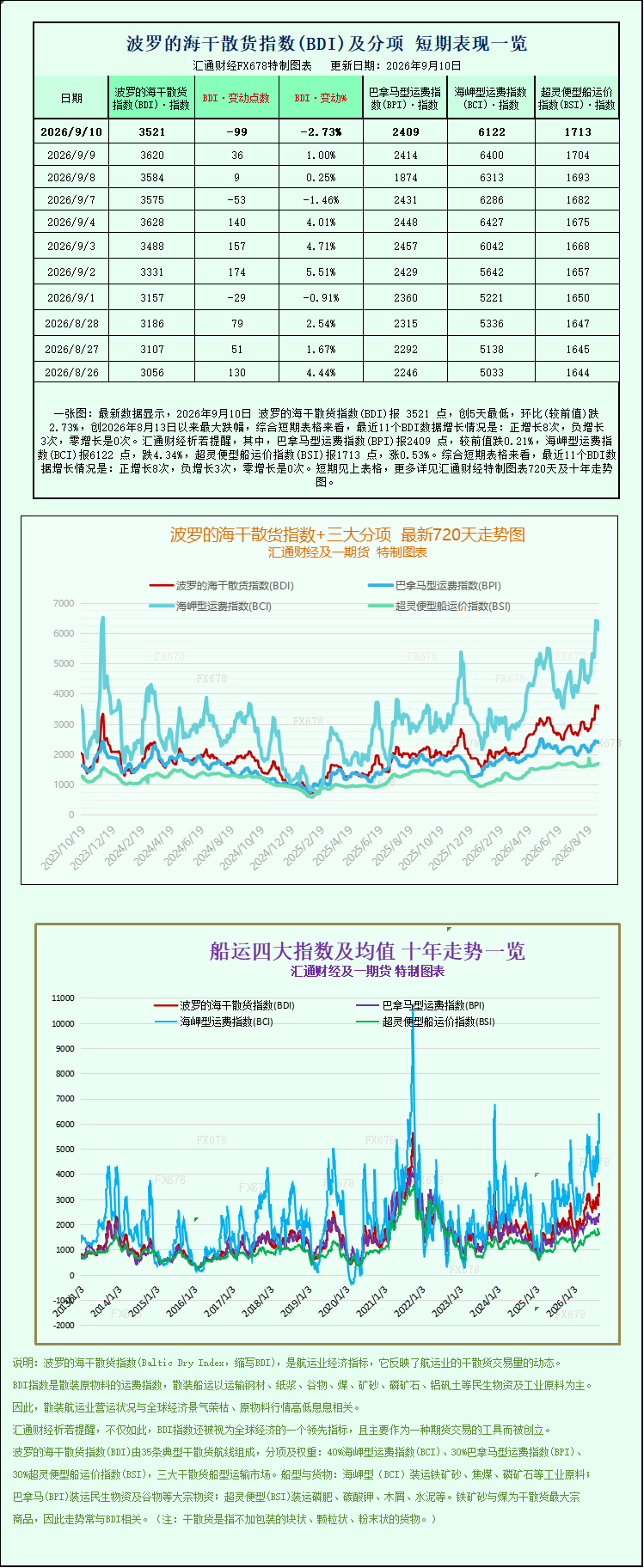 On September 10th, the international dry bulk shipping market experienced a significant correction, with the Baltic Dry Index (BDI) falling sharply. Dragged down by cooling demand for large bulk carriers, the overall market sentiment declined, and ship type prices showed significant structural divergence. As a core indicator of global commodity shipping trends, the decline in the Baltic Dry Index (BDI) directly reflects the weakening marginal demand for global industrial raw materials. The latest trading data for the day showed that the Baltic Dry Index, which covers the three major dry bulk carrier types—Capemax, Panamax, and Supramax—fell sharply by 99 points, a single-day drop of 2.7%, ultimately closing at 3521 points, ending its previous short-term consolidation and returning to a downward trend. This decline was not a broad-based drop, but rather a structural characteristic characterized by significant weakness in large vessels and slight resilience in smaller vessels. Large vessels carrying bulk industrial raw materials were the main drag on the index. The market decline was most pronounced in the Capesize vessel market. This type of vessel primarily carries ultra-large cargo ships of 150,000 tons, with core commodities being essential industrial raw materials such as iron ore and thermal coal. It is a core, weighted segment of the dry bulk shipping market. Data shows that the Capesize vessel-specific freight rate index plummeted 278 points in a single day, a drop of 4.3%, closing at 6122 points, leading the decline among all market sub-type vessel indices. Correspondingly, shipowner profits shrank accordingly, with average daily charter income for Capesize vessels decreasing by $2,522, and the latest average daily income falling to $52,016. The profit margins for large ocean-going bulk carriers continue to shrink. Industry analysts point out that the core reason for the sharp decline in Capesize freight rates is the continued weakness in global iron ore demand. As the world's largest consumer of iron ore, the profitability and operating rate of China's steel industry directly influence international iron ore trade and shipping demand. Recently, domestic steel mill profits have continued to be under pressure, with demand for steel from downstream construction and manufacturing sectors falling short of expectations. The industry has entered its traditional off-season, and most steel mills have adopted conservative procurement strategies, focusing on replenishing stock as needed and strictly controlling raw material inventory. This has significantly reduced concentrated purchases of imported iron ore and long-distance shipping orders. Affected by weak demand, international iron ore prices have declined for the second consecutive trading day, hitting their lowest level in nearly a week. Even though there were minor disruptions in production and transportation in some Australian mining areas, leading to a slight tightening of supply in the short term, weak end-user demand completely offset the supply-side benefits, making it difficult to support stable ore prices and corresponding shipping rates. This directly resulted in reduced cargo volume on Capesize long-haul routes, a cooling of chartering demand, and a significant correction in freight rates. Compared to the sharp decline in large Capesize vessels, the medium-sized Panamax vessel market performed relatively steadily, with a significantly narrower decline. Data shows that the Panamax freight rate index fell by only 5 points, a slight decrease of 0.2%, to 2409 points, with the overall market remaining basically stable. This vessel type is primarily suited for 60,000 to 70,000-ton cargo transport needs, mainly transporting energy and agricultural products such as coal and grain, covering routes primarily for regional trade and short-to-medium-haul ocean shipping. On the same day, the average daily charter income for Panamax vessels decreased slightly by $41, ultimately closing at $21,684, with minimal fluctuations in earnings, demonstrating strong market resilience. The market for small and medium-sized vessels even bucked the trend with a slight increase, offsetting some of the downward pressure on the market. The index tracking the Supramax bulk carrier market rose 9 points, or 0.5%, to close at 1713 points. These smaller vessels offer greater flexibility, suitable for short-haul, small-volume, and frequent cargo orders, mainly handling the transport of niche categories such as building materials, agricultural supplies, and small-volume grains. They are less affected by fluctuations in demand for large industrial raw materials, and coupled with the support of rigid demand from regional trade, their market performance has strengthened independently, resulting in a divergence in price movements between large and small vessel types. Looking at the current dry bulk shipping market, structural characteristics are becoming increasingly apparent. Demand for large industrial raw materials via sea freight continues to weaken, dragged down by the sluggish downstream industrial sector, becoming a core factor suppressing the overall market index. Meanwhile, small and medium-sized vessels, relying on their flexible transportation advantages and stable regional demand, maintain a stable to slightly stronger market. Overall, the current market exhibits a differentiated trend of "cooling down of bulk raw material transportation and robust transportation for consumer goods and regional trade." Market institutions predict that the Baltic Dry Index will continue to fluctuate with a slight downward bias in the short term. Subsequent market trends will heavily depend on the pace of recovery in China's steel industry, the strength of the rebound in iron ore and coal import demand, and the continued impact of global grain trade transportation demand and the pace of ocean shipping capacity deployment. If domestic end-user demand remains weak, freight rates for large bulk carriers may continue their downward adjustment, and the structural differentiation in the market may persist.
On September 10th, the international dry bulk shipping market experienced a significant correction, with the Baltic Dry Index (BDI) falling sharply. Dragged down by cooling demand for large bulk carriers, the overall market sentiment declined, and ship type prices showed significant structural divergence. As a core indicator of global commodity shipping trends, the decline in the Baltic Dry Index (BDI) directly reflects the weakening marginal demand for global industrial raw materials. The latest trading data for the day showed that the Baltic Dry Index, which covers the three major dry bulk carrier types—Capemax, Panamax, and Supramax—fell sharply by 99 points, a single-day drop of 2.7%, ultimately closing at 3521 points, ending its previous short-term consolidation and returning to a downward trend. This decline was not a broad-based drop, but rather a structural characteristic characterized by significant weakness in large vessels and slight resilience in smaller vessels. Large vessels carrying bulk industrial raw materials were the main drag on the index. The market decline was most pronounced in the Capesize vessel market. This type of vessel primarily carries ultra-large cargo ships of 150,000 tons, with core commodities being essential industrial raw materials such as iron ore and thermal coal. It is a core, weighted segment of the dry bulk shipping market. Data shows that the Capesize vessel-specific freight rate index plummeted 278 points in a single day, a drop of 4.3%, closing at 6122 points, leading the decline among all market sub-type vessel indices. Correspondingly, shipowner profits shrank accordingly, with average daily charter income for Capesize vessels decreasing by $2,522, and the latest average daily income falling to $52,016. The profit margins for large ocean-going bulk carriers continue to shrink. Industry analysts point out that the core reason for the sharp decline in Capesize freight rates is the continued weakness in global iron ore demand. As the world's largest consumer of iron ore, the profitability and operating rate of China's steel industry directly influence international iron ore trade and shipping demand. Recently, domestic steel mill profits have continued to be under pressure, with demand for steel from downstream construction and manufacturing sectors falling short of expectations. The industry has entered its traditional off-season, and most steel mills have adopted conservative procurement strategies, focusing on replenishing stock as needed and strictly controlling raw material inventory. This has significantly reduced concentrated purchases of imported iron ore and long-distance shipping orders. Affected by weak demand, international iron ore prices have declined for the second consecutive trading day, hitting their lowest level in nearly a week. Even though there were minor disruptions in production and transportation in some Australian mining areas, leading to a slight tightening of supply in the short term, weak end-user demand completely offset the supply-side benefits, making it difficult to support stable ore prices and corresponding shipping rates. This directly resulted in reduced cargo volume on Capesize long-haul routes, a cooling of chartering demand, and a significant correction in freight rates. Compared to the sharp decline in large Capesize vessels, the medium-sized Panamax vessel market performed relatively steadily, with a significantly narrower decline. Data shows that the Panamax freight rate index fell by only 5 points, a slight decrease of 0.2%, to 2409 points, with the overall market remaining basically stable. This vessel type is primarily suited for 60,000 to 70,000-ton cargo transport needs, mainly transporting energy and agricultural products such as coal and grain, covering routes primarily for regional trade and short-to-medium-haul ocean shipping. On the same day, the average daily charter income for Panamax vessels decreased slightly by $41, ultimately closing at $21,684, with minimal fluctuations in earnings, demonstrating strong market resilience. The market for small and medium-sized vessels even bucked the trend with a slight increase, offsetting some of the downward pressure on the market. The index tracking the Supramax bulk carrier market rose 9 points, or 0.5%, to close at 1713 points. These smaller vessels offer greater flexibility, suitable for short-haul, small-volume, and frequent cargo orders, mainly handling the transport of niche categories such as building materials, agricultural supplies, and small-volume grains. They are less affected by fluctuations in demand for large industrial raw materials, and coupled with the support of rigid demand from regional trade, their market performance has strengthened independently, resulting in a divergence in price movements between large and small vessel types. Looking at the current dry bulk shipping market, structural characteristics are becoming increasingly apparent. Demand for large industrial raw materials via sea freight continues to weaken, dragged down by the sluggish downstream industrial sector, becoming a core factor suppressing the overall market index. Meanwhile, small and medium-sized vessels, relying on their flexible transportation advantages and stable regional demand, maintain a stable to slightly stronger market. Overall, the current market exhibits a differentiated trend of "cooling down of bulk raw material transportation and robust transportation for consumer goods and regional trade." Market institutions predict that the Baltic Dry Index will continue to fluctuate with a slight downward bias in the short term. Subsequent market trends will heavily depend on the pace of recovery in China's steel industry, the strength of the rebound in iron ore and coal import demand, and the continued impact of global grain trade transportation demand and the pace of ocean shipping capacity deployment. If domestic end-user demand remains weak, freight rates for large bulk carriers may continue their downward adjustment, and the structural differentiation in the market may persist.
- Risk Warning and Disclaimer
- The market involves risk, and trading may not be suitable for all investors. This article is for reference only and does not constitute personal investment advice, nor does it take into account certain users’ specific investment objectives, financial situation, or other needs. Any investment decisions made based on this information are at your own risk.