Gold Trading Alert: With inflation and geopolitical storms intertwined and the Fed rate hike countdown underway, will this week be a crucial week for gold prices to stage a dramatic comeback or a last chance to escape?
2026-09-14 07:24:07
Global gold markets saw a significant rebound last Friday, with spot gold rising nearly 2% at one point, reaching a high of $4402.19 per ounce, before closing up 0.74% at $4348.35. Although the weekly cumulative decline was still around 1.8%, this rapid recovery attracted market attention. Meanwhile, the latest US inflation data reinforced expectations of a Federal Reserve rate hike this week, while continued geopolitical conflicts in the Middle East pushed up oil prices, further exacerbating uncertainty about the interest rate outlook. Entering this week, investors are closely watching the upcoming Federal Reserve policy meeting and whether gold has formed a technical bottom after its short-term correction. On Monday (September 14th) in early Asian trading, spot gold opened slightly lower and is currently trading around $4340 per ounce, down about 0.2%. Last Thursday, a drone attack from Iraq struck Saudi Arabia's east-west oil pipeline, forcing the Saudi government to shut down this vital oil transport artery. Riyadh has not yet disclosed the extent of the pipeline damage or the expected duration of the shutdown. A diplomatic meeting between Iran and Gulf Arab states, originally scheduled for Monday in Oman, was abruptly postponed following the pipeline attack. The meeting was originally intended to discuss the situation in the Strait of Hormuz and temporary shipping arrangements. International oil prices opened more than 2% higher, and rose more than 3% in early trading on Monday, further exacerbating inflation concerns and putting pressure on gold prices. 
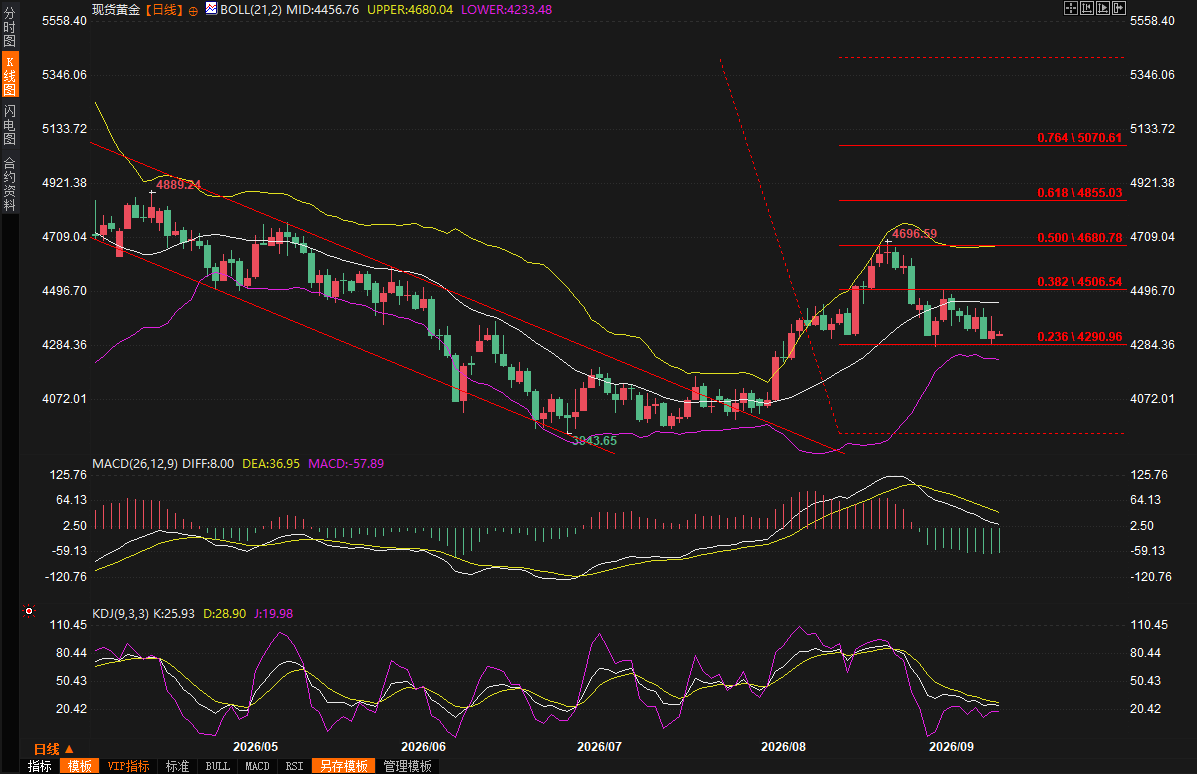 (Spot gold daily chart, source: FX678) At 07:20 Beijing time, spot gold is currently trading at $4336.68 per ounce.
Inflation data is accelerating, and expectations for a Federal Reserve rate hike are rising sharply.
The U.S. Consumer Price Index (CPI) released last Friday showed that prices rose 0.4% month-over-month in August, far higher than July's 0.1%, while the year-over-year increase remained flat at 3.4%. The core CPI, excluding food and energy, rose 0.3% month-over-month, the largest increase in four months, exceeding market expectations of 0.2% for the previous two months. Gasoline prices jumped 3.9% after two consecutive months of decline, contributing more than a third of the overall CPI increase, while motor vehicle fuel prices, including diesel, surged 9.6% month-over-month. Although food prices rose only slightly by 0.1%, sub-categories such as eggs and dairy products still saw increases, while inflation-adjusted real wages declined year-over-year. These data quickly changed market pricing for monetary policy. The CME FedWatch tool showed that traders' probability of a 25 basis point rate hike by the Federal Reserve this week rose sharply from about 67% before the data release to around 87%. Most analysts believe that accelerating inflation, coupled with signs of stabilization in employment data, has not only increased the likelihood of an interest rate hike this week but may also lay the groundwork for further tightening in October or December. Independent precious metals trader Tai Wong points out that gold is rebounding rapidly after a brief pullback, as CPI data further solidified expectations of a rate hike, and the market has already priced in a higher probability, resulting in reduced volatility. Current price action suggests that gold is forming a short-term bottom after its recent correction. Rising interest rates typically diminish the attractiveness of non-interest-bearing gold, as the opportunity cost of holding it increases. While inflation itself remains a traditional factor supporting gold, in the current environment, the strengthening of expectations for a Fed rate hike has a more direct suppressive effect on gold prices. Although oil prices retreated somewhat last Friday, they remained above $100 per barrel overall, with diesel prices hitting record highs. This further amplified concerns about inflation spreading to broader sectors and made the market more determined to price in a rate hike.Escalating conflict in the Middle East pushes up oil prices, while interest rate dynamics dominate gold price logic.
The escalating tensions in the Middle East are compounded by the inflation data. The Houthi rebels in Yemen, allied with Iran, reached the strategically important Perim Island in the Bab el-Mandeb Strait last Friday and seized the nearby Red Sea coastal town of Dubab. The Strait of Hormuz was already effectively blocked, affecting approximately one-fifth of global oil and liquefied natural gas trade, making countries like Saudi Arabia increasingly reliant on the Red Sea route. The Houthi advance could threaten another crucial energy route, further pushing up oil prices. Satellite images show thick smoke near Saudi Arabia's east-west oil pipeline, a vital export route bypassing the Strait of Hormuz. Data from the International Energy Agency shows that Saudi Arabia's crude oil supply in August fell to its lowest level in over 30 years. After a slight pullback on Friday, oil prices still closed above $100 per barrel last week. According to the current market logic, continued escalation of tensions in the Middle East will increase supply concerns by pushing up oil prices, thereby reinforcing inflation expectations and significantly increasing the probability of a Federal Reserve interest rate hike. A higher interest rate environment will directly increase the opportunity cost of holding gold, thus putting downward pressure on gold prices. Conversely, if the situation in the Middle East eases significantly, a drop in oil prices would alleviate inflation concerns and lower expectations of interest rate hikes, making it easier for gold prices to rise. Meanwhile, the US dollar strengthened against the euro and Swiss franc after the inflation data release, but the overall change was limited, constrained by the fragile market sentiment caused by high oil prices. The yield on the 10-year US Treasury note once approached 5%, reaching a recent high, before subsequently declining. Rising yields will be transmitted to the entire economy through borrowing costs, putting pressure on the stock market and risk assets, but could also further suppress the attractiveness of gold as interest rate expectations strengthen.Demand-side divergence and market sentiment: key variables in the formation of a short-term bottom.
From the perspective of physical demand, market feedback around last Friday showed a clear divergence. Last week, Indian gold demand weakened due to price volatility, with buyers adopting a wait-and-see attitude; while in China, the largest gold consumer, investment demand remained strong. This regional difference reflects the varying sensitivities of different markets to gold price fluctuations and suggests that some Asian buyers may re-enter the market after the price pullback. Entering this week, market focus has shifted to the Federal Reserve policy meeting. Investors almost universally consider a rate hike a high-probability event, but the more crucial question is whether this rate hike is a "one-off" event or the beginning of a new tightening cycle. Most former officials and analysts believe that if the Fed takes action while inflation remains significantly above the 2% target, further rate hikes are likely. The new Fed chairman's previous statements leaned towards a hawkish stance, suggesting that central banks are not adept at fine-tuning, which further reinforced market expectations of continued tightening. In the dual game of interest rates and inflation, gold's short-term price movements are often driven by sentiment and technical factors. Last Friday's rebound showed that after a pullback of approximately 1.8%, buying activity began to pick up. If the Fed raises interest rates this week, but the situation in the Middle East escalates and pushes up oil prices, the expectation of a rate hike may be further strengthened, and gold prices will face greater downward pressure. If the situation eases and oil prices fall, it will help alleviate interest rate concerns, thereby supporting the rise in gold prices.Overall Outlook: Gold's direction in a complex macroeconomic environment depends on the interplay of geopolitics and interest rates.
In summary, last Friday's strong rebound in gold prices was not an isolated event, but rather the result of the combined effects of inflation data, geopolitical risks, and market sentiment. The accelerated rise in the US August CPI strengthened expectations of interest rate hikes, theoretically bearish for gold. Meanwhile, the escalating conflict in the Middle East, leading to high oil prices, further increased the interest rate outlook through inflation, exerting a dominant downward pressure on gold prices. The formation of a short-term bottom has been confirmed by some traders, but whether it can transform into a medium-term trend depends on the specific decisions and communication at this week's Federal Reserve meeting, as well as the evolution of the Middle East situation. According to the current dominant logic, if the tensions in the Middle East continue to escalate, it will strengthen expectations of a Fed rate hike by pushing up oil prices, thus putting downward pressure on gold prices. If the situation eases, a decline in oil prices will alleviate inflation concerns, reduce expectations of rate hikes, and make it easier for gold prices to find upward support. As an asset with both commodity and monetary attributes, gold exhibits strong volatility in the current environment. While focusing on the interest rate path, investors should also pay close attention to the transmission of geopolitical factors to energy supply and inflation expectations. As the market enters a policy window this week, gold price volatility may rise again, and any changes in the Middle East situation will be a key variable in determining the short-term direction. (Spot gold daily chart, source: FX678) At 07:20 Beijing time, spot gold is currently trading at $4336.68 per ounce.
- Risk Warning and Disclaimer
- The market involves risk, and trading may not be suitable for all investors. This article is for reference only and does not constitute personal investment advice, nor does it take into account certain users’ specific investment objectives, financial situation, or other needs. Any investment decisions made based on this information are at your own risk.