The UK economy has exceeded expectations for three consecutive months, but ING warns it's on the "cliff edge."
2026-09-14 08:40:08
On Monday (September 14) during Asian trading hours, the pound traded in a narrow range against the dollar, currently hovering around 1.3520, almost unchanged for the day. The UK Office for National Statistics reported on Friday that GDP grew by 0.4% in July, following a 0.3% increase in June, far exceeding economists' expectations of zero growth. This marks the third consecutive month of stronger-than-expected growth for the UK economy and is on track to defy expectations of a sharp slowdown in the second half of 2026. However, economists at ING believe that UK inflation is more important than a month of strong growth. The bank maintains its baseline assessment that the Bank of England will not raise interest rates, which puts the pound at risk of a potential "cliff-edge dovish repricing." The key signal is that the strong growth data has not solved the inflation problem, and once the market's priced-in expectations of interest rate hikes are reduced, the pound will face downward pressure. 
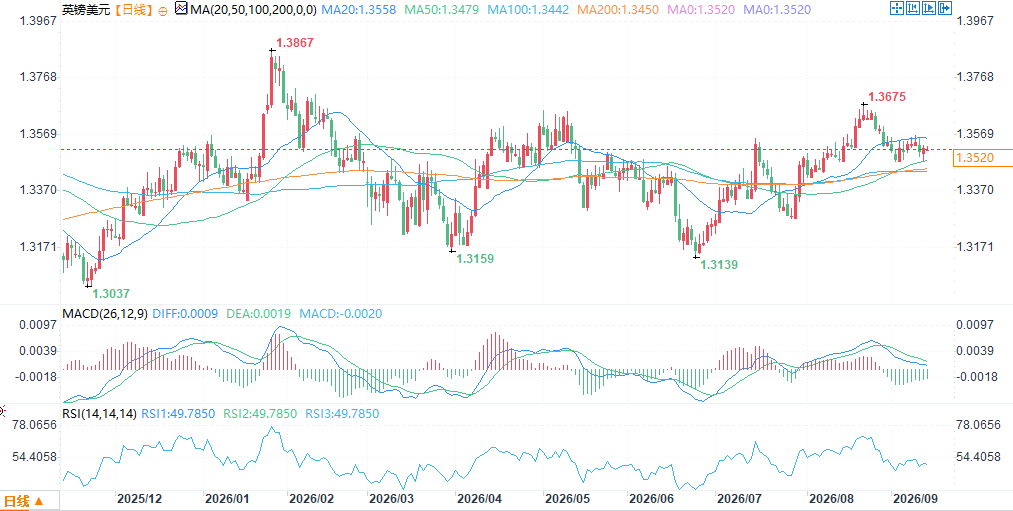 (GBP/USD daily chart, source: FX678) At 8:25 Beijing time, GBP/USD was trading at 1.3520/21.
Growth exceeded expectations, but the positive impact on the pound may be limited.
The UK economy grew 0.4% in July, following a 0.3% increase in June, with growth in the services, manufacturing, and construction sectors all contributing to the month. The pound initially benefited from this data, but ING strategist Francesco Pesole cautioned, "The pound has strengthened slightly as a result, but these monthly growth figures will have little impact on the Bank of England's decision-making." Pesole remains skeptical of any further interest rate hikes: "Our baseline scenario remains that the Bank of England will not raise rates at all, which leaves the pound facing a potential cliff-edge dovish repricing."Stronger growth has not solved the inflation problem.
ING economist James Smith points out that recent UK GDP data, which exceeded expectations, shows some resilience in economic output, but this has not fundamentally alleviated inflationary pressures. Policymakers are now more inclined to rely on their own activity surveys rather than simply looking at official growth figures. Survey results show little clear evidence that higher energy costs are spreading to broader inflation, with core inflation and wage growth remaining relatively moderate. Ahead of the Bank of England's monetary policy meeting on September 17, Smith, assessing the latest GDP data, emphasized: "We expect to keep interest rates unchanged again this week by a 6-3 vote." He believes that faster economic growth itself does not automatically translate into persistent price pressures. The real key is whether stronger output will be accompanied by more persistent price pressures, which cannot be accurately determined by GDP data alone. A still weak labor market and limited corporate pricing power mean that the second-round effect (i.e., the transmission of energy costs to wages and core goods and services prices) is currently not significant. For ING, if investors reduce their previously priced-in interest rate hike expectations accordingly, the pound will face downside risks. The market currently has high bets on further tightening by the Bank of England, and the pound could come under pressure if growth data is interpreted as "no inflation concerns." Smith cautions that energy price volatility remains a significant variable; if prices such as natural gas remain high, the inflation peak could shift upwards, thus altering the policy path. However, current evidence suggests a clearer decoupling between strong growth and inflation, giving the central bank reason to remain cautious and avoid premature tightening that could cause unnecessary economic shocks. Overall, the data mix supports maintaining current interest rates rather than an immediate shift to a hawkish stance.Exchange Rate Forecast: ING is bearish on the British pound.
The market has already priced in a certain level of interest rate hike expectations, while ING's baseline assessment is that the Bank of England will not raise rates at all. This means that once investors begin to reduce these bets, the pound will face direct downward pressure against the dollar. Looking at exchange rate forecasts, ING maintains its fourth-quarter target of 1.33 for the pound against the dollar, representing a downside of about 1.5% from the current level of around 1.35. This forecast itself reflects the bank's bearish stance on the pound. Meanwhile, the dollar is supported by better-than-expected US CPI – the probability of a September rate hike has risen to 86.2% – further amplifying the downward pressure on the pound against the dollar. In the short term, the pound faces a directional choice around 1.35: if UK inflation data confirms that price pressures remain stubborn, the market's pricing in a Bank of England rate hike may remain or even strengthen, potentially supporting the pound; conversely, if inflation, as ING expects, does not spread to a wider range, a dovish repricing will push the pound against the dollar down to test the 1.33-1.34 range.Summarize
UK GDP growth in July was 0.4%, far exceeding expectations of stagnation, but ING believes this has not changed the Bank of England's policy outlook. The bank maintains its baseline assessment that the Bank of England will not raise interest rates, expecting a 6-3 vote this week to keep rates unchanged. ING's fourth-quarter exchange rate forecast is: GBP/USD target 1.33, bearish on the pound. The core conclusion is that one month of strong growth is insufficient to address inflation, and once market expectations for interest rate hikes are reduced, the pound will face downward pressure. (GBP/USD daily chart, source: FX678) At 8:25 Beijing time, GBP/USD was trading at 1.3520/21.
- Risk Warning and Disclaimer
- The market involves risk, and trading may not be suitable for all investors. This article is for reference only and does not constitute personal investment advice, nor does it take into account certain users’ specific investment objectives, financial situation, or other needs. Any investment decisions made based on this information are at your own risk.