Negotiations delayed; the US overdraws its overall interests to control oil prices in preparation for the midterm elections.
2026-09-14 15:52:07
Recent escalating geopolitical tensions in the Middle East, with frequent risks along the Strait of Hormuz and the Bab el-Mandeb Strait—two vital energy routes—and the ongoing US-Iran rivalry, have kept international oil prices high. Brent crude is currently holding steady at $107 per barrel, having briefly surpassed $109 per barrel intraday, while WTI crude remains above $100 per barrel. The slight short-term pullback has not altered the core high-price trend. Oil price fluctuations are essentially a true measure of the US's power in the US-Iran rivalry. The current high prices directly reflect the strategic predicament of the US's insufficient short-term price control and lack of effective means to counterbalance Iran. 
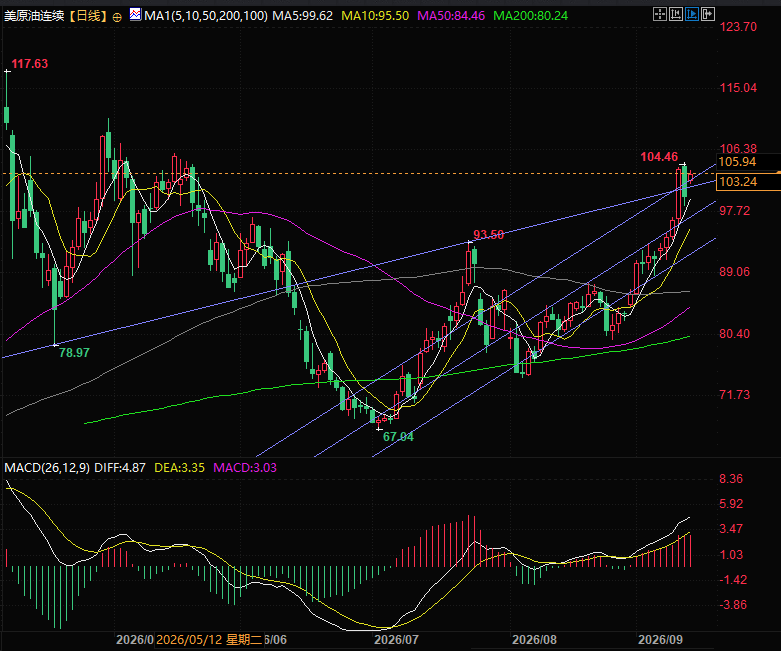 (WTI crude oil futures daily chart, source: EasyTrade) At 15:48 Beijing time, WTI crude oil futures were trading at $103.19 per barrel.
Middle East shipping routes under pressure: Global crude oil transportation system encounters double bottlenecks
Two major shipping lanes in the Middle East are under simultaneous pressure, creating a critical bottleneck in the global crude oil transportation system. On Sunday, an Iranian cargo ship was attacked near Qeshm Island in the Strait of Hormuz, resulting in one death and four injuries, significantly increasing the risk to navigation in the strait. British maritime authorities also confirmed that a merchant ship in the area was hit by projectiles and caught fire, forcing the crew to evacuate. As a core global oil chokepoint, the Strait of Hormuz handles over 30% of global crude oil transport. Due to the ongoing conflict, commercial traffic is currently sluggish and unlikely to return to pre-war levels. The conflict has further spilled over into the Red Sea, with the Iranian-backed Houthi rebels seizing high ground and islands around the Bab el-Mandeb Strait, blocking key outlets for Saudi Arabia and other countries. Adding to the woes, Saudi Arabia's transoceanic oil pipeline, carrying 4 million barrels per day, was shut down by a drone attack. This is a crucial energy lifeline for Saudi Arabia to mitigate the risks posed by the strait. Market predictions suggest that if the pipeline remains shut down for an extended period, Saudi crude oil inventories can only support 5 to 7 days of exports, potentially putting pressure on 4% of global crude oil supply and further pushing up oil prices.Regional talks stalled: Shipping order reconstruction falls through, uncertainty rises.
The shipping talks between Iran and the Gulf states, originally scheduled for Oman, have been officially postponed, dashing plans to rebuild regional shipping order. Previously, Iran planned to work with Oman to develop a control plan for the Strait of Hormuz, proposing to demarcate navigable waters and collect transit fees. However, Saudi Arabia and other Gulf Cooperation Council (GCC) countries worried that the new regulations would reshape the geopolitical landscape and harm their own interests, demanding amendments and indirectly contributing to the postponement of the meeting. The stalled talks have further increased geopolitical uncertainty in the Middle East, providing continued support for oil prices. Even if negotiations resume later, Oman has stated that the opening of the strait may be limited.Iran's strategic logic: leveraging geopolitical risks to raise oil prices and gain the upper hand in the standoff.
The US-Iran rivalry presents a clear contrast between offense and defense, with both sides using oil prices as the core bargaining chip. Iran's core strategy is to leverage its geographical advantages to proactively create shipping risks and raise the risk premium for crude oil. When its bargaining leverage with the US dwindles and the standoff reaches a stalemate, Iran uses methods such as attacks on ships and regional military deterrence to stimulate oil price increases and reverse its strategic disadvantage. Iran's official stance is firm, clearly stating that it will not yield to external pressure and will refuse to initiate any US-Iran negotiations until the US lifts its naval blockade and meets its core demands, effectively closing the window for short-term reconciliation.The US Price Control Dilemma: Multi-Dimensional Intervention Efforts Lead to Complete Passivity
The United States has consistently maintained a defensive posture, with its core objectives being to suppress oil prices, alleviate domestic inflation, and safeguard its position for the midterm elections. While the US military has maintained a naval blockade against Iran, diverting 101 merchant ships and striking Iranian oil tankers, this has only partially restricted Iranian shipping and has failed to eliminate the security risks in the Strait of Hormuz. The Trump administration has frequently signaled its willingness to negotiate, predicting that the conflict might end after the November midterm elections and oil prices would likely fall, but no substantial progress has been made. It is noteworthy that in order to control oil prices, the US has sacrificed multiple geostrategic interests and overdrawn the core rights of its allies: on the one hand, it has pressured the UK to open up North Sea oil and gas exploration, attempting to expand global crude oil supply and offset the Middle East deficit; on the other hand, it has deliberately intervened in the Russia-Ukraine conflict, actively demanding that Ukraine cease its attacks on Russia's refined oil and refining supply chains. To stabilize global oil prices and serve its own electoral interests, the US has been willing to damage its core interests concerning the initiative on the Ukrainian battlefield and national security, effectively dismantling Ukraine's key bargaining chip against Russia. This series of actions demonstrates that stabilizing oil prices, controlling domestic inflation, and ensuring people's livelihoods are currently the highest priorities for the US, with concessions made on foreign strategy and the interests of its allies.The outcome of the game confirms: the results and reasons for the US's short-term control over oil prices.
However, judging from market results, the US's series of price control operations have essentially failed. International oil prices have not seen a sustained decline; instead, they have continued to fluctuate at high levels due to overlapping geopolitical risks. This phenomenon directly exposes the core problem: the US has extremely limited control over oil prices in the short term, and lacks effective countermeasures against Iran. The US military blockade can only partially restrict Iranian crude oil exports, but cannot completely control the Strait of Hormuz or eliminate regional shipping risks. Pressuring Europe and allowing the Russia-Ukraine situation to develop can only improve long-term supply expectations, but cannot offset the current supply gap caused by the obstruction of the two Middle Eastern shipping routes and the closure of Saudi oil pipelines. In the game where Iran continues to actively create risks and the US is passively defending and unable to break the deadlock, rising oil prices have become an inevitable result, which also directly reflects that Iran has gained the short-term initiative in the current US-Iran game. From a deeper perspective, the US's determination to control oil prices at all costs directly highlights the key value of the US midterm elections and precisely matches Trump's governing style and political demands. The current high oil prices continue to push up domestic inflation in the US, exacerbating the pressure on people's livelihoods and becoming a core variable affecting the election's trajectory. The Trump administration's all-out efforts to control prices and its compromises on various fronts are essentially aimed at securing seats in both parties and consolidating its ruling base. Its tough stance and flexible adjustments to foreign policy are all ultimately geared towards electoral gains, attempting to stabilize energy prices and alleviate domestic economic pressure in exchange for more congressional seats and public support.Overall Outlook: High oil prices will persist, and the game will continue.
In summary, Iran leverages its geopolitical advantages to manipulate oil prices and compensate for its weaknesses in the power struggle by disrupting the situation. The US, while exhausting military, diplomatic, and energy means to control prices, is constrained by short-term geopolitical limitations and electoral pressure, finding itself in a passive position. In the short term, the geopolitical risks in the Middle East are unlikely to dissipate, and the US currently lacks effective means to counterbalance Iran and suppress oil prices; international crude oil prices are likely to remain high. Subsequent oil price movements will continue to be anchored to the pace of the US-Iran power struggle and the progress of the US midterm elections, becoming a core indicator for observing the Middle East situation and the direction of US domestic and foreign policy. Technically, WTI oil prices are supported by an upward channel and the X-line support; a break below these lines could indicate weakness or even a trend reversal. (WTI crude oil futures daily chart, source: EasyTrade) At 15:48 Beijing time, WTI crude oil futures were trading at $103.19 per barrel.
- Risk Warning and Disclaimer
- The market involves risk, and trading may not be suitable for all investors. This article is for reference only and does not constitute personal investment advice, nor does it take into account certain users’ specific investment objectives, financial situation, or other needs. Any investment decisions made based on this information are at your own risk.