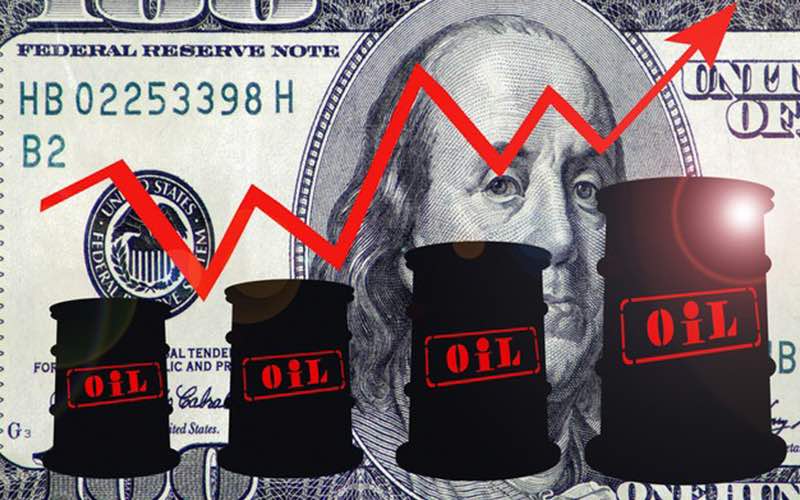
With 87% of the pricing already locked up, will the Fed dare to remain inactive?
2026-09-14 16:00:09
On Monday, September 14th, just two trading days remained before the Federal Reserve's policy meeting on September 15th and 16th. The target range for the federal funds rate remained unchanged at 3.50% to 3.75%, a position the committee has maintained for several consecutive weeks since the 25 basis point reduction in December 2025. The market's implied probability of a 25 basis point rate hike this week rose to approximately 87%, with Goldman Sachs, JPMorgan Chase, and HSBC all shifting their previous stance of holding rates steady or delaying rate hikes to taking action in September. West Texas Intermediate crude oil traded around $103 per barrel, the yield on the 10-year US Treasury note was between 4.96% and 4.98%, and the US dollar index fluctuated around 99.5. After the release of the US August Consumer Price Index, the real question on the trading floor wasn't whether or not there would be a rate hike, but rather whether the statement would describe the action as a one-off hedge or the start of a new round of tightening. 
 At the cross-asset level, the frequency with which the US dollar index moves in the same direction as the 10-year US Treasury real yield, energy prices, and the probability of interest rate hikes is increasing. When interest rate expectations are revised upward, the US dollar index often reflects term premiums and short-term pricing simultaneously; rising energy prices, on the other hand, disrupt both inflation expectations and risk appetite. More useful is breaking down these three factors: the short-term pricing resulting from changes in the probability of interest rate hikes, the real interest rate resulting from changes in long-term yields, and the transmission lag of the energy component to the next price report.
Why did the institutions predict a shift within a week?
The speed of this round of expectation shifts is itself a message. Goldman Sachs previously based its forecast on the Fed holding rates steady in September, but has now changed it to a 25 basis point rate hike; JPMorgan Chase has moved its previously December rate hike to September, while retaining the possibility of another hike in December; HSBC similarly projects 25 basis points each in September and December. Deutsche Bank, in addition to September and December, has also included a 25 basis point hike in March 2027 in its forecast. The paths differ significantly, but they share one commonality: removing the "no change this week" scenario from the baseline. Goldman Sachs economist David Merrickler's statement makes the logic very strong: the committee doesn't want to create surprises. The market implication of this is that when futures pricing has pushed the probability of a rate hike to nearly 90%, holding rates steady is no longer "neutral" and requires a longer, stronger statement to explain it. JPMorgan Chase economist Michael Feroli summarized the past week as three things happening simultaneously: rising long-term yields, rising energy prices, and inflation readings strong enough to make a September rate hike a high-probability event. The institutions are not competing to see who is more hawkish, but rather repricing the same set of constraints.Price components and energy prices have rewritten the policy function.
The U.S. Consumer Price Index (CPI) rose 0.4% month-over-month and 3.4% year-over-year in August; the core CPI, excluding food and energy, rose 0.3% month-over-month and 2.4% year-over-year. The year-over-year core figure was slightly lower than July's 2.5%, but this did not ease trading tensions, as the month-over-month core figure was higher than the market's previous expectation of 0.2%. The energy sub-index rose 2.1% month-over-month, gasoline rose 3.9% month-over-month, and energy prices remained above 16% year-over-year. The housing sub-index rose 0.3% month-over-month and 3.0% year-over-year, indicating that sticky items have not provided clear confirmation of a cooling trend. Chairman Kevin Warsh's criteria given at Jackson Hole on August 28th are etched in the market's memory: there must be confidence that underlying inflation is clearly and rapidly approaching the target, otherwise the Committee has more work to do. He also pointed out that the credit and lending markets show almost no signs of policy constraints. This statement rewrites the reaction function from "whether the year-over-year decline has occurred" to "whether the trend is rapid enough and whether financial conditions are truly tight." Crude oil's return to above $100 a barrel will likely influence the next price report through gasoline, air transport, and inflation expectations, also raising inflation compensation in nominal interest rates. Escalating tensions between the US and Iran make it harder to portray energy premiums as one-off noise. For traders, the real focus will be on how the statement addresses energy shocks: will it be described as supply disruptions or broader price pressures requiring policy intervention?Pricing constraints: When the implied probability approaches 90%
Federal funds futures have pushed the probability of a 25 basis point rate hike in September to about 87%, a significant upward revision from about 70% before the price data release, and the December path has also been raised. Once the probability exceeds this range, the asymmetry of policy choice will reverse: a 25 basis point rate hike is largely priced in, with fluctuations stemming from the dot plot, summary of economic projections, and press conference statements; holding rates steady requires the committee to explain why it openly clashes with market pricing. Goldman Sachs, while raising its September path, still retains the possibility of two rate cuts in 2027, but shifts the timing later, effectively making this week's action closer to "aligning with pricing" rather than "rewriting the medium-term neutral rate." Deutsche Bank, by including March 2027 in its rate hike sequence, represents the other end: viewing September as the starting point of the sequence. The September meeting will release both the summary of economic projections and the dot plot, making the length of the statement and the dot plot distribution more weighted than the points themselves. The market needs to analyze whether the median has shifted upward, whether there will be a second rate hike in 2026, and how the chairman defines "insurance action." Long-term yields are already near recent highs, and the yield curve will react differently to "one-time adjustment" and "continued follow-up" in terms of term premium. The core of pricing constraints is not the points, but rather the committee's willingness to bear the communication costs of publicly deviating from market expectations.Observation of the daily structure of the US dollar index
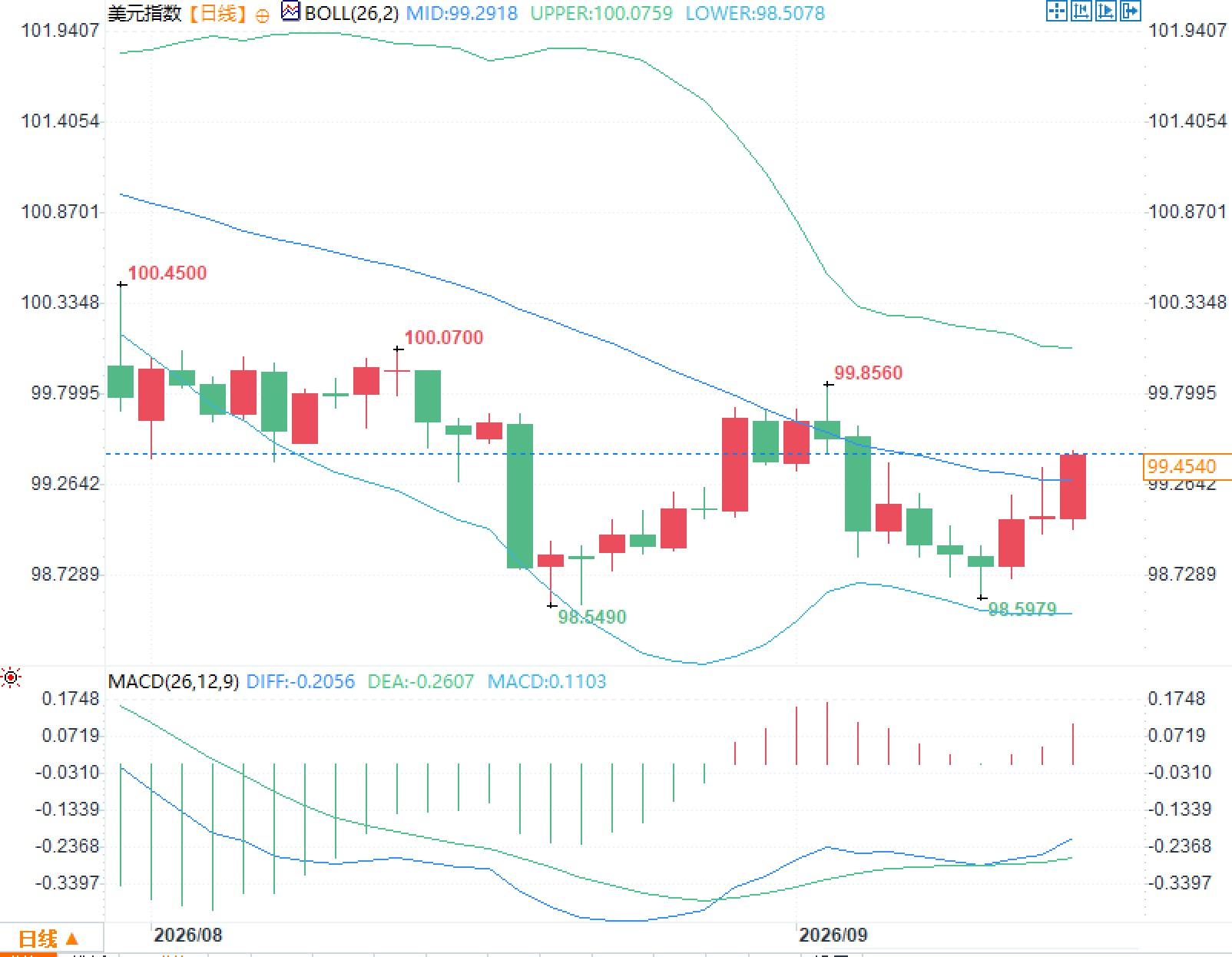
The US dollar index is currently trading around 99.5, with the Bollinger Band middle band at approximately 99.29, the upper band at approximately 100.08, and the lower band at approximately 98.51. The price is close to the middle band, and the band width has narrowed significantly compared to early August. The MACD DIFF is approximately -0.21, DEA is approximately -0.26, and the histogram value is approximately 0.11. The fast and slow lines are still below the zero axis, but the histogram has turned from negative to positive. At the cross-asset level, the frequency with which the US dollar index moves in the same direction as the 10-year US Treasury real yield, energy prices, and the probability of interest rate hikes is increasing. When interest rate expectations are revised upward, the US dollar index often reflects term premiums and short-term pricing simultaneously; rising energy prices, on the other hand, disrupt both inflation expectations and risk appetite. More useful is breaking down these three factors: the short-term pricing resulting from changes in the probability of interest rate hikes, the real interest rate resulting from changes in long-term yields, and the transmission lag of the energy component to the next price report.Frequently Asked Questions
Question 1: Why were institutions able to change their September rate hold to a rate hike within days? Answer: The triggering conditions were a combination of three factors: a 0.3% month-on-month increase in core prices in August, crude oil returning above $100 per barrel, and the 10-year Treasury yield rising to 4.96% to 4.98%. The implied probability in futures contracts is now around 87%. Question 2: Core inflation has reached 2.4% year-on-year, so why is it still described as under pressure? Answer: Year-on-year growth is affected by the base effect. Month-on-month core inflation was higher than expected, with energy and gasoline sub-categories showing strength, while housing inflation remains at 3.0% year-on-year. Warsh's standard is that the trend must approach 2% "clearly and quickly enough." Recent momentum is seen in month-on-month and sub-categories, not in a single year-on-year figure.- Risk Warning and Disclaimer
- The market involves risk, and trading may not be suitable for all investors. This article is for reference only and does not constitute personal investment advice, nor does it take into account certain users’ specific investment objectives, financial situation, or other needs. Any investment decisions made based on this information are at your own risk.