Soaring oil prices and interest rate hikes are putting pressure on gold prices, but bulls remain optimistic and have not reduced their positions.
2026-09-14 20:42:09
On Monday (September 14), during the Asian and European sessions, international gold prices retreated in the short term due to rising oil prices leading to higher-than-expected US inflation and increased expectations of interest rate hikes. Spot gold was at $4287, down 1.39% on the day, with futures also weakening. Gold prices have been correcting for three consecutive weeks. Overall, oil prices, Federal Reserve policies, global risk appetite and geopolitical issues, as well as gold demand are jointly driving market movements. Short-term pressure does not change the medium- to long-term upward trend. 
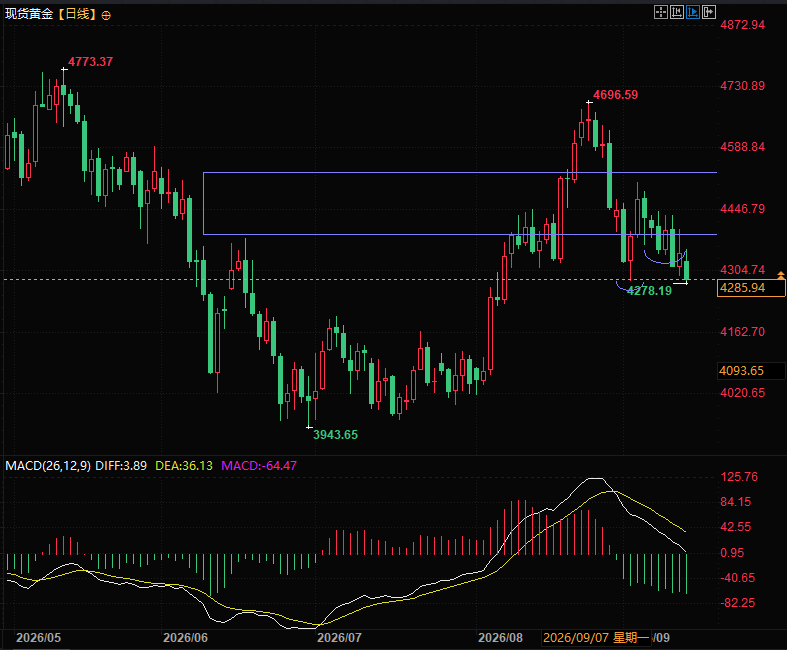 (Spot gold daily chart, source: EasyTrade) At 20:39 Beijing time, spot gold is currently trading at $4279.5 per ounce.
Middle East geopolitical tensions drive up oil prices, while global inflationary pressures continue to rise.
Tensions in the Middle East, coupled with rising shipping risks, have driven international oil prices sharply higher, with Brent crude breaking through $107 per barrel, a nearly 9% increase in a single week, continuing to push up global inflation. The shipping negotiations between Iran and Gulf states in the Strait of Hormuz, originally scheduled for this week, have been postponed, perpetuating uncertainty in energy supply and supporting sticky inflation at high oil prices. Simultaneously, overseas inflationary pressures are spreading, with India's wholesale inflation rising to 9.92% in August, nearing double digits, and prices for energy, food, and industrial goods all rising across the board. This high-inflation environment strengthens expectations of a Fed tightening, suppressing gold prices in the short term, while also continuously activating demand for gold as a safe haven against inflation, providing a floor for gold prices in the medium to long term.The market has shifted its focus from whether or not to raise interest rates to concerns about inflation and how many times to raise rates.
The US August core CPI exceeded expectations, coupled with strong employment and soaring oil prices, raising the market's probability of a Fed rate hike this week to 88%. Rate hike expectations have pushed up the dollar and US Treasury yields, putting short-term pressure on gold, which has no interest rate, and is the core reason for the recent decline in gold prices. Last Friday's inflation data was a case of "the bad news being priced in, turning bad into good," as the market had already fully priced in the rate hike expectations. A Fed rate hike as expected could stabilize inflation expectations, restore policy credibility, and eliminate market panic about runaway inflation. However, after the weekend's developments, the market believes that the uncertainty of high inflation is the biggest risk suppressing the market, compared to a small rate hike. Influenced by inflation, the market has even begun to discuss how many rate hikes there might be, with some banks believing the Fed may raise rates twice by the end of the year, and Bank of America even suggesting three hikes. Therefore, inflation remains one of the most important factors affecting gold prices, as central banks will raise rates due to inflation. At the same time, inflationary pressures actually limit the US from adopting various easing measures, such as Bessant's repurchase agreements and Trump's money printing, which are constrained by inflation, resulting in limited effectiveness.Multiple fundamental factors support gold prices, limiting downside potential.
Physical demand remains resilient: Chinese institutions continue to increase their gold holdings, India is approaching its seasonal peak consumption season, and coupled with high domestic inflation, physical buying is steadily improving. Global gold ETF and speculative fund holdings continue to improve. Geopolitically, ongoing conflicts in the Middle East and instability in global supply chains ensure long-term safe-haven demand. Meanwhile, political intervention in Federal Reserve policy weakens the dollar's credibility, indirectly benefiting gold valuations. Within the precious metals sector, there is divergence, with platinum bucking the trend and strengthening, proving that the current situation is only a phase of adjustment for gold, not a systemic weakening. Furthermore, the CFTC positioning report shows no significant reduction in gold long positions.Institutions unanimously hold a bullish view on the medium- to long-term outlook for gold.
Major investment banks remain optimistic about the gold market outlook. ANZ Bank maintains its 12-month gold price target of $5,400/oz, believing that even with continued Fed rate hikes, geopolitical inflationary pressures and physical demand will continue to support gold prices. UBS points out that the market has already priced in the impact of this rate hike, and the September rate hike will only bring a temporary pullback, not disrupt the upward trend in gold. With the year-end approaching and peak season demand in India being released, gold volatility is increasing, but the probability of further price increases will continue to rise.Summary and Technical Analysis:
Gold prices are currently facing short-term downward pressure due to rising oil prices, inflationary pressures leading to the risk of continuous interest rate hikes, and a strong dollar, but these negative factors are likely to be fully priced in. The market is also influenced by recent narratives suggesting a potential slowdown in AI company development, leading to a contraction in market risk appetite and putting pressure on buying across various assets in the short term. However, if the US addresses the recent imbalance in capital expenditures by AI-related companies, market risk appetite is expected to recover quickly. Supported by geopolitical risks, high inflation, physical demand, and central bank gold purchases, gold prices, after consolidation, still present a medium- to long-term investment opportunity. While inflation may suppress gold prices in the short term, the long-term decline in monetary purchasing power is beneficial for gold. Technically, gold prices have broken below the lower edge of the trading range, and the double bottom pattern on the daily chart has been breached. If prices cannot quickly recover above the double bottom in the near term, further downward movement is possible. (Spot gold daily chart, source: EasyTrade) At 20:39 Beijing time, spot gold is currently trading at $4279.5 per ounce.
- Risk Warning and Disclaimer
- The market involves risk, and trading may not be suitable for all investors. This article is for reference only and does not constitute personal investment advice, nor does it take into account certain users’ specific investment objectives, financial situation, or other needs. Any investment decisions made based on this information are at your own risk.