Crude oil trading alert: The continued shutdown of Saudi Arabia's East-West pipeline is supporting high levels of US crude oil prices due to supply-side concerns.
2026-09-15 09:24:09
International oil prices continued their upward trend on Tuesday, with WTI crude rising above $102 during the session, last trading at around $102.35. Compared to the previous level of around $98.60, oil prices have moved further upward, indicating that supply risk has once again become a core variable in market pricing. The current market focus is not only on the impact on a single energy facility, but also on the simultaneous uncertainty facing major Middle Eastern transport corridors and alternative export routes, further reducing the safety margin of the crude oil supply chain.  The Saudi East-West Pipeline is one of the most important focuses in the market right now. This alternative shipping route, connecting Saudi Arabia's eastern oil-producing region with ports along the Red Sea coast, was originally intended to divert traffic when shipping was disrupted in the Strait of Hormuz. Latest information indicates that the pipeline remains shut down after the drone attacks, and the market has yet to obtain a clear timeline for its resumption. Analysis shows that the route can normally transport approximately 4 million barrels per day of crude oil, equivalent to about 4% of global supply. Therefore, the continued shutdown of the pipeline is significant not only because it affects Saudi Arabia's own export capacity, but also because it weakens the global crude oil market's backup capacity to cope with the risks of shipping through the Strait of Hormuz. Meanwhile, regional talks on shipping arrangements in the Strait of Hormuz have been postponed, meaning that the market's previous expectations for improving shipping conditions through diplomatic channels have temporarily failed. Oman stated that the postponement of the meeting aims to create more suitable conditions for further dialogue, and the relevant consultations originally involved the resumption of some shipping and improving the regional security environment. For the crude oil market, the postponement of negotiations does not itself equate to a wider supply disruption, but it will prolong the existence of risk premiums, making it more difficult for traders to judge the specific pace of shipping recovery. Shipping risks have also become a significant factor driving up oil prices. Reports indicate that an oil tanker exploded after attempting to enter restricted waters, with allegations suggesting a landmine strike, but the specific details and liability remain uncertain. Regardless of the final investigation results, as long as the market continues to perceive high shipping risks in the Strait of Hormuz, shipowners, insurers, and traders are likely to increase transportation costs and risk compensation, ultimately reflected in oil prices through spot premiums and futures risk premiums. From a supply chain perspective, the crude oil market currently faces the dual pressures of "restricted main routes + damaged alternative routes." The Strait of Hormuz handles approximately one-fifth of global oil transportation, and the Saudi East-West Pipeline was originally a crucial alternative to reduce the risks associated with this single shipping route. When both routes are disrupted simultaneously, the market's sensitivity to actual supply losses increases significantly. Even if the actual production cuts are ultimately limited, declining inventories, shipping delays, and tighter spot supply may be reflected in prices before production data. On the other hand, changes in liquidity are also worth noting. TD Securities points out that trend-following commodity trading advisors are currently highly concentrated in the energy sector, with long positions covering the crude oil, diesel, and gasoline markets. The agency believes that the main factor limiting further increases in positions by such systemic funds has shifted from trend judgment to market volatility. This means that once oil prices continue to break through key technical resistance, trend-following funds may further reinforce the upward trend; however, if prices reverse rapidly, highly concentrated long positions may amplify downward pressure. This is also a key difference between the current oil market and ordinary supply and demand markets. In the past, oil price increases relied more on gradual changes in inventory, production, and demand expectations, while the current market is simultaneously driven by geopolitical risk premiums, shipping costs, and algorithmic trading. Once oil prices break through key psychological levels, they easily attract momentum funds to chase the price higher, thus forming a positive feedback loop of "supply concerns—price increases—trend-following fund increases—volatility increases." However, if supply disruptions do not expand further, or alternative transportation routes recover quickly, this risk premium may also be quickly reversed. The impact of high oil prices is also spreading from the energy market to the macroeconomic level. After crude oil prices continue to break through $100, gasoline, diesel, aviation fuel, and transportation costs face further upward pressure and may push up inflation expectations again. Meanwhile, rising oil prices will also compress consumers' actual purchasing power and increase business operating costs, thus constraining global economic growth. Therefore, investors need to pay attention not only to crude oil inventory and export data, but also to whether high oil prices begin to alter interest rate expectations, bond yields, and the dollar's trajectory in major economies. Furthermore, news regarding Eastern European energy infrastructure has also caused some market volatility. Ukraine has stated that it is willing to take corresponding measures if Russia ceases its attacks on energy targets, but the arrangements remain uncertain. In the short term, this factor has a lower direct impact on WTI than the Hormuz and Saudi supply lines, but if subsequent attacks on energy facilities decrease and the risk to Russian refined oil and crude oil supply declines, it could become a significant variable suppressing oil price risk premiums in the medium term. Currently, the most critical issue in the market has shifted from "whether oil prices can break through $100" to "whether the rise above $100 can be supported by actual supply tightening." If the Saudi East-West pipeline remains suspended and the recovery of shipping from the Hormuz is slow, the risk premium for crude oil could widen further. Conversely, if the pipeline resumes operation, regional negotiations restart, or shipping volumes improve significantly, the previously accumulated risk premium for oil prices could be quickly corrected. From a daily chart perspective, WTI has formed a clear pattern of rising highs and lows since its August lows, and the bullish trend has been further strengthened after prices climbed back above $100. Currently, the $102 level is both a key psychological level and a battleground between bulls and bears in the short term. Latest technical data shows that WTI's medium- to long-term moving average structure remains bullish, with the 100-day and 200-day moving averages significantly lower than the current price, indicating that the medium-term upward structure has not been broken. If oil prices can stabilize above $102 and further break through the $103-$105 area, they could extend towards the $108-$112 area; if supply risks worsen further, resistance near previous highs may be retested. Support levels to watch are first the $100 psychological level, followed by the $98-$99 area. If the $100 level is breached, the short-term upward momentum will cool significantly, with a further pullback target around $95.50. If the $95 area also fails to hold, it indicates the market is beginning to release geopolitical risk premiums, and prices may further seek support around $93.50. The current daily chart structure remains bullish, but the risk of chasing highs is increasing after the rapid rise in oil prices. Looking at the 4-hour chart, WTI remains in a high-level consolidation pattern with a slightly bullish bias. $102 to $105 constitutes the most important short-term breakout area. If prices break and hold above $105 with significant volume, the short-term trend is expected to open up further upside potential, potentially pushing towards $108 or even $110. However, if multiple attempts to break through $103 to $105 fail, and prices subsequently fall below $100, a short-term double top or a high-level pullback structure may form. Recent technical indicators have shown some divergence, with some momentum indicators weakening, indicating that short-term profit-taking is increasing during the upward trend. Therefore, in the next few trading days, it is more important to pay attention to whether the price can maintain its upward structure by reaching higher lows after a pullback, rather than simply observing whether new highs are reached intraday.
 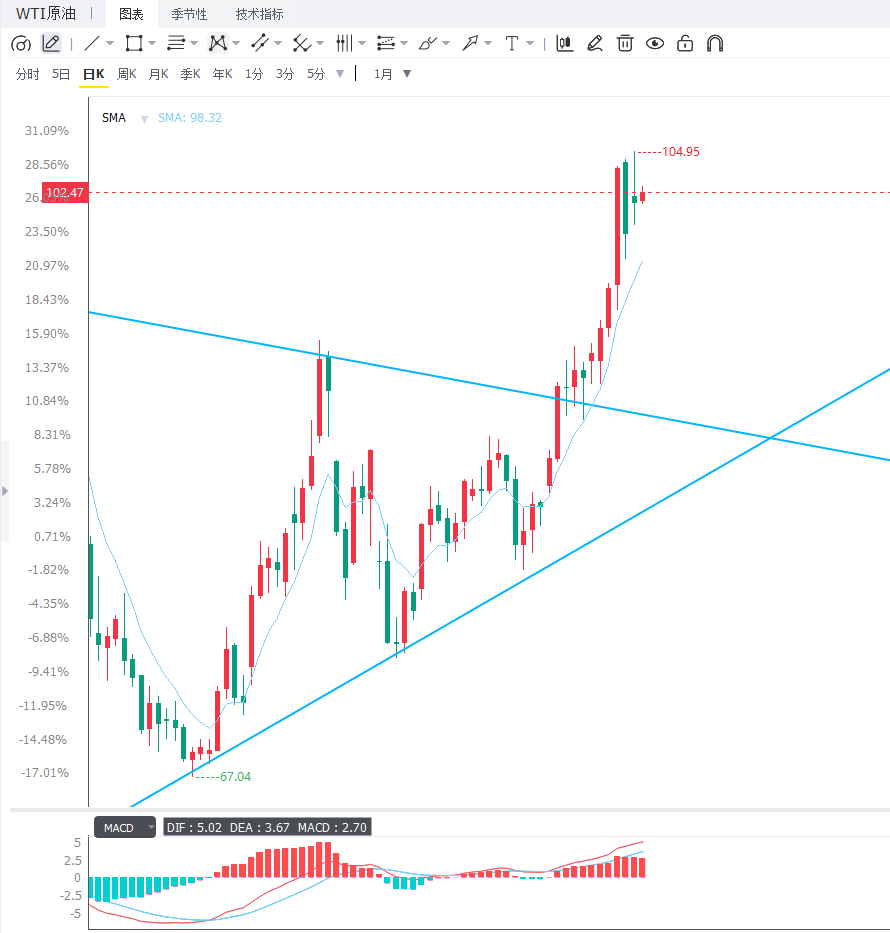 The core driver behind WTI's breakout above $102 remains supply risk, rather than a sudden and significant improvement in demand. The continued shutdown of the Saudi East-West pipeline weakens backup transport capacity in the event of the Hormuz blockade, while delays in related regional negotiations further postpone expectations of supply recovery. With trend-following funds heavily concentrated on long positions, oil prices still have the potential to challenge the $103-$105 resistance zone in the short term. However, the market is currently in a high-volatility phase. If actual supply losses continue to widen, oil prices may move further towards the $108-$112 area; if transport routes resume, diplomatic negotiations progress, or the market discovers that actual supply losses are lower than expected, the high risk premium may quickly decline. For future price movements, $100 will continue to be a crucial dividing line for judging the strength or weakness of WTI, while the $103-$105 range is a key technical area determining the next round of upward movement.
The Saudi East-West Pipeline is one of the most important focuses in the market right now. This alternative shipping route, connecting Saudi Arabia's eastern oil-producing region with ports along the Red Sea coast, was originally intended to divert traffic when shipping was disrupted in the Strait of Hormuz. Latest information indicates that the pipeline remains shut down after the drone attacks, and the market has yet to obtain a clear timeline for its resumption. Analysis shows that the route can normally transport approximately 4 million barrels per day of crude oil, equivalent to about 4% of global supply. Therefore, the continued shutdown of the pipeline is significant not only because it affects Saudi Arabia's own export capacity, but also because it weakens the global crude oil market's backup capacity to cope with the risks of shipping through the Strait of Hormuz. Meanwhile, regional talks on shipping arrangements in the Strait of Hormuz have been postponed, meaning that the market's previous expectations for improving shipping conditions through diplomatic channels have temporarily failed. Oman stated that the postponement of the meeting aims to create more suitable conditions for further dialogue, and the relevant consultations originally involved the resumption of some shipping and improving the regional security environment. For the crude oil market, the postponement of negotiations does not itself equate to a wider supply disruption, but it will prolong the existence of risk premiums, making it more difficult for traders to judge the specific pace of shipping recovery. Shipping risks have also become a significant factor driving up oil prices. Reports indicate that an oil tanker exploded after attempting to enter restricted waters, with allegations suggesting a landmine strike, but the specific details and liability remain uncertain. Regardless of the final investigation results, as long as the market continues to perceive high shipping risks in the Strait of Hormuz, shipowners, insurers, and traders are likely to increase transportation costs and risk compensation, ultimately reflected in oil prices through spot premiums and futures risk premiums. From a supply chain perspective, the crude oil market currently faces the dual pressures of "restricted main routes + damaged alternative routes." The Strait of Hormuz handles approximately one-fifth of global oil transportation, and the Saudi East-West Pipeline was originally a crucial alternative to reduce the risks associated with this single shipping route. When both routes are disrupted simultaneously, the market's sensitivity to actual supply losses increases significantly. Even if the actual production cuts are ultimately limited, declining inventories, shipping delays, and tighter spot supply may be reflected in prices before production data. On the other hand, changes in liquidity are also worth noting. TD Securities points out that trend-following commodity trading advisors are currently highly concentrated in the energy sector, with long positions covering the crude oil, diesel, and gasoline markets. The agency believes that the main factor limiting further increases in positions by such systemic funds has shifted from trend judgment to market volatility. This means that once oil prices continue to break through key technical resistance, trend-following funds may further reinforce the upward trend; however, if prices reverse rapidly, highly concentrated long positions may amplify downward pressure. This is also a key difference between the current oil market and ordinary supply and demand markets. In the past, oil price increases relied more on gradual changes in inventory, production, and demand expectations, while the current market is simultaneously driven by geopolitical risk premiums, shipping costs, and algorithmic trading. Once oil prices break through key psychological levels, they easily attract momentum funds to chase the price higher, thus forming a positive feedback loop of "supply concerns—price increases—trend-following fund increases—volatility increases." However, if supply disruptions do not expand further, or alternative transportation routes recover quickly, this risk premium may also be quickly reversed. The impact of high oil prices is also spreading from the energy market to the macroeconomic level. After crude oil prices continue to break through $100, gasoline, diesel, aviation fuel, and transportation costs face further upward pressure and may push up inflation expectations again. Meanwhile, rising oil prices will also compress consumers' actual purchasing power and increase business operating costs, thus constraining global economic growth. Therefore, investors need to pay attention not only to crude oil inventory and export data, but also to whether high oil prices begin to alter interest rate expectations, bond yields, and the dollar's trajectory in major economies. Furthermore, news regarding Eastern European energy infrastructure has also caused some market volatility. Ukraine has stated that it is willing to take corresponding measures if Russia ceases its attacks on energy targets, but the arrangements remain uncertain. In the short term, this factor has a lower direct impact on WTI than the Hormuz and Saudi supply lines, but if subsequent attacks on energy facilities decrease and the risk to Russian refined oil and crude oil supply declines, it could become a significant variable suppressing oil price risk premiums in the medium term. Currently, the most critical issue in the market has shifted from "whether oil prices can break through $100" to "whether the rise above $100 can be supported by actual supply tightening." If the Saudi East-West pipeline remains suspended and the recovery of shipping from the Hormuz is slow, the risk premium for crude oil could widen further. Conversely, if the pipeline resumes operation, regional negotiations restart, or shipping volumes improve significantly, the previously accumulated risk premium for oil prices could be quickly corrected. From a daily chart perspective, WTI has formed a clear pattern of rising highs and lows since its August lows, and the bullish trend has been further strengthened after prices climbed back above $100. Currently, the $102 level is both a key psychological level and a battleground between bulls and bears in the short term. Latest technical data shows that WTI's medium- to long-term moving average structure remains bullish, with the 100-day and 200-day moving averages significantly lower than the current price, indicating that the medium-term upward structure has not been broken. If oil prices can stabilize above $102 and further break through the $103-$105 area, they could extend towards the $108-$112 area; if supply risks worsen further, resistance near previous highs may be retested. Support levels to watch are first the $100 psychological level, followed by the $98-$99 area. If the $100 level is breached, the short-term upward momentum will cool significantly, with a further pullback target around $95.50. If the $95 area also fails to hold, it indicates the market is beginning to release geopolitical risk premiums, and prices may further seek support around $93.50. The current daily chart structure remains bullish, but the risk of chasing highs is increasing after the rapid rise in oil prices. Looking at the 4-hour chart, WTI remains in a high-level consolidation pattern with a slightly bullish bias. $102 to $105 constitutes the most important short-term breakout area. If prices break and hold above $105 with significant volume, the short-term trend is expected to open up further upside potential, potentially pushing towards $108 or even $110. However, if multiple attempts to break through $103 to $105 fail, and prices subsequently fall below $100, a short-term double top or a high-level pullback structure may form. Recent technical indicators have shown some divergence, with some momentum indicators weakening, indicating that short-term profit-taking is increasing during the upward trend. Therefore, in the next few trading days, it is more important to pay attention to whether the price can maintain its upward structure by reaching higher lows after a pullback, rather than simply observing whether new highs are reached intraday. The core driver behind WTI's breakout above $102 remains supply risk, rather than a sudden and significant improvement in demand. The continued shutdown of the Saudi East-West pipeline weakens backup transport capacity in the event of the Hormuz blockade, while delays in related regional negotiations further postpone expectations of supply recovery. With trend-following funds heavily concentrated on long positions, oil prices still have the potential to challenge the $103-$105 resistance zone in the short term. However, the market is currently in a high-volatility phase. If actual supply losses continue to widen, oil prices may move further towards the $108-$112 area; if transport routes resume, diplomatic negotiations progress, or the market discovers that actual supply losses are lower than expected, the high risk premium may quickly decline. For future price movements, $100 will continue to be a crucial dividing line for judging the strength or weakness of WTI, while the $103-$105 range is a key technical area determining the next round of upward movement.
- Risk Warning and Disclaimer
- The market involves risk, and trading may not be suitable for all investors. This article is for reference only and does not constitute personal investment advice, nor does it take into account certain users’ specific investment objectives, financial situation, or other needs. Any investment decisions made based on this information are at your own risk.