With Canadian inflation remaining at 3% and the Bank of Canada likely to hold rates steady for an extended period, the USD/CAD exchange rate hovered around 1.3900.
2026-09-15 10:36:08
The USD/CAD pair remained around 1.3900 in Asian trading on Tuesday, temporarily halting its decline from a near two-week high in the previous session. The exchange rate currently lacks a clear direction. On the one hand, renewed strengthening expectations of US interest rates are keeping the US dollar relatively strong; on the other hand, high international oil prices are supporting the commodity currency, the Canadian dollar. With Canadian inflation data releases and the Federal Reserve policy meeting approaching, the market is more inclined to await new policy signals rather than making large bets on the exchange rate direction in advance. 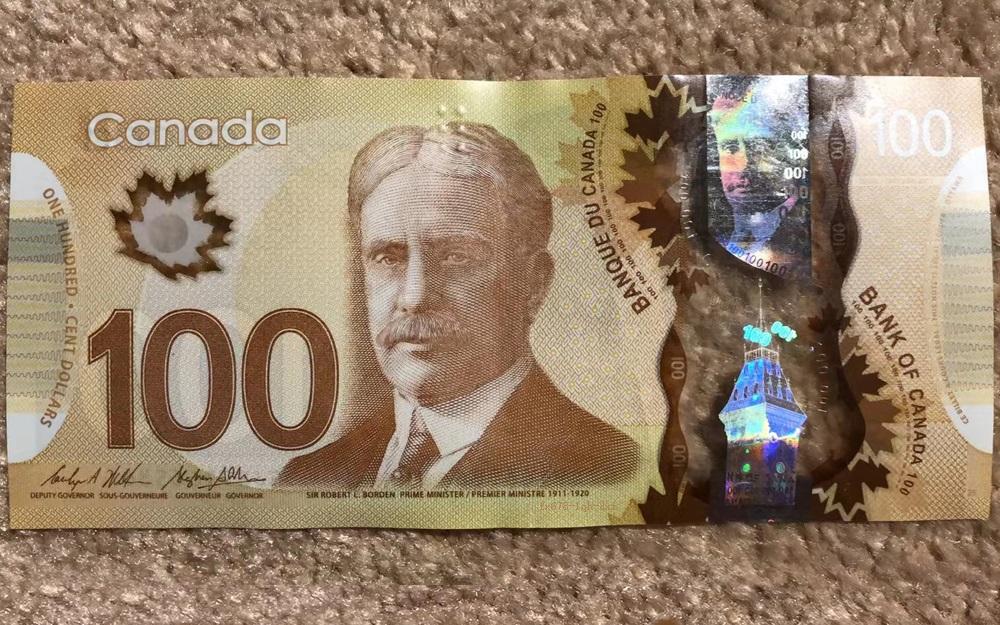 Canada's Consumer Price Index (CPI) rose 3% year-on-year in August, in line with July's level and market expectations. Meanwhile, the Bank of Canada's key core inflation indicator remained close to its 2% policy target, indicating that underlying price pressures in Canada are generally under control. The lack of further significant inflation increases the Bank of Canada's room to maintain interest rates unchanged for the foreseeable future and reduces market expectations for a short-term rate hike. Royal Bank of Canada believes that the August inflation data is generally in line with its baseline scenario, in which the Bank of Canada may maintain interest rates unchanged for the remainder of 2026 and begin gradually raising rates in 2027 as the economy improves. If this expectation is further accepted by the market, the Canadian dollar will lack strong support from the interest rate side, while the USD/CAD pair may gain some upside potential. However, the inflation data also released another important signal: the current rise in energy prices has not yet clearly created widespread secondary inflationary pressure. Royal Bank of Canada pointed out that there is currently insufficient evidence to suggest that higher energy costs have been significantly passed on to the prices of other goods and services. This means that the Bank of Canada does not need to adjust its policy quickly due to rising energy prices for the time being, but if the high oil price period continues, the spread of energy costs to core inflation remains a concern. Regarding the US dollar, US Treasury yields continue to hover near multi-year highs, with market repricing of the Federal Reserve's policy path providing significant support. Recent strong US inflation, coupled with potential inflationary pressures from high energy prices, has increased traders' expectations that the Fed will maintain a tight policy stance. This has kept the US dollar index near its highest level in nearly two weeks, further strengthening the upward momentum of the USD/CAD pair. However, the upcoming policy decision from the Federal Reserve remains the biggest event risk for the market. Investors are not only focusing on the interest rate decision itself but also closely watching the policy statement and officials' comments on the future path of interest rates. If the Fed releases a more hawkish signal than the market expects, US yields and the dollar may continue to strengthen, providing further upward momentum for the USD/CAD pair. Conversely, if the policy stance leans towards easing, the recent gains in the dollar may be reversed. Oil prices are a crucial balancing factor in the USD/CAD exchange rate movement. International crude oil prices remain at levels not seen since late May, with Middle East supply risks and shipping issues in the Strait of Hormuz continuing to drive a high risk premium in the oil market. As a major energy exporter, Canada typically benefits from high oil prices, giving the Canadian dollar some ability to offset the strength of the US dollar. This power imbalance between the dollar and oil prices complicates the short-term trend of the USD/CAD pair. If US yields continue to rise while oil prices fall, the USD/CAD pair may break through recent resistance; conversely, if oil prices continue to rise and drive inflows into the Canadian dollar, the pair may continue to be suppressed in the 1.3900-1.4000 range, even if the dollar remains strong. From a funding perspective, the market currently lacks strong buying interest in the USD/CAD pair. The pair previously encountered significant resistance near the 100-day moving average and failed to break through, indicating that bulls still need new fundamental catalysts. Meanwhile, high oil prices have reduced investors' willingness to significantly short the Canadian dollar. Therefore, before the Fed's policy announcement, the USD/CAD pair is more likely to remain range-bound, awaiting a re-evaluation of the direction from interest rates and the energy market. From a daily chart perspective, the USD/CAD pair is currently trading in a high-level area after a rebound, but significant technical resistance has formed around 1.3930. This position coincides with both the 38.2% Fibonacci retracement level and the 100-day simple moving average, making it a significant dividing line between bullish and bearish sentiment. If the exchange rate can effectively break through and hold above 1.3930, the next resistance level to watch is the 50% retracement level near 1.3989, followed by the 61.8% retracement level near 1.4051. If the bulls can break through 1.4050, the medium-term rebound structure of USD/CAD is expected to strengthen further. On the downside, the first support level to watch is the 23.6% Fibonacci retracement level near 1.3852, which is the first short-term support. If the price falls below 1.3852, it means that the recent rebound momentum has weakened significantly, and it may further test the important structural support near 1.3728. As long as 1.3728 can hold effectively, the overall rebound structure may still be repaired. From the 4-hour chart, USD/CAD is currently consolidating at a high level, with the area around 1.3900 becoming the current battleground between bulls and bears. If the exchange rate regains its footing above 1.3930, the short-term trend will turn bullish, and it may further test 1.3989 and 1.4051. Conversely, if it fails to break through 1.3930 multiple times and falls below 1.3852, a high-level pullback structure may form. Currently, the technical indicators do not provide a clear one-sided signal; therefore, the Fed's policy statements, US yields, and oil prices remain key variables determining the direction of the breakout.
 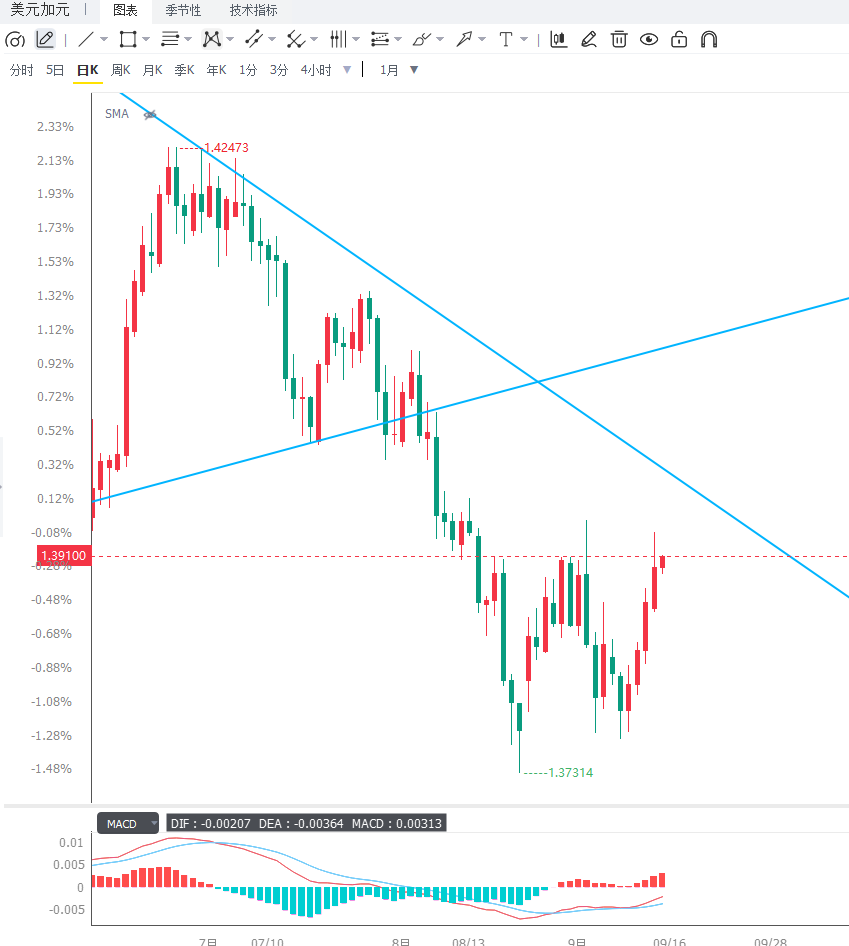 Editor's Summary: The USD/CAD pair is currently at the intersection of three forces: a strong US dollar, a cautious stance from the Bank of Canada, and support for the Canadian dollar from high oil prices. Canadian inflation remained at 3% in August, with core inflation near the policy target, increasing the likelihood that the Bank of Canada will maintain its current interest rate. Meanwhile, rising US interest rate expectations are pushing the US dollar strong. In the short term, 1.3930 is a key technical level for the USD/CAD pair's breakout direction. If the Federal Reserve releases hawkish signals and US yields continue to rise, the exchange rate could extend towards 1.3989 or even 1.4051; if oil prices continue to strengthen and support the Canadian dollar, the USD/CAD pair may fall back towards 1.3852 or even 1.3728. The market should currently focus on the synchronized changes in the Fed's policy path and oil prices, as this will determine the main direction of the exchange rate in the next stage.
Canada's Consumer Price Index (CPI) rose 3% year-on-year in August, in line with July's level and market expectations. Meanwhile, the Bank of Canada's key core inflation indicator remained close to its 2% policy target, indicating that underlying price pressures in Canada are generally under control. The lack of further significant inflation increases the Bank of Canada's room to maintain interest rates unchanged for the foreseeable future and reduces market expectations for a short-term rate hike. Royal Bank of Canada believes that the August inflation data is generally in line with its baseline scenario, in which the Bank of Canada may maintain interest rates unchanged for the remainder of 2026 and begin gradually raising rates in 2027 as the economy improves. If this expectation is further accepted by the market, the Canadian dollar will lack strong support from the interest rate side, while the USD/CAD pair may gain some upside potential. However, the inflation data also released another important signal: the current rise in energy prices has not yet clearly created widespread secondary inflationary pressure. Royal Bank of Canada pointed out that there is currently insufficient evidence to suggest that higher energy costs have been significantly passed on to the prices of other goods and services. This means that the Bank of Canada does not need to adjust its policy quickly due to rising energy prices for the time being, but if the high oil price period continues, the spread of energy costs to core inflation remains a concern. Regarding the US dollar, US Treasury yields continue to hover near multi-year highs, with market repricing of the Federal Reserve's policy path providing significant support. Recent strong US inflation, coupled with potential inflationary pressures from high energy prices, has increased traders' expectations that the Fed will maintain a tight policy stance. This has kept the US dollar index near its highest level in nearly two weeks, further strengthening the upward momentum of the USD/CAD pair. However, the upcoming policy decision from the Federal Reserve remains the biggest event risk for the market. Investors are not only focusing on the interest rate decision itself but also closely watching the policy statement and officials' comments on the future path of interest rates. If the Fed releases a more hawkish signal than the market expects, US yields and the dollar may continue to strengthen, providing further upward momentum for the USD/CAD pair. Conversely, if the policy stance leans towards easing, the recent gains in the dollar may be reversed. Oil prices are a crucial balancing factor in the USD/CAD exchange rate movement. International crude oil prices remain at levels not seen since late May, with Middle East supply risks and shipping issues in the Strait of Hormuz continuing to drive a high risk premium in the oil market. As a major energy exporter, Canada typically benefits from high oil prices, giving the Canadian dollar some ability to offset the strength of the US dollar. This power imbalance between the dollar and oil prices complicates the short-term trend of the USD/CAD pair. If US yields continue to rise while oil prices fall, the USD/CAD pair may break through recent resistance; conversely, if oil prices continue to rise and drive inflows into the Canadian dollar, the pair may continue to be suppressed in the 1.3900-1.4000 range, even if the dollar remains strong. From a funding perspective, the market currently lacks strong buying interest in the USD/CAD pair. The pair previously encountered significant resistance near the 100-day moving average and failed to break through, indicating that bulls still need new fundamental catalysts. Meanwhile, high oil prices have reduced investors' willingness to significantly short the Canadian dollar. Therefore, before the Fed's policy announcement, the USD/CAD pair is more likely to remain range-bound, awaiting a re-evaluation of the direction from interest rates and the energy market. From a daily chart perspective, the USD/CAD pair is currently trading in a high-level area after a rebound, but significant technical resistance has formed around 1.3930. This position coincides with both the 38.2% Fibonacci retracement level and the 100-day simple moving average, making it a significant dividing line between bullish and bearish sentiment. If the exchange rate can effectively break through and hold above 1.3930, the next resistance level to watch is the 50% retracement level near 1.3989, followed by the 61.8% retracement level near 1.4051. If the bulls can break through 1.4050, the medium-term rebound structure of USD/CAD is expected to strengthen further. On the downside, the first support level to watch is the 23.6% Fibonacci retracement level near 1.3852, which is the first short-term support. If the price falls below 1.3852, it means that the recent rebound momentum has weakened significantly, and it may further test the important structural support near 1.3728. As long as 1.3728 can hold effectively, the overall rebound structure may still be repaired. From the 4-hour chart, USD/CAD is currently consolidating at a high level, with the area around 1.3900 becoming the current battleground between bulls and bears. If the exchange rate regains its footing above 1.3930, the short-term trend will turn bullish, and it may further test 1.3989 and 1.4051. Conversely, if it fails to break through 1.3930 multiple times and falls below 1.3852, a high-level pullback structure may form. Currently, the technical indicators do not provide a clear one-sided signal; therefore, the Fed's policy statements, US yields, and oil prices remain key variables determining the direction of the breakout. Editor's Summary: The USD/CAD pair is currently at the intersection of three forces: a strong US dollar, a cautious stance from the Bank of Canada, and support for the Canadian dollar from high oil prices. Canadian inflation remained at 3% in August, with core inflation near the policy target, increasing the likelihood that the Bank of Canada will maintain its current interest rate. Meanwhile, rising US interest rate expectations are pushing the US dollar strong. In the short term, 1.3930 is a key technical level for the USD/CAD pair's breakout direction. If the Federal Reserve releases hawkish signals and US yields continue to rise, the exchange rate could extend towards 1.3989 or even 1.4051; if oil prices continue to strengthen and support the Canadian dollar, the USD/CAD pair may fall back towards 1.3852 or even 1.3728. The market should currently focus on the synchronized changes in the Fed's policy path and oil prices, as this will determine the main direction of the exchange rate in the next stage.
- Risk Warning and Disclaimer
- The market involves risk, and trading may not be suitable for all investors. This article is for reference only and does not constitute personal investment advice, nor does it take into account certain users’ specific investment objectives, financial situation, or other needs. Any investment decisions made based on this information are at your own risk.