US Treasury yields rose above 5%, and expectations of interest rate hikes intensified, causing spot gold to fall below $4,300 as investors await the Federal Reserve's decision.
2026-09-15 09:28:09
Spot gold continued to be under pressure during Asian trading hours on Tuesday, with XAU/USD falling to around $4295 at one point. The recent weakness in precious metals is not simply due to profit-taking, but rather the renewed dominance of the US dollar interest rate environment as a major suppressive factor. Stronger-than-expected US inflation data, coupled with high energy prices, has led the market to reassess the future path of monetary policy. With the Fed's September meeting approaching, the core contradiction in the gold market has shifted from safe-haven demand to the "game between inflationary pressures and interest rate expectations."  The yield on the 10-year US Treasury note briefly broke through 5% on Monday, reaching this level for the first time since 2023. The rapid rise in long-term yields reflects both the market's repricing of inflation risks and increased financing needs from the US government and businesses. For gold, which does not generate interest income, the continued rise in US Treasury yields means an increased opportunity cost of holding gold, thus funds are more inclined to reallocate to higher-yielding dollar assets, thereby limiting the upside potential for gold prices. Rising energy prices further amplify this logic. With increased supply risks in the oil market, oil prices have returned to high levels, raising market concerns that energy costs may be transmitted to overall inflation through transportation, production, and consumption channels. If high oil prices persist, the inflation risks that the Federal Reserve needs to consider when formulating policy will also increase. This weakens the logic that gold previously benefited from expectations of easing policies, especially with the simultaneous rise in US Treasury yields, making the short-term pressure on precious metals more pronounced. Changes in interest rate expectations are also worth noting. According to CME FedWatch data, the market currently expects the probability of a 25 basis point rate hike by the Federal Reserve at its September policy meeting to have risen to approximately 92.4%. A significant shift in market pricing indicates that traders have substantially increased their expectations for the Federal Reserve to maintain a tight policy stance. It's important to note that interest rate expectations are already largely priced into asset prices; therefore, the next move in gold prices may not necessarily depend on whether the Fed adjusts interest rates. More importantly, it will depend on whether the policy statement and officials' speeches release signals that are more hawkish or dovish than the market expects. The Fed Chair's press conference will be another key risk factor from this meeting. If the policy statement continues to emphasize inflation risks and suggests that high interest rates need to be maintained for a longer period, US Treasury yields and the dollar may receive further support, and gold may retest recent lows. Conversely, if the policy statement is more cautious about economic growth risks or signals a future shift towards easing, the upward trend in yields may temporarily ease, providing room for a gold rebound. Recent price performance suggests that the gold market has not completely lost medium-term support. ANZ analysts believe that the recent rebound in gold prices coincided with a decline in the US 10-year Treasury yield from its near 5% high, while oil prices also fell from their previous peaks. These two changes reduced some of the inflationary pressures that had previously weighed on gold. The institution therefore maintains a constructive view on gold in the medium term, but believes the upcoming Federal Reserve meeting will be a key test of whether the gold price rebound can continue. This means that gold is currently in a relatively typical macroeconomic policy window. On the one hand, geopolitical risks, fiscal deficits, and safe-haven demand can still provide medium- to long-term support for gold; on the other hand, if US long-term yields continue to remain high, or even break through further upwards, the valuation pressure on gold may increase. Especially with rising oil prices pushing up inflation expectations again, the support that gold previously relied on from interest rate cut expectations is weakening. The changes in the US dollar index also need to be monitored. The US dollar and gold usually have a strong inverse relationship in stages. If the Federal Reserve maintains a hawkish stance and pushes US Treasury yields higher, the US dollar may be supported, further suppressing gold priced in US dollars. Conversely, if the meeting results are lower than the market's hawkish expectations, the US dollar and yields will fall in tandem, and gold may experience a strong technical rebound. Therefore, what the gold market really needs to digest right now is not a single interest rate decision, but the linkage between the Federal Reserve's policy path, long-term US Treasury yields, energy prices, and the US dollar. If oil prices remain high, inflation expectations may struggle to cool quickly; if the 10-year US Treasury yield stabilizes around 5%, valuation pressure on gold will persist. Conversely, if oil prices fall and lead to a corresponding decline in yields, the macroeconomic pressure previously faced by gold may ease temporarily. From a funding perspective, the recent decline in gold also means that long positions need to find new fundamental support. If the Fed meeting does not provide new easing catalysts, some short-term funds may continue to reduce their gold exposure, causing prices to move closer to technical support levels. However, if gold prices find buying support near key support levels, and yields show a significant decline, the current correction may evolve into a normal adjustment within a medium-term uptrend. From a daily chart perspective, spot gold has recently encountered resistance after a surge and has continued to fall. The price has now broken below the 100-day simple moving average and the 20-day Bollinger Band middle line, indicating a significant weakening of short- to medium-term upward momentum. The 14-day RSI is currently around 44, having fallen from a previously strong area to near neutral, but has not yet entered a severely oversold zone; therefore, technical indicators have not yet formed a clear bottom signal. The daily chart trend is currently closer to a high-level consolidation structure. If gold prices fail to recover the 100-day moving average around $4330, the bears still have room to test lower support levels. The first resistance level to watch is around $4330, which corresponds to the 100-day moving average and is a key resistance level for determining whether the short-term trend can be repaired. If gold prices regain a foothold at this level, the next target will be the 20-day Bollinger Band middle line around $4455; a further break above this level would present stronger resistance at the upper Bollinger Band around $4685. On the downside, the key support level to watch is the lower Bollinger Band around $4230. If gold prices break below $4230, it means the consolidation structure has expanded further, and prices may seek new support in lower areas; if this area holds, the market may continue to fluctuate within a range. From the 4-hour chart, gold is still in a short-term downtrend, with rebound highs constantly being suppressed. The area around $4295 has become a crucial short-term observation zone. If the price finds support in this area and breaks through $4330 again, a short-term recovery is possible. However, if the rebound consistently fails to hold below $4330 and falls below $4290 again, downward pressure may re-emerge, further testing the $4250-$4230 area. Current momentum indicators are weak, but not yet extremely oversold, so gold may still have room to fall further before the Fed's decision. The key to determining the next direction will be whether yields can continue to decline from around 5% and whether the Fed's policy statement is less hawkish than the market's current expectations.
 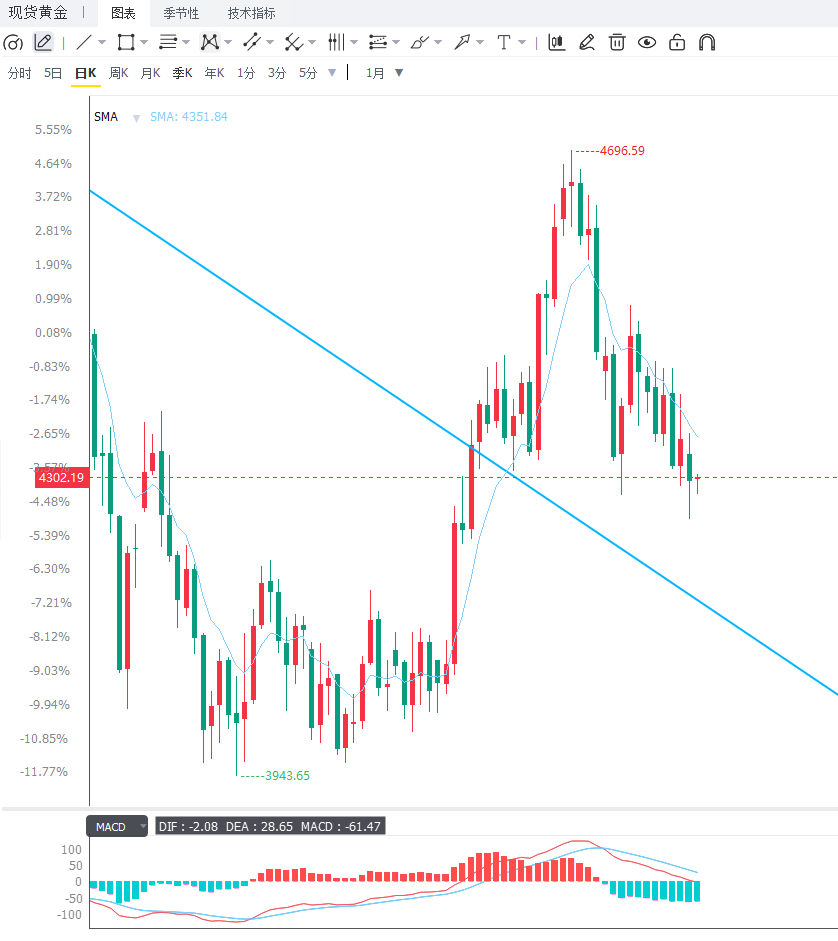 Editor's Summary: The core pressure currently facing spot gold stems from the US interest rate environment, rather than a fundamental change in gold's long-term fundamentals. The 10-year US Treasury yield breaking through 5%, coupled with inflation concerns stemming from rising energy prices, has increased market expectations that the Federal Reserve will maintain its tightening policy, causing gold to fall back to around $4295. In the short term, the Fed's decision and press conference will determine whether gold can stop its decline. If yields continue to rise and are accompanied by a stronger dollar, the area around $4230 will become a key support level; if the Fed releases relatively dovish policy signals, pushing yields and the dollar down, gold prices may rebound to $4330 or even $4455. Gold is currently at the intersection of a medium-term upward trend and short-term interest rate pressures. The key to future market movements lies not only in whether policy is adjusted, but also in the market's repricing of future interest rate paths.
The yield on the 10-year US Treasury note briefly broke through 5% on Monday, reaching this level for the first time since 2023. The rapid rise in long-term yields reflects both the market's repricing of inflation risks and increased financing needs from the US government and businesses. For gold, which does not generate interest income, the continued rise in US Treasury yields means an increased opportunity cost of holding gold, thus funds are more inclined to reallocate to higher-yielding dollar assets, thereby limiting the upside potential for gold prices. Rising energy prices further amplify this logic. With increased supply risks in the oil market, oil prices have returned to high levels, raising market concerns that energy costs may be transmitted to overall inflation through transportation, production, and consumption channels. If high oil prices persist, the inflation risks that the Federal Reserve needs to consider when formulating policy will also increase. This weakens the logic that gold previously benefited from expectations of easing policies, especially with the simultaneous rise in US Treasury yields, making the short-term pressure on precious metals more pronounced. Changes in interest rate expectations are also worth noting. According to CME FedWatch data, the market currently expects the probability of a 25 basis point rate hike by the Federal Reserve at its September policy meeting to have risen to approximately 92.4%. A significant shift in market pricing indicates that traders have substantially increased their expectations for the Federal Reserve to maintain a tight policy stance. It's important to note that interest rate expectations are already largely priced into asset prices; therefore, the next move in gold prices may not necessarily depend on whether the Fed adjusts interest rates. More importantly, it will depend on whether the policy statement and officials' speeches release signals that are more hawkish or dovish than the market expects. The Fed Chair's press conference will be another key risk factor from this meeting. If the policy statement continues to emphasize inflation risks and suggests that high interest rates need to be maintained for a longer period, US Treasury yields and the dollar may receive further support, and gold may retest recent lows. Conversely, if the policy statement is more cautious about economic growth risks or signals a future shift towards easing, the upward trend in yields may temporarily ease, providing room for a gold rebound. Recent price performance suggests that the gold market has not completely lost medium-term support. ANZ analysts believe that the recent rebound in gold prices coincided with a decline in the US 10-year Treasury yield from its near 5% high, while oil prices also fell from their previous peaks. These two changes reduced some of the inflationary pressures that had previously weighed on gold. The institution therefore maintains a constructive view on gold in the medium term, but believes the upcoming Federal Reserve meeting will be a key test of whether the gold price rebound can continue. This means that gold is currently in a relatively typical macroeconomic policy window. On the one hand, geopolitical risks, fiscal deficits, and safe-haven demand can still provide medium- to long-term support for gold; on the other hand, if US long-term yields continue to remain high, or even break through further upwards, the valuation pressure on gold may increase. Especially with rising oil prices pushing up inflation expectations again, the support that gold previously relied on from interest rate cut expectations is weakening. The changes in the US dollar index also need to be monitored. The US dollar and gold usually have a strong inverse relationship in stages. If the Federal Reserve maintains a hawkish stance and pushes US Treasury yields higher, the US dollar may be supported, further suppressing gold priced in US dollars. Conversely, if the meeting results are lower than the market's hawkish expectations, the US dollar and yields will fall in tandem, and gold may experience a strong technical rebound. Therefore, what the gold market really needs to digest right now is not a single interest rate decision, but the linkage between the Federal Reserve's policy path, long-term US Treasury yields, energy prices, and the US dollar. If oil prices remain high, inflation expectations may struggle to cool quickly; if the 10-year US Treasury yield stabilizes around 5%, valuation pressure on gold will persist. Conversely, if oil prices fall and lead to a corresponding decline in yields, the macroeconomic pressure previously faced by gold may ease temporarily. From a funding perspective, the recent decline in gold also means that long positions need to find new fundamental support. If the Fed meeting does not provide new easing catalysts, some short-term funds may continue to reduce their gold exposure, causing prices to move closer to technical support levels. However, if gold prices find buying support near key support levels, and yields show a significant decline, the current correction may evolve into a normal adjustment within a medium-term uptrend. From a daily chart perspective, spot gold has recently encountered resistance after a surge and has continued to fall. The price has now broken below the 100-day simple moving average and the 20-day Bollinger Band middle line, indicating a significant weakening of short- to medium-term upward momentum. The 14-day RSI is currently around 44, having fallen from a previously strong area to near neutral, but has not yet entered a severely oversold zone; therefore, technical indicators have not yet formed a clear bottom signal. The daily chart trend is currently closer to a high-level consolidation structure. If gold prices fail to recover the 100-day moving average around $4330, the bears still have room to test lower support levels. The first resistance level to watch is around $4330, which corresponds to the 100-day moving average and is a key resistance level for determining whether the short-term trend can be repaired. If gold prices regain a foothold at this level, the next target will be the 20-day Bollinger Band middle line around $4455; a further break above this level would present stronger resistance at the upper Bollinger Band around $4685. On the downside, the key support level to watch is the lower Bollinger Band around $4230. If gold prices break below $4230, it means the consolidation structure has expanded further, and prices may seek new support in lower areas; if this area holds, the market may continue to fluctuate within a range. From the 4-hour chart, gold is still in a short-term downtrend, with rebound highs constantly being suppressed. The area around $4295 has become a crucial short-term observation zone. If the price finds support in this area and breaks through $4330 again, a short-term recovery is possible. However, if the rebound consistently fails to hold below $4330 and falls below $4290 again, downward pressure may re-emerge, further testing the $4250-$4230 area. Current momentum indicators are weak, but not yet extremely oversold, so gold may still have room to fall further before the Fed's decision. The key to determining the next direction will be whether yields can continue to decline from around 5% and whether the Fed's policy statement is less hawkish than the market's current expectations. Editor's Summary: The core pressure currently facing spot gold stems from the US interest rate environment, rather than a fundamental change in gold's long-term fundamentals. The 10-year US Treasury yield breaking through 5%, coupled with inflation concerns stemming from rising energy prices, has increased market expectations that the Federal Reserve will maintain its tightening policy, causing gold to fall back to around $4295. In the short term, the Fed's decision and press conference will determine whether gold can stop its decline. If yields continue to rise and are accompanied by a stronger dollar, the area around $4230 will become a key support level; if the Fed releases relatively dovish policy signals, pushing yields and the dollar down, gold prices may rebound to $4330 or even $4455. Gold is currently at the intersection of a medium-term upward trend and short-term interest rate pressures. The key to future market movements lies not only in whether policy is adjusted, but also in the market's repricing of future interest rate paths.
- Risk Warning and Disclaimer
- The market involves risk, and trading may not be suitable for all investors. This article is for reference only and does not constitute personal investment advice, nor does it take into account certain users’ specific investment objectives, financial situation, or other needs. Any investment decisions made based on this information are at your own risk.