US inflation reinforces expectations of interest rate hikes, causing the USD/JPY pair to rebound after a sharp decline, but the risk of a Bank of Japan rate hike limits upside potential.
2026-09-15 09:52:08
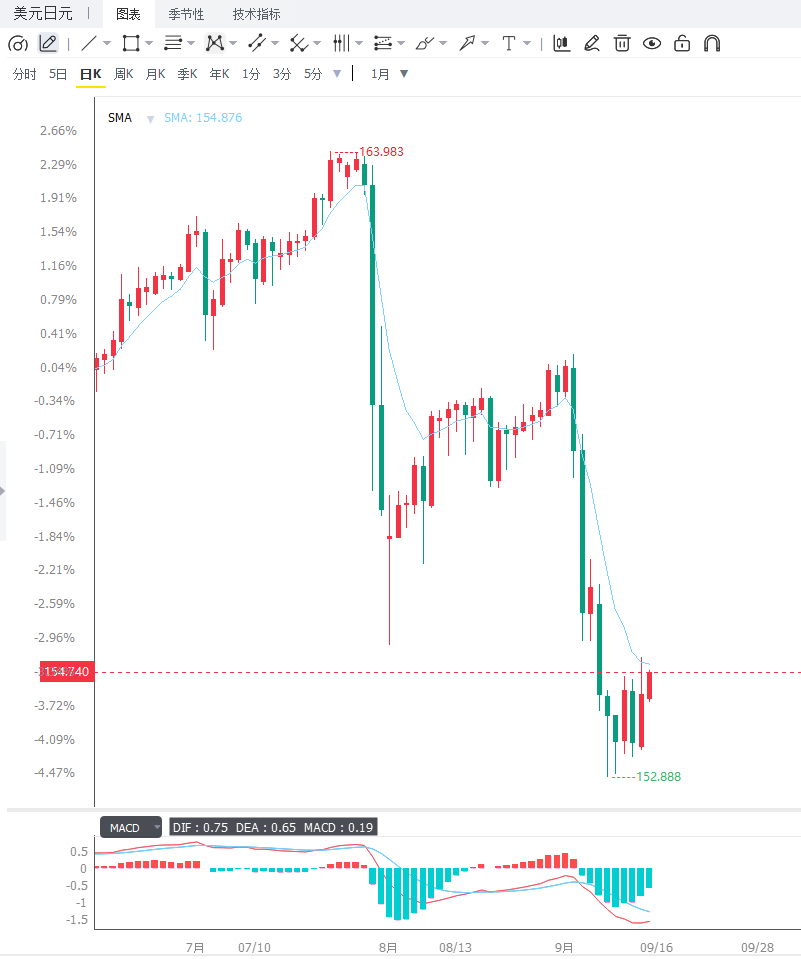
The dollar rose to around 154.70 against the yen in early Asian trading on Tuesday, as the dollar regained some support driven by rising expectations of a Federal Reserve policy shift. Market assessments of the US interest rate path have changed significantly recently. The continued rise in the August consumer price index, coupled with core inflation recording its most significant increase in months, has prompted traders to reassess the Fed's future policy stance. With the Fed's interest rate decision approaching, expectations of an interest rate differential between the dollar and the yen have once again become a major factor driving exchange rate volatility.  The latest US inflation data has become a significant catalyst for the current dollar rebound. Data shows that the US CPI continued to rise in August, and core inflation also strengthened, leading the market to increase expectations that the Federal Reserve will maintain a tight policy stance. According to CME FedWatch data, the market's pricing probability of a 25 basis point rate hike at the September policy meeting rose to approximately 92.4%, a significant increase from about 60% a week earlier. This rapid shift in interest rate expectations has supported the dollar and also caused the USD/JPY pair to rebound from recent lows. However, the dollar's current advantage is not a one-way street, as the Bank of Japan (BOJ) is also entering a crucial policy window. The BOJ is expected to announce its September interest rate decision this Friday, with the market widely focused on whether it will further raise policy rates and whether BOJ President Kazuo Ueda will provide clearer signals regarding the pace of future rate hikes. Since the market has already largely priced in a 25 basis point rate hike, the key factor truly affecting the yen's performance may not be "whether or not there will be a rate hike," but rather the BOJ's statement on its future policy path. If Ueda hints that the BOJ will continue to maintain a relatively rapid pace of policy normalization, the yen may receive further support, and the upside potential for the USD/JPY pair will be limited. Conversely, if the Bank of Japan remains cautious about its subsequent actions after raising interest rates, or emphasizes that economic growth still faces significant uncertainty, then some of the previously accumulated long yen positions may be liquidated, thus driving a further rebound in USD/JPY. From a funding perspective, the market positioning of the yen has also changed. DBS Bank points out that speculative funds have significantly reduced their previous short yen positions, driven by factors including previous expectations of joint intervention by Japan and the US, and rising market expectations of further tightening of monetary policy by the Bank of Japan. This means that the yen's long-term suppression by the ultra-low interest rate environment is changing, and the attractiveness of carry trades has decreased compared to the past. Another important variable for USD/JPY is the US Treasury yield. If the Federal Reserve maintains a hawkish stance due to inflationary pressures, and US long-term yields continue to rise, the dollar may receive further support, pushing USD/JPY to higher levels. However, if the Federal Reserve releases a more dovish policy signal, and US yields fall, the narrowing of the Japan-US interest rate differential will again become an important catalyst for yen bulls. Therefore, USD/JPY is currently caught in a tug-of-war between two policy forces. On the one hand, renewed US inflation has reinforced expectations of high interest rates, providing temporary support for the US dollar; on the other hand, expectations for the Bank of Japan's policy normalization are strengthening, and the fundamental environment for the yen has improved significantly compared to before. In the coming trading days, the Fed's decision, the Bank of Japan's decision, and the statements from both central banks regarding future interest rate paths will be the core variables determining the direction of the exchange rate. The market also needs to pay attention to the risk appetite of USD/JPY. If global financial market risk sentiment deteriorates, the safe-haven demand for the yen may further increase, and even if the Fed maintains a hawkish stance, it may limit the rise of USD/JPY. Conversely, if US economic data continues to be resilient, US yields remain high, and the Bank of Japan is cautious about further interest rate hikes, carry trades may reignite, and USD/JPY will gain stronger rebound momentum. From a daily chart perspective, although USD/JPY has rebounded from recent lows, it is still limited by the overall medium-term downward structure. The exchange rate is currently significantly below the 20-day Bollinger Band middle line and the 100-day moving average, indicating that the short-term rebound has not yet changed the overall weak pattern. The 14-day RSI has rebounded from oversold territory to around 36, indicating a slight easing of downward momentum. However, the indicator has not yet re-entered the overbought zone, so the current market movement is more likely to be interpreted as a technical correction within a downtrend. The first resistance level to watch is the 20-day Bollinger Band middle line around 157.15, a key resistance level for determining whether this rebound can extend further. A decisive break above 157.15 would target the 100-day moving average around 159.60; a further break above this level would present stronger resistance at the upper Bollinger Band around 162.05. As long as the exchange rate remains under pressure below 157.15, the overall bearish structure on the daily chart remains largely unchanged. On the downside, watch for recent support around 153.55 and the lower Bollinger Band around 152.25. If USD/JPY falls below 153.55 again, it indicates a significant lack of momentum in this rebound, and the exchange rate may seek support again around 152.25. A decisive break below 152.25 would signify a further strengthening of the yen's appreciation trend, potentially leading to a deeper correction in the exchange rate. Looking at the 4-hour chart, USD/JPY is currently showing a short-term rebound, but the 154.50-155.00 area remains a battleground between bulls and bears. If the price can stabilize above 155.00 and further break through 157.15, the short-term rebound structure is likely to continue; however, if it continues to encounter resistance near 155 and breaks below 153.55 again, the previous downtrend may regain dominance. The current RSI correction indicates some easing of bearish pressure, but this is insufficient to confirm a trend reversal. Therefore, short-term trading should focus on observing the Fed's policy signals and changes in the Bank of Japan's expectations.
  Editor's Summary: The recent rebound in USD/JPY has been primarily driven by US inflation data reinforcing expectations of tighter interest rates, but the Bank of Japan's policy normalization is also providing significant support for the yen. With both the Federal Reserve and the Bank of Japan entering their policy windows, relying solely on the USD/JPY interest rate differential to predict exchange rate direction has become significantly more difficult. In the short term, 157.15 is a crucial technical level for USD/JPY to reverse its weak trend, while 153.55 and 152.25 are key support levels. If US yields continue to rise and the Fed releases hawkish signals, the exchange rate could see further upside potential; conversely, if the Bank of Japan signals accelerated rate hikes while US yields decline, the yen may strengthen again. The main risk in the current market lies in the repricing of policy expectations from the two major central banks, which could lead to continued high volatility in the exchange rate.
The latest US inflation data has become a significant catalyst for the current dollar rebound. Data shows that the US CPI continued to rise in August, and core inflation also strengthened, leading the market to increase expectations that the Federal Reserve will maintain a tight policy stance. According to CME FedWatch data, the market's pricing probability of a 25 basis point rate hike at the September policy meeting rose to approximately 92.4%, a significant increase from about 60% a week earlier. This rapid shift in interest rate expectations has supported the dollar and also caused the USD/JPY pair to rebound from recent lows. However, the dollar's current advantage is not a one-way street, as the Bank of Japan (BOJ) is also entering a crucial policy window. The BOJ is expected to announce its September interest rate decision this Friday, with the market widely focused on whether it will further raise policy rates and whether BOJ President Kazuo Ueda will provide clearer signals regarding the pace of future rate hikes. Since the market has already largely priced in a 25 basis point rate hike, the key factor truly affecting the yen's performance may not be "whether or not there will be a rate hike," but rather the BOJ's statement on its future policy path. If Ueda hints that the BOJ will continue to maintain a relatively rapid pace of policy normalization, the yen may receive further support, and the upside potential for the USD/JPY pair will be limited. Conversely, if the Bank of Japan remains cautious about its subsequent actions after raising interest rates, or emphasizes that economic growth still faces significant uncertainty, then some of the previously accumulated long yen positions may be liquidated, thus driving a further rebound in USD/JPY. From a funding perspective, the market positioning of the yen has also changed. DBS Bank points out that speculative funds have significantly reduced their previous short yen positions, driven by factors including previous expectations of joint intervention by Japan and the US, and rising market expectations of further tightening of monetary policy by the Bank of Japan. This means that the yen's long-term suppression by the ultra-low interest rate environment is changing, and the attractiveness of carry trades has decreased compared to the past. Another important variable for USD/JPY is the US Treasury yield. If the Federal Reserve maintains a hawkish stance due to inflationary pressures, and US long-term yields continue to rise, the dollar may receive further support, pushing USD/JPY to higher levels. However, if the Federal Reserve releases a more dovish policy signal, and US yields fall, the narrowing of the Japan-US interest rate differential will again become an important catalyst for yen bulls. Therefore, USD/JPY is currently caught in a tug-of-war between two policy forces. On the one hand, renewed US inflation has reinforced expectations of high interest rates, providing temporary support for the US dollar; on the other hand, expectations for the Bank of Japan's policy normalization are strengthening, and the fundamental environment for the yen has improved significantly compared to before. In the coming trading days, the Fed's decision, the Bank of Japan's decision, and the statements from both central banks regarding future interest rate paths will be the core variables determining the direction of the exchange rate. The market also needs to pay attention to the risk appetite of USD/JPY. If global financial market risk sentiment deteriorates, the safe-haven demand for the yen may further increase, and even if the Fed maintains a hawkish stance, it may limit the rise of USD/JPY. Conversely, if US economic data continues to be resilient, US yields remain high, and the Bank of Japan is cautious about further interest rate hikes, carry trades may reignite, and USD/JPY will gain stronger rebound momentum. From a daily chart perspective, although USD/JPY has rebounded from recent lows, it is still limited by the overall medium-term downward structure. The exchange rate is currently significantly below the 20-day Bollinger Band middle line and the 100-day moving average, indicating that the short-term rebound has not yet changed the overall weak pattern. The 14-day RSI has rebounded from oversold territory to around 36, indicating a slight easing of downward momentum. However, the indicator has not yet re-entered the overbought zone, so the current market movement is more likely to be interpreted as a technical correction within a downtrend. The first resistance level to watch is the 20-day Bollinger Band middle line around 157.15, a key resistance level for determining whether this rebound can extend further. A decisive break above 157.15 would target the 100-day moving average around 159.60; a further break above this level would present stronger resistance at the upper Bollinger Band around 162.05. As long as the exchange rate remains under pressure below 157.15, the overall bearish structure on the daily chart remains largely unchanged. On the downside, watch for recent support around 153.55 and the lower Bollinger Band around 152.25. If USD/JPY falls below 153.55 again, it indicates a significant lack of momentum in this rebound, and the exchange rate may seek support again around 152.25. A decisive break below 152.25 would signify a further strengthening of the yen's appreciation trend, potentially leading to a deeper correction in the exchange rate. Looking at the 4-hour chart, USD/JPY is currently showing a short-term rebound, but the 154.50-155.00 area remains a battleground between bulls and bears. If the price can stabilize above 155.00 and further break through 157.15, the short-term rebound structure is likely to continue; however, if it continues to encounter resistance near 155 and breaks below 153.55 again, the previous downtrend may regain dominance. The current RSI correction indicates some easing of bearish pressure, but this is insufficient to confirm a trend reversal. Therefore, short-term trading should focus on observing the Fed's policy signals and changes in the Bank of Japan's expectations. Editor's Summary: The recent rebound in USD/JPY has been primarily driven by US inflation data reinforcing expectations of tighter interest rates, but the Bank of Japan's policy normalization is also providing significant support for the yen. With both the Federal Reserve and the Bank of Japan entering their policy windows, relying solely on the USD/JPY interest rate differential to predict exchange rate direction has become significantly more difficult. In the short term, 157.15 is a crucial technical level for USD/JPY to reverse its weak trend, while 153.55 and 152.25 are key support levels. If US yields continue to rise and the Fed releases hawkish signals, the exchange rate could see further upside potential; conversely, if the Bank of Japan signals accelerated rate hikes while US yields decline, the yen may strengthen again. The main risk in the current market lies in the repricing of policy expectations from the two major central banks, which could lead to continued high volatility in the exchange rate.
- Risk Warning and Disclaimer
- The market involves risk, and trading may not be suitable for all investors. This article is for reference only and does not constitute personal investment advice, nor does it take into account certain users’ specific investment objectives, financial situation, or other needs. Any investment decisions made based on this information are at your own risk.