Even opponents of the Bank of Japan's tightening policy have switched sides. How much room is left for yen short sellers?
2026-09-15 14:10:11
The US dollar rose for the second consecutive day against the Japanese yen in Asian trading on Tuesday (September 15), currently trading around 154.70, due to a general strengthening of the US dollar. The Federal Reserve and the Bank of Japan announced their policy decisions on Wednesday and Friday respectively, with market expectations for an imminent interest rate hike remaining strong. Focus will now shift to the forward guidance from both central banks, which will play a key role in determining the next directional move of the USD/JPY pair. 
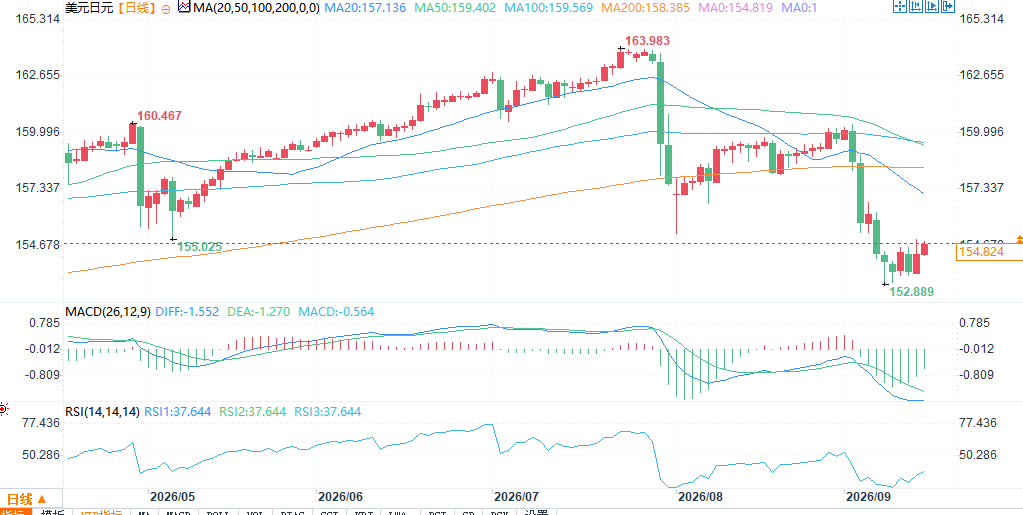 (USD/JPY daily chart, source: EasyForex) At 14:09 Beijing time, USD/JPY was trading at 154.80/81.
Rising expectations of tightening by the Bank of Japan are providing support for the yen.
Analysts at well-known institutions point out that speculative positions have clearly shifted in favor of the yen. "Speculators have closed their short yen positions after the joint US-Japan intervention in July and the market's changing expectations for further tightening by the Bank of Japan." The bank stated that the policy debate has also shifted. "Even those who were previously skeptical of the Bank of Japan's tightening—including economic advisors in Kaohsiung and former public opponents of the Bank of Japan's tightening—now acknowledge the rationale for higher interest rates, reinforcing expectations of a hawkish rate hike on September 18." A more hawkish repricing of the Bank of Japan's policy normalization path may continue to support the yen and act as a headwind for the currency pair. However, bullish sentiment towards the US dollar, supported by high US Treasury yields and continued geopolitical uncertainty, may continue to provide some support for USD/JPY, limiting downside potential. Current market expectations for the Bank of Japan's policy path have changed significantly. The previously long-standing "short yen crowding" phenomenon quickly eased after the joint intervention, with speculative funds shifting from bearish to neutral or even bullish. At the policy level, the shift in internal debate is particularly crucial—voices that previously insisted on low interest rates are now acknowledging the necessity of a rate hike, significantly increasing the probability of a hawkish outcome at the September 18th meeting. If the central bank raises rates as expected and signals further tightening, the yen will receive sustained support, putting downward pressure on the USD/JPY exchange rate. However, persistently high US Treasury yields and geopolitical risks in the Middle East continue to provide safe-haven buying for the dollar, potentially limiting the yen's appreciation in the short term. Overall, the yen's support logic has shifted from simple intervention to policy expectation-driven, and its future performance will heavily depend on the Bank of Japan's communication and changes in the USD/JPY interest rate differential.US Treasury yields broke through 5%, and the safe-haven dollar approached a two-week high.
Amid rising expectations of a Federal Reserve rate hike, inflation concerns stemming from rising energy prices have pushed the benchmark 10-year Treasury yield above 5% for the first time since 2023. Furthermore, the risk of further escalation of tensions between the US and Iran and in the Middle East has brought the safe-haven dollar near its two-week high reached on Monday. The 10-year Treasury yield breaking 5% signifies a market reassessment of the long-term interest rate environment. The continued rise in energy costs has directly increased inflation expectations, coupled with strong core CPI data in August, reinforcing the pricing of a Fed rate hike this week and the maintenance of high interest rates. Rising yields not only increase the opportunity cost of holding other assets but also attract funds back to the US Treasury market, further supporting the dollar. Meanwhile, the risk of escalating conflict in the Middle East has exacerbated global risk aversion, with the dollar, as a traditional safe-haven currency, benefiting significantly and approaching its two-week high. This dual driver of "yield + safe-haven" has made the dollar strong among major currency pairs. In the short term, if the Fed meeting releases a more hawkish signal or geopolitical tensions continue, yields and the dollar may strengthen further; conversely, signs of easing tensions could trigger some profit-taking. Investors should closely monitor the impact of this week's Federal Reserve decision and developments in the Middle East on this combination.Summarize
The Federal Reserve and the Bank of Japan announced their decisions on Wednesday and Friday, respectively. Market expectations for an imminent rate hike remained strong, shifting focus to the two central banks' forward guidance. Leading institutions noted a clear shift in speculative positioning towards the yen, and a change in the Bank of Japan's policy debate, with even those previously skeptical of tightening acknowledging the rationale for higher rates, reinforcing expectations of a hawkish rate hike on September 18th. The 10-year US Treasury yield broke 5% for the first time since 2023, and the US-Iran standoff pushed the safe-haven dollar near a two-week high, providing support for the USD/JPY pair. A more hawkish repricing by the Bank of Japan may limit the yen's decline, but bullish sentiment towards the dollar is likely to continue to limit the downside for the currency pair. (USD/JPY daily chart, source: EasyForex) At 14:09 Beijing time, USD/JPY was trading at 154.80/81.
- Risk Warning and Disclaimer
- The market involves risk, and trading may not be suitable for all investors. This article is for reference only and does not constitute personal investment advice, nor does it take into account certain users’ specific investment objectives, financial situation, or other needs. Any investment decisions made based on this information are at your own risk.