Houthi attacks on Saudi Arabia, US financial sanctions take effect, efforts to release positive news for peace talks and control oil prices.
2026-09-15 16:14:10
On Tuesday (September 15), during the Asian and European sessions, international oil prices rebounded slightly. Although oil prices experienced continuous adjustments in the previous two trading days, they are still near short-term highs. Brent crude oil was trading around 107.36, up 1.14%, while WTI crude oil was trading at 103.08, up 1.67%. Overall, the situation reflects ongoing conflicts between Russia and Ukraine, various locations in the Gulf region, and an uncertain future for US-Iran negotiations. However, the US is actively trying to maintain oil prices. The following is a summary of the marginal changes in oil prices compared to yesterday. 
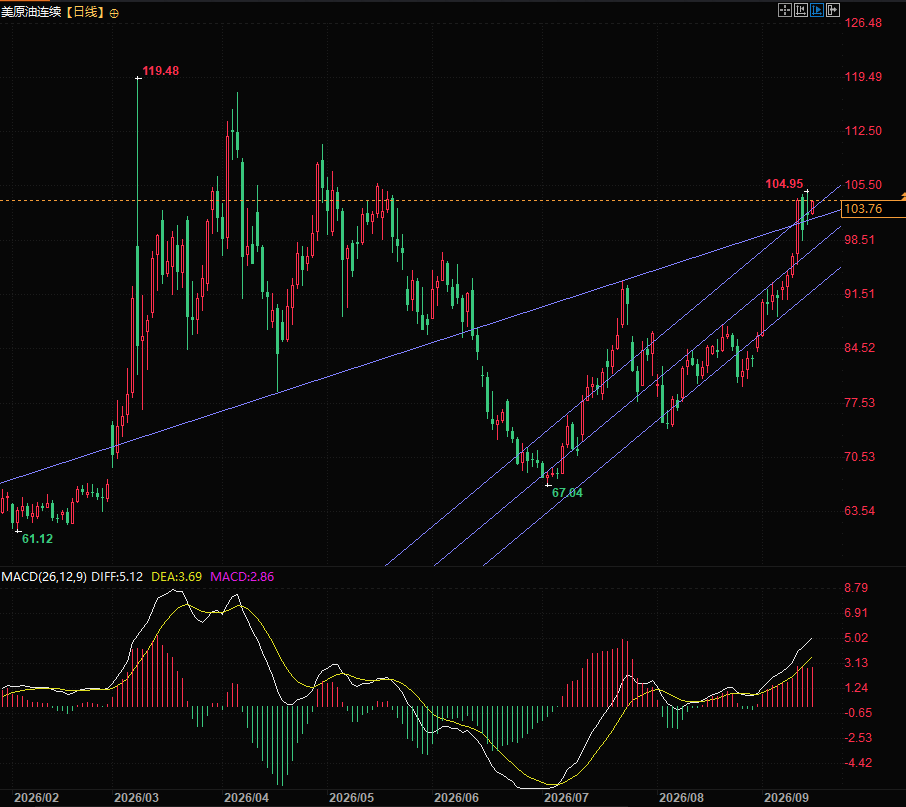 (WTI crude oil futures daily chart, source: EasyTrade) At 16:11 Beijing time, WTI crude oil futures were trading at $103.63 per barrel.
Houthi attacks on Saudi Arabia and delayed Gulf talks fuel supply concerns.
The Houthi rebels launched another long-range attack on Saudi Arabia, firing numerous missiles and drones at the Khamis Mushait airbase in southern Saudi Arabia, targeting hangars, radar, runways, and ammunition depots in retaliation for Saudi airstrikes in Yemen. Following the attack, Saudi Arabia issued emergency alerts in four southern cities; talks between Gulf Arab states and Iran, scheduled to discuss shipping arrangements in the Strait of Hormuz, were postponed, and market concerns about energy supply disruptions rapidly escalated.Minor repairs have been made to the passage of ships through the strait.
Maritime data shows a slight recovery in vessel traffic through the Strait, but the actual volume of crude oil shipments remains significantly lower than pre-war levels. Only four cargo ships were publicly tracked in the past 24 hours, while a large number of vessels, totaling 436, are anchored around the Strait. Many ship owners have opted to disable their Automatic Identification Systems (AIS) to mitigate risk, so the actual volume of traffic is likely slightly higher than the statistics suggest. Many vessels are anchored around the Strait, with some disabling their AIS transponders to avoid risk. Continued mine and missile attacks are driving up war insurance costs, leading shipping companies to generally postpone voyages or choose alternative routes. The previous attack on Saudi Arabia's east-west oil pipeline bypassing the Strait further amplifies its reliance on crude oil transport through the Strait. Brent crude oil has stabilized above $107 per barrel, approaching a near two-month high.The US-Iran standoff continues, with conflicting signals from the negotiations.
The standoff between the US and Iran continues. The US has consistently signaled its willingness to negotiate, with Trump repeatedly stating that Iran hopes for an agreement and that oil prices would fall rapidly once the conflict ends. However, Iranian state media immediately refuted these claims, explicitly stating that Tehran has no intention of negotiating. This contradictory stance reflects internal divisions within Iran, with pro-war and pro-peace factions struggling to reach a consensus. There is no clear path for negotiations between the US and Iran, limiting the scope for diplomatic intervention.The US escalates financial sanctions and offers rewards for whistleblowers to address intelligence gaps.
Beyond diplomatic and military means, the U.S. Treasury Department continues its "economic exile operation," intensifying its financial strangulation of Iran. On September 14, the U.S. formally sanctioned Russia's VTB Bank, accusing it of assisting Iran in establishing financial channels circumventing Western sanctions and establishing agency clearing relationships with sanctioned Iranian banks. In addition, the U.S. had previously imposed 36 sanctions targeting Iran's aviation industry chain, covering intermediary institutions in multiple countries. However, this secondary sanctions system is insufficient to completely sever Iran's cross-border capital flows. Large amounts of funds flow covertly through multiple shell companies, third-party intermediaries, and informal payment networks, making it extremely difficult to penetrate sanctions. Against this backdrop, Treasury Secretary Bessenter offered a global reward, calling on global financial professionals and insiders to report companies, banks, and individuals assisting Iran in transferring funds. Cash rewards were offered for valid leads, attempting to fill the intelligence gaps in sanctions through internal whistleblowing. However, the reward is a passive, patchy approach, with limited actual progress in dismantling Iran's existing cross-border financial networks.Hoping for a ceasefire in the Russia-Ukraine energy conflict to stabilize oil prices, but its practical implementation faces numerous obstacles.
To suppress rising diesel and crude oil prices, the US is simultaneously attempting to find a breakthrough in the Russia-Ukraine conflict. Trump announced that Russia and Ukraine had reached an agreement not to attack each other's energy facilities, aiming to alleviate global diesel supply pressure. However, the day after the announcement, Kyiv was attacked by drones, damaging gas stations and warehouses. Russia has continued to expand its energy target range, having targeted approximately 300 gas stations in Ukraine in recent months. While Zelenskyy has stated his willingness to consider a ceasefire on energy facilities, this is contingent on the US guaranteeing Russia's fulfillment of its commitments. The implementation of this energy ceasefire agreement is highly uncertain, and the idea of stabilizing oil prices through a Russia-Ukraine energy truce is unlikely to materialize in the short term.Market Summary: Limited US Influence, High Price Volatility Continues in Oil Prices
In summary, the four aforementioned clues all point to the same core conclusion: the United States currently has limited actual influence over the Middle East situation, but its policy focus is highly concentrated on curbing rising oil prices. Whether it's pushing for US-Iran negotiations, expanding cross-border financial sanctions, pushing for a ceasefire in the Russia-Ukraine energy conflict, or attempting to stabilize shipping in the Strait of Hormuz, all these efforts serve the goal of controlling rising energy prices. In the short term, the uncertainty of geopolitical conflicts remains, and oil prices still have the potential for impulsive surges; however, the US will continue to use various diplomatic and financial tools to hedge against risks, continuously putting resistance to further price increases. The oil market will maintain a highly volatile and multi-faceted pattern, requiring continuous monitoring of real-time changes in the Strait of Hormuz's navigation, US-Iran diplomatic signals, and the Russia-Ukraine energy infrastructure conflict. Technical Analysis: Recently, a technical analysis pattern has emerged around the X-line and an ascending channel; oil prices are expected to continue rising as long as this pattern holds. (WTI crude oil futures daily chart, source: EasyTrade) At 16:11 Beijing time, WTI crude oil futures were trading at $103.63 per barrel.
- Risk Warning and Disclaimer
- The market involves risk, and trading may not be suitable for all investors. This article is for reference only and does not constitute personal investment advice, nor does it take into account certain users’ specific investment objectives, financial situation, or other needs. Any investment decisions made based on this information are at your own risk.