India's August inflation rate was higher than expected. How much support will the expected domestic interest rate hike provide for the rupee?
2026-09-15 15:36:09
On Tuesday (September 15) during the European session, the US dollar rose slightly against the Indian rupee, currently trading around 95.90. The rupee's continued weakness was expected by the market – the 10-year US Treasury yield has hit a multi-year high of 5%, and oil prices continue to rise. 
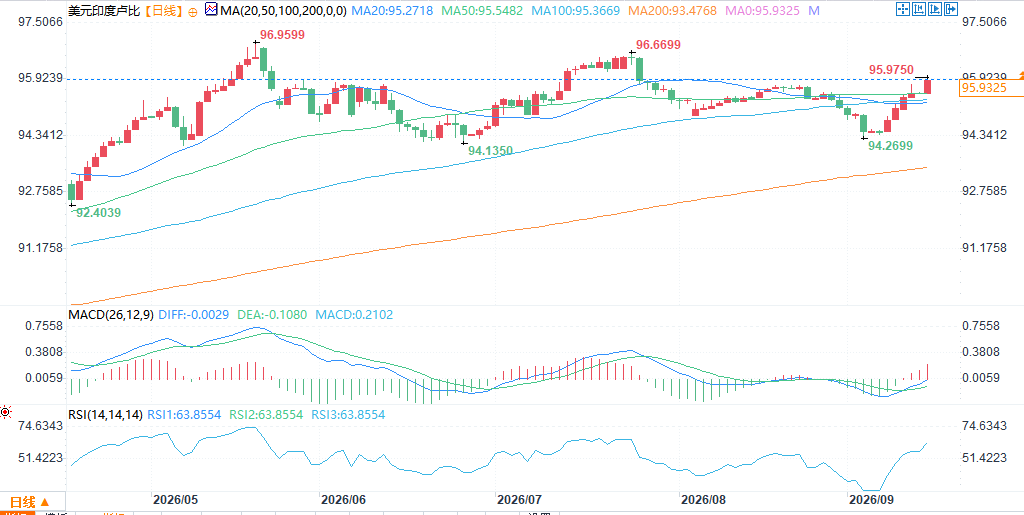 (USD/INR daily chart, source: FX678) At 15:23 Beijing time, the USD/INR exchange rate was 95.92/93.
US Treasury yields hit 5%, reinforcing expectations of a hawkish Federal Reserve.
U.S. Treasury yields have extended their gains to just above 5%, their highest level since October 2023, as market expectations for a rate hike in Wednesday's policy statement remain strong. This hawkish Fed expectation stems from stronger-than-expected U.S. August PPI and CPI reports. While a rate hike is almost certain, investors will be focusing more on the monetary policy statement and Chairman Warsh's press conference for new clues about the interest rate outlook. The 10-year Treasury yield breaking through 5% signifies a major repricing of the long-term interest rate environment. The better-than-expected August PPI and CPI figures directly fueled concerns about inflation stickiness, bringing the probability of a 25-basis-point rate hike this week close to certainty. The rising yields reflect not only short-term policy expectations but also long-term concerns about fiscal deficits and debt sustainability. Investors have now shifted their focus from "whether there will be a rate hike" to "the path after the hike." The wording of the statement and Warsh's remarks at the press conference will be key to determining whether further tightening will occur. A signal of "higher and longer" yields could climb further; an emphasis on data dependence or a one-off adjustment could trigger some profit-taking. Overall, hawkish expectations are being transmitted to global asset prices through the yield channel.Institutional View: The Fed's September rate hike may be a "one-time" move.
Economists from a prominent institution explained that they "adjusted their view to a 25 basis point rate hike by the Federal Reserve in September after Chairman Warsh's Jackson Hole speech," adding that "subsequent data has proven this decision correct." While acknowledging that "the usual assumption is that if the Fed raises rates, it won't just do it once," and that "financial markets are currently pricing in two and a half more rate hikes after the almost certain September 16th hike," the team believes "this time we think it might be a one-time hike," with their employment and inflation forecasts indicating "no need for a series of rate hikes." The institution's core logic lies in distinguishing between "necessary adjustments" and a "continued tightening cycle." Warsh's Jackson Hole speech had already signaled concern about inflation continuing to exceed the target, and subsequent better-than-expected price data further validated the necessity of a rate hike. However, the team's employment and inflation models show that a single 25 basis point adjustment is sufficient to push the policy rate to a restraining level, and if subsequent data declines, there is no need for consecutive rate hikes. This contrasts sharply with the market's current pricing of "two and a half more hikes." If the final outcome is close to a "one-time hike," financial markets may experience a significant repricing, leading to a decline in yields and a rebound in risk assets. Conversely, if the statement hints at further room for action, hawkish pricing will be further reinforced. Investors should closely monitor the statement's ambiguous or explicit statements regarding the future path.Oil prices remain high, and concerns about energy supply persist.
Currencies of economies heavily reliant on oil imports for energy needs, such as the Indian rupee, tend to underperform in high oil price environments. Analysts from prominent institutions emphasize that the latest oil price movement "followed the preventative closure of a major Saudi pipeline on Friday evening due to recent attacks, and the postponement of today's meeting between Iran and other Gulf states to discuss establishing a temporary shipping lane in the Strait of Hormuz." Analysts point out that these developments have reinforced market concerns about regional supply security and key shipping routes. High oil prices are impacting global markets through multiple channels. The preventative closure of the Saudi pipeline and the postponement of negotiations on the temporary Hormuz passage directly exacerbated expectations of supply disruptions, pushing crude oil prices close to multi-month highs. For highly import-dependent economies like India, rising energy costs not only push up domestic inflation but also put pressure on foreign exchange reserves and the current account, thus suppressing the performance of their currencies. Analysts point out that current price movements have fully reflected geopolitical risk premiums; if the attacks escalate further or diplomatic efforts continue to falter, oil prices could break through to even higher levels. Conversely, any signs of easing tensions could trigger profit-taking. In the short term, energy supply security will become the core variable driving oil prices and related currency trends, and the market will be highly sensitive to developments in the Middle East.India's retail CPI slightly exceeded expectations, fueling expectations of an interest rate hike.
On Monday, India's Ministry of Statistics and Planning reported that the retail CPI rose 4.82% year-on-year in August, higher than the expected 4.8% and the previous value of 4.45%. However, this figure remains within the Reserve Bank of India's (RBI) tolerance range of 2%-6%. The faster-than-expected inflationary pressures at the retail level may increase expectations of a near-term RBI interest rate hike. While the 4.82% retail CPI is still within the RBI's tolerance range, the unexpected rebound has prompted a reassessment of the policy path in the market. Previously, a decline in inflation had supported the central bank maintaining an accommodative or neutral stance, but this rebound suggests that the transmission effect of energy and food prices may be stronger than expected. If subsequent data continues to be strong, the RBI may be forced to consider raising interest rates earlier to prevent inflation expectations from derailing. For the rupee, rising domestic interest rate hike expectations may provide some support, but the import cost pressure from high oil prices still poses a headwind. Overall, marginal changes in inflation data are becoming an important driver of short-term monetary policy expectations. Investors need to pay attention to subsequent core inflation and industrial output data to determine whether the central bank will adjust its policy stance. (USD/INR daily chart, source: FX678) At 15:23 Beijing time, the USD/INR exchange rate was 95.92/93.
- Risk Warning and Disclaimer
- The market involves risk, and trading may not be suitable for all investors. This article is for reference only and does not constitute personal investment advice, nor does it take into account certain users’ specific investment objectives, financial situation, or other needs. Any investment decisions made based on this information are at your own risk.