Crude oil analysis: The Red Sea and the Gulf, two vital passages, are narrowing simultaneously, cutting off the loopholes?
2026-09-15 19:22:08
On Tuesday, September 15th, Brent crude oil futures were trading around $106 per barrel, having reached a high of nearly $109.80 per barrel in the previous trading day. While prices have already factored in some of the supply shocks of the past few days, the fundamentals have not eased due to the short-term pullback: traffic in the Strait of Hormuz remains far below pre-conflict levels, Saudi Arabia's east-west pipeline was shut down after the drone attack, the Gulf meeting scheduled to discuss temporary navigation arrangements was postponed, and risks on the Red Sea side have increased simultaneously. Fewer alternative export routes mean that the delayed or lost barrels are more difficult to quickly make up for. The International Energy Agency's September report showed that Gulf oil exports in August were approximately 13 million barrels per day, close to half of pre-conflict levels; global observed inventories fell by another 95 million barrels in August, a cumulative decline of approximately 507 million barrels since February, equivalent to an average of about 2.8 million barrels per day. The supply constraint has shifted from "blocked strait" to "disruption of alternative pipelines," which is currently the main theme of oil market pricing. 
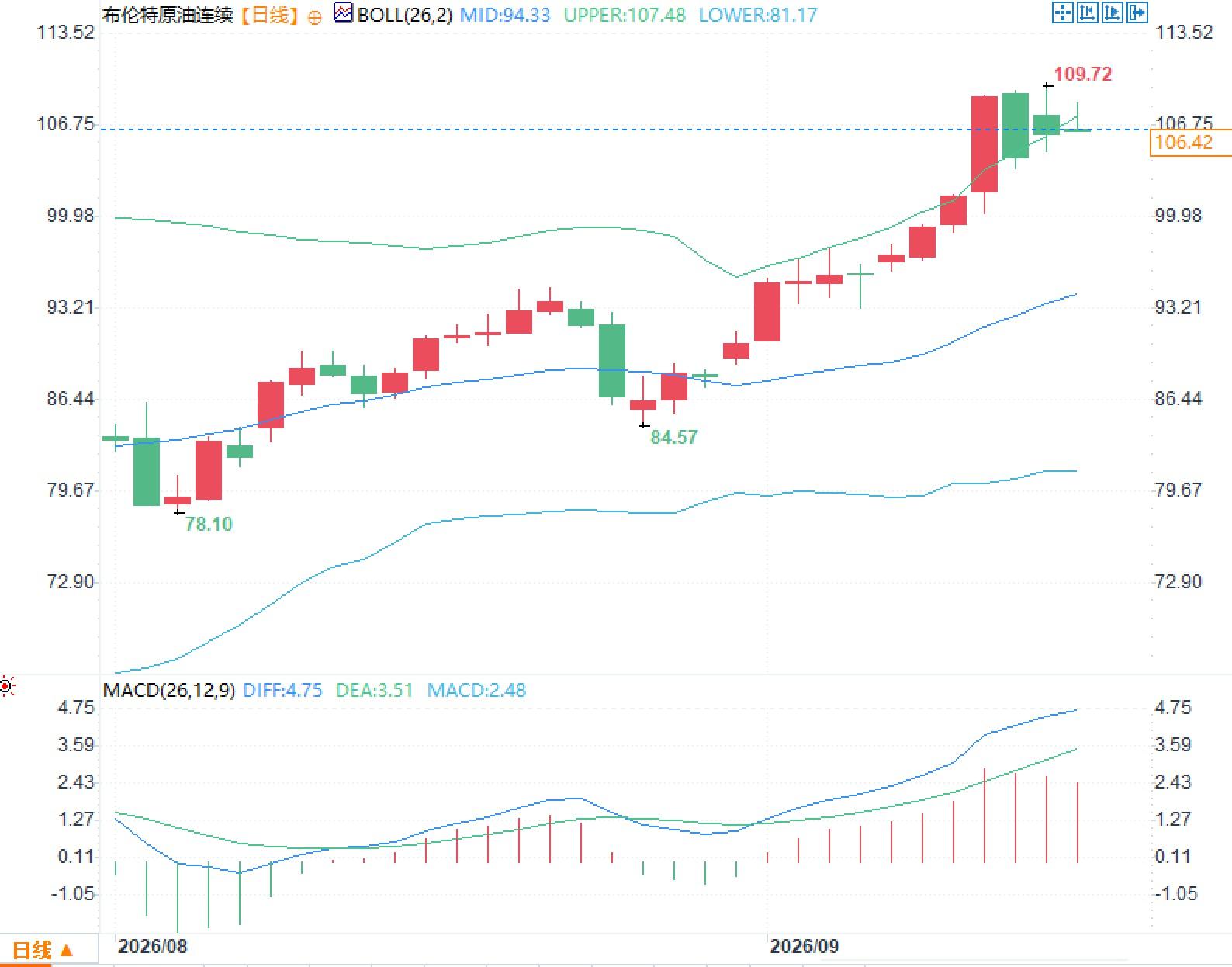 The Bollinger Bands have the middle band at approximately $94.33/barrel, the upper band at approximately $107.48/barrel, and the lower band at approximately $81.17/barrel; the latest price is around $106/barrel, fluctuating near the upper band. The MACD readings are DIFF 4.75, DEA 3.51, and MACD 2.48. The histogram is still above the zero line, but the height of the near-end histogram bars has converged from the peak.
How to rewrite the outlet structure when the east-west pipeline is shut down
The Saudi East-West Pipeline stretches approximately 1,200 kilometers from the Abkeq processing hub in the east to the port of Yanbu on the Red Sea, with a designed maximum pumping capacity of about 7 million barrels per day. Following the outbreak of conflict, this pipeline became a key route bypassing the Strait of Hormuz. Energy consultancy Rystad Energy estimates that since late August, approximately 2.6 million to 4 million barrels of crude oil have been transported daily through this pipeline and out to sea from Yanbu; several market sources place the recent actual transport volume at 4 million to 5 million barrels per day. The International Energy Agency estimates 4 million barrels per day to be roughly 4% of global supply. Saudi Arabia's energy authorities announced last Friday that the pipeline was being shut down as a precautionary measure due to multiple drone attacks in the Riyadh and Medina area. Regional officials estimate the repair period to be between three and five weeks, while estimates for full restoration of pumping station functionality have been extended to six to eight weeks. According to the International Energy Agency, Saudi Arabia's crude oil production in August was approximately 5.97 million barrels per day, compared to a sustainable capacity of about 12.11 million barrels per day. This output is significantly lower than the nearly 10 million barrels per day level before the conflict. If the pipeline cannot be restarted for an extended period, production and exports may be forced to continue to contract, rather than simply being rerouted.Both air traffic to and diplomatic access to the Hormuz are narrowing.
Before the conflict, the Strait of Hormuz carried about one-fifth of the world's oil shipments, approximately 20 million barrels per day. Currently, industry estimates place the actual flow at around 6 to 9 million barrels per day, with fewer than 10 commodity ships passing through daily over the weekend, down from the previous ten-day average of about 14. The strait hasn't physically "disappeared," but the combined effects of insurance, escorts, attacks, and screening have resulted in an effective shipping capacity far below the nominal channel capacity. A meeting scheduled for Monday in Oman, where Iran and Gulf states discussed temporary navigation arrangements, has been postponed. Oman's Foreign Minister publicly stated that the postponement was to "seek consensus"; the Iranian Foreign Ministry indicated that some regional countries requested a rescheduling. The meeting was intended to discuss a draft framework for temporary shipping routes between Oman and Iran, involving ship screening and even transit fees, with the Gulf side favoring limited passage arrangements.Red Sea Risks, Inventory Buffers, and Refinery Behavior
The shutdown of the east-west pipeline has forced Saudi crude oil, which could have been routed through the Red Sea, back into the already strained Gulf export system. Meanwhile, the Bab el-Mandeb Strait, the southern entrance to the Red Sea, remains turbulent. Research firm Melius Research estimates that oil flow through the Bab el-Mandeb Strait was approximately 3 million barrels per day in early September, and its latest assessment suggests the channel is nearing a standstill. The simultaneous pressure on these two critical choke points means that the operational flexibility of "using the west route when the east route is blocked, and turning back to the east route when the west route is unstable" has been severely limited. Inventories had previously acted as a shock absorber in this round of shocks. The International Energy Agency stated that global inventories cumulatively decreased by approximately 410 million barrels from February to July, falling below 7.9 billion barrels by the end of July; a further decrease of 95 million barrels was observed in August, and floating storage at sea also decreased by approximately 65 million barrels. Global oil supply in August was approximately 100.1 million barrels per day, a decrease of 1.6 million barrels per day month-on-month, with over 10 million barrels per day of Gulf production still constrained by security measures. On the demand side, the agency lowered its 2026 global oil demand forecast to a year-on-year decrease of approximately 2.5 million barrels per day, acknowledging that high prices and logistical disruptions are already consuming demand.The fluctuation pattern shown by the daily chart structure
Brent crude oil futures contracts rose from the August low of around $78.10 per barrel on the daily chart, reaching a retracement low of around $84.57 per barrel in September, before returning to a high of $109.72 per barrel. The Bollinger Bands have the middle band at approximately $94.33/barrel, the upper band at approximately $107.48/barrel, and the lower band at approximately $81.17/barrel; the latest price is around $106/barrel, fluctuating near the upper band. The MACD readings are DIFF 4.75, DEA 3.51, and MACD 2.48. The histogram is still above the zero line, but the height of the near-end histogram bars has converged from the peak.Frequently Asked Questions
Question 1: Why is the shutdown of the east-west pipeline attracting more attention than a regular facility malfunction? Answer: This pipeline is the main route for Saudi Arabia to transport crude oil from the east to the Red Sea, bypassing the Strait of Hormuz, after the conflict. Recently, it has been transporting approximately 2.6 million to 5 million barrels per day, accounting for about 4% of global supply. After the shutdown, Yanbu's inventory can only sustain exports for a few days, and repairs may take weeks. Alternative shipping routes are also under pressure, and short-term buffers cannot cover the medium-term capacity gap. Question 2: Does the postponement of the meeting mean the Strait will be closed indefinitely? Answer: The postponement only indicates that the temporary navigation plan failed to be implemented at the original time, not that it is a permanent closure. Current daily traffic is already far below the pre-conflict level of approximately 20 million barrels. What the market lacks is an executable timetable: whether screening rules, insurance, and escort services can be restored simultaneously is more decisive than diplomatic rhetoric in determining shipping schedules. Question 3: With inventories still being depleted, does this mean that near-month volatility will only amplify in one direction? A: August inventories fell by another 95 million barrels, bringing the cumulative decrease to approximately 507 million barrels. The buffer has indeed thinned, making refineries more sensitive to near-month shocks from attacks or diplomatic developments. However, demand is already suppressed by high prices, and refineries may proactively reduce operating rates. Increased volatility is a structural result and does not mean a single direction is locked in.- Risk Warning and Disclaimer
- The market involves risk, and trading may not be suitable for all investors. This article is for reference only and does not constitute personal investment advice, nor does it take into account certain users’ specific investment objectives, financial situation, or other needs. Any investment decisions made based on this information are at your own risk.