Market expectations are at their highest for this week's Federal Reserve meeting.
2026-09-15 19:54:08
The situation this week is quite worrying. The attacks on the East-West oil pipeline have created significant uncertainty in oil prices, adding unpredictable variables to market movements. The impact on global oil supply has been limited. The recent rise in Brent crude prices is an overshoot, with the market panicking and pricing in a supply shock far greater than the actual situation. However, it is undeniable that we are currently shrouded in a thick "fog of war."  Next up is the Federal Reserve's interest rate meeting on Wednesday. These meetings are always stressful: the entire meeting is broken down into different segments, each potentially sending drastically different signals to the market. At 2 PM Eastern Time, the FOMC policy statement (clarifying whether the Fed will raise interest rates) will be released, followed by a press conference at 2:30 PM Eastern Time. The press conference is far more important, especially this week. A rate hike is a foregone conclusion. Market pricing shows a 90% probability of a 25 basis point hike, making it almost impossible for the Fed to abandon the rate hike. If it doesn't raise rates, the market will again heavily question the Fed's credibility, and long-term US Treasuries could likely resume their sell-off. The situation is somewhat tricky: as I analyzed in my Saturday article, last Friday's unexpectedly high CPI data was merely noise, but the die is cast. The Fed has no option but to raise rates, and the risk of a surge in US Treasury yields is simply too high. What truly affects the market is the press conference. The market has already fully priced in a complete rate hike cycle: the market expects two more rate hikes this year and two more in 2027, and this expectation is already reflected in market prices. Warsh will almost certainly be repeatedly questioned about his stance on this market expectation, and I don't think he has a perfect answer. The biggest risk is that his remarks will lean towards a dovish stance compared to market expectations. In this case, even if the Fed has just raised interest rates in an attempt to stabilize long-term yields, long-term US Treasuries will still be sold off. The dollar may weaken as a result, and the market will once again be debating the Fed's credibility. In short, this interest rate meeting is fraught with risks, and the press conference is the focal point of those risks.
 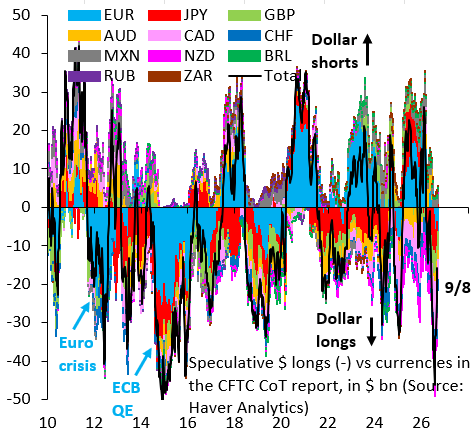 Chart Explanation: The black line in the chart represents the overall dollar position in the Commitment of Traders (COT) report from the Commodity Futures Trading Commission (CFTC). A negative curve indicates that the market is bullish on the dollar. Latest data as of Tuesday, September 8th, shows that the market has already heavily bet on a stronger dollar. Following the release of this data, the CPI data exceeded expectations, and the market's pricing of Fed policy shifted towards a hawkish stance, leading to further accumulation of long dollar positions. Therefore, market expectations for this week's Fed meeting are extremely high. If the press conference communication goes awry, the dollar could very well fall along with the controversy surrounding the Fed's credibility. A weaker dollar against the backdrop of interest rate hikes is not entirely uncommon; this often happens when central bank communication becomes chaotic. If this occurs, "currency devaluation trading" will once again flourish. This Fed rate hike will not have a substantial negative impact on gold and similar assets, as the purpose of the rate hike is to suppress long-term US Treasury yields. Artificially constraining yields is precisely the core favorable condition for currency devaluation trading.
Next up is the Federal Reserve's interest rate meeting on Wednesday. These meetings are always stressful: the entire meeting is broken down into different segments, each potentially sending drastically different signals to the market. At 2 PM Eastern Time, the FOMC policy statement (clarifying whether the Fed will raise interest rates) will be released, followed by a press conference at 2:30 PM Eastern Time. The press conference is far more important, especially this week. A rate hike is a foregone conclusion. Market pricing shows a 90% probability of a 25 basis point hike, making it almost impossible for the Fed to abandon the rate hike. If it doesn't raise rates, the market will again heavily question the Fed's credibility, and long-term US Treasuries could likely resume their sell-off. The situation is somewhat tricky: as I analyzed in my Saturday article, last Friday's unexpectedly high CPI data was merely noise, but the die is cast. The Fed has no option but to raise rates, and the risk of a surge in US Treasury yields is simply too high. What truly affects the market is the press conference. The market has already fully priced in a complete rate hike cycle: the market expects two more rate hikes this year and two more in 2027, and this expectation is already reflected in market prices. Warsh will almost certainly be repeatedly questioned about his stance on this market expectation, and I don't think he has a perfect answer. The biggest risk is that his remarks will lean towards a dovish stance compared to market expectations. In this case, even if the Fed has just raised interest rates in an attempt to stabilize long-term yields, long-term US Treasuries will still be sold off. The dollar may weaken as a result, and the market will once again be debating the Fed's credibility. In short, this interest rate meeting is fraught with risks, and the press conference is the focal point of those risks. Chart Explanation: The black line in the chart represents the overall dollar position in the Commitment of Traders (COT) report from the Commodity Futures Trading Commission (CFTC). A negative curve indicates that the market is bullish on the dollar. Latest data as of Tuesday, September 8th, shows that the market has already heavily bet on a stronger dollar. Following the release of this data, the CPI data exceeded expectations, and the market's pricing of Fed policy shifted towards a hawkish stance, leading to further accumulation of long dollar positions. Therefore, market expectations for this week's Fed meeting are extremely high. If the press conference communication goes awry, the dollar could very well fall along with the controversy surrounding the Fed's credibility. A weaker dollar against the backdrop of interest rate hikes is not entirely uncommon; this often happens when central bank communication becomes chaotic. If this occurs, "currency devaluation trading" will once again flourish. This Fed rate hike will not have a substantial negative impact on gold and similar assets, as the purpose of the rate hike is to suppress long-term US Treasury yields. Artificially constraining yields is precisely the core favorable condition for currency devaluation trading.
- Risk Warning and Disclaimer
- The market involves risk, and trading may not be suitable for all investors. This article is for reference only and does not constitute personal investment advice, nor does it take into account certain users’ specific investment objectives, financial situation, or other needs. Any investment decisions made based on this information are at your own risk.