













Freight rates hit record highs, but inventories surged while multiple forces intervened in oil prices.
2026-09-16 16:44:08
On Wednesday (September 16), during the Asian and European sessions, oil prices saw a slight overall pullback due to the API inventory data and the meeting between high-ranking Chinese government officials and Iranian officials focusing on stabilizing the situation. However, prices still held onto most of Tuesday's gains. On Tuesday night (September 15), oil prices surged, primarily driven by renewed threats from the US regarding Iran, solidifying the confrontation, coupled with Iran's claim to block the Strait of Hormuz and Saudi Arabia's suspension of Red Sea exports. This simultaneous restriction on the world's two major oil shipping routes led to a sudden and rigid contraction in supply, directly pushing up the geopolitical risk premium for crude oil and driving up prices. Meanwhile, Bessant stated that the focus now is on ending the threat posed by Iran, not merely "managing" it. Treasury officials recently visited the UAE, and talks progressed smoothly. Shipping sources indicated that Yanbu, Saudi Arabia's main Red Sea port, had suspended crude oil loading operations following the attack on the East-West pipeline. The Islamic Revolutionary Guard Corps (IRGC) issued a statement from its navy, declaring the Strait of Hormuz blocked and under its intelligent control, warning that any vessel entering the dangerous waterway would face serious consequences. Wang Yi held talks with Iranian Foreign Minister Araqchi and stated that China's policy toward Iran has maintained continuity and stability, consistently upholding justice on the UN Security Council and multilateral platforms, opposing the use of force, and safeguarding the norms of international relations. China is willing to strengthen communication and coordination with Iran to promote new progress in China-Iran relations, which has played a key role in stabilizing the situation. 
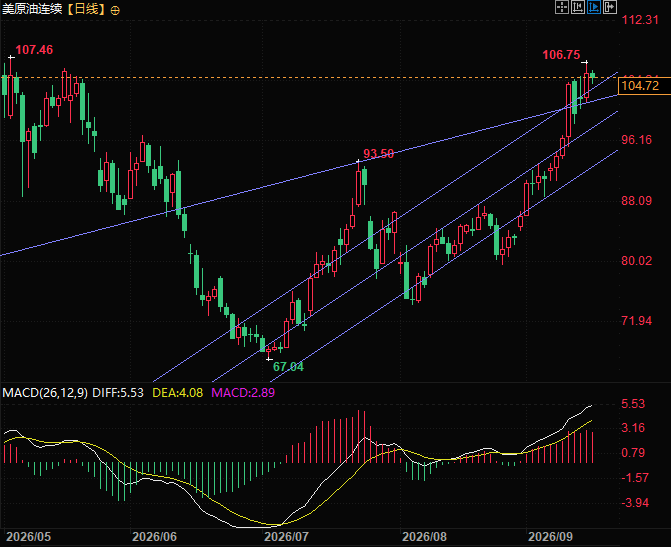 (WTI crude oil futures daily chart, source: EasyForex) At 16:40 Beijing time, WTI crude oil futures were trading at $104.80 per barrel.
The Houthi rebels achieved a tactical breakthrough, expanding their control over the Red Sea.
From July to September, the Houthi rebels achieved significant geopolitical expansion, successfully capturing the Red Sea port of Mocha and the strategic island of Mayon, effectively controlling the core shipping lanes of the Bab el-Mandeb Strait, and completely blocking Saudi Arabia's Red Sea oil export route. The Houthi issue remains unresolved due to the severely insufficient ability of the US, Saudi Arabia, and other parties to effectively restrain the Houthis: airstrikes have failed to eradicate their fighting capacity, the opposing camp is fragmented and lacks effective counterbalance, diplomatic negotiations have stalled, and coupled with continued Iranian support, Houthi disruption of Red Sea shipping and Saudi oil and gas facilities will become a long-term norm. Simultaneously, the Houthis have formed tactical coordination with pro-Iranian militias in Iraq, exerting pressure on Saudi energy facilities on two fronts.Attacks on Saudi Arabia's core pipelines have disrupted operations, creating a rigid increase in global supply gaps.
A major supply-side variable emerged in mid-September: Saudi Arabia's core transoceanic oil pipeline was shut down as a precautionary measure following a drone attack by Iranian-linked militias, with repairs expected to take 3-5 weeks. This pipeline has a daily capacity of 2.6-4 million barrels, representing approximately 4% of global crude oil supply. This short-term loss of capacity has created a new supply gap. As a result, Saudi Arabia's daily crude oil production fell to a 30-year low, and Red Sea crude oil loadings plummeted from 3.8 million barrels per day in August to 2.2 million barrels per day, further shrinking the effective supply capacity of Middle Eastern crude oil.The global shipping industry is undergoing a restructuring, with crude oil freight rates hitting record highs.
Multiple shipping lane blockades coupled with pipeline shutdowns have forced significant marginal adjustments to crude oil transportation routes. Saudi Arabia has been forced to abandon the Red Sea route for 70% of its Yanbu crude oil exports, instead circumventing the Suez Canal, the Mediterranean, and even the Cape of Good Hope in Africa. The transit time to Asia has doubled from 24 days to 54 days. The combined effects of tight capacity, longer transit times, and rising fuel prices have pushed crude oil shipping costs to record highs. As of mid-September, the charter rate for Very Large Crude Carriers (VLCCs) transporting 2 million barrels of US Gulf Coast crude oil to Asia surged to $44.8 million, significantly exceeding previous records.Latest API data shows anomaly in inventory levels across all product categories: confirming weakening global physical demand.
However, surprisingly, for the week ending September 11, US API petroleum product inventories increased more than expected across the board, indicating a clear weakening of fundamentals. Key marginal data are as follows: crude oil inventories increased by 7.144 million barrels (expected -1.75 million barrels), gasoline inventories increased by 1.462 million barrels (expected -1.201 million barrels), and distillate fuel inventories increased by 1.607 million barrels (expected +0.827 million barrels). Key conclusion: The simultaneous and unexpected increase in inventories across all petroleum product categories confirms weakening global end-user physical demand. The current oil market is characterized by a strong supply risk premium offsetting the negative impact of weak demand, ending the upward trend in oil prices. Going forward, prices are expected to maintain a high-level, wide-range fluctuation.Summary and Technical Analysis:
Based on the latest industry data from September, the EIA has raised its global supply contraction forecast, predicting a continued widening of the year-on-year decline in global oil supply in 2026, with a significant expansion of the global crude oil supply-demand gap in the fourth quarter. However, rising inventories suggest short-term resilience in supply and demand. This is due to both a potential contraction in actual demand and the effectiveness of alternative supply models adopted by various countries. However, the impact of the Houthis on crude oil supply cannot be fully reflected in this EIA report. Therefore, overall oil prices remain in a tight supply situation, while also being susceptible to upward pressure from geopolitical factors. Technically, oil prices remain above the X-line and the upward channel line, indicating that the trend remains unchanged and further increases are likely. (WTI crude oil futures daily chart, source: EasyForex) At 16:40 Beijing time, WTI crude oil futures were trading at $104.80 per barrel.
- Risk Warning and Disclaimer
- The market involves risk, and trading may not be suitable for all investors. This article is for reference only and does not constitute personal investment advice, nor does it take into account certain users’ specific investment objectives, financial situation, or other needs. Any investment decisions made based on this information are at your own risk.

