Gold rebounds, short-selling trap realized; tonight's terrifying data may be underestimated.
2026-09-16 18:28:10
On Wednesday (September 16), spot gold rebounded during the Asian and European sessions, currently up $4335, a gain of 0.97%. The short-term pullback in oil prices has given gold a breather, while interest rate hikes and rising real interest rates continue to erode the returns of holding gold. The prevailing narrative is that strong US AI and economic growth naturally raise real interest rates because increased investment and a shortage of funds are causing capital to flow out of gold and Treasury bonds, thus increasing the cost of capital for gold. Therefore, the key focus now is whether this narrative of strong economic growth is stable and sustainable. So, aside from the outcome of the US interest rate meeting and changes in the dot plot, I believe the most important factor is the data related to US economic growth, such as the US retail sales growth rate to be released tonight—the truly alarming figure. 
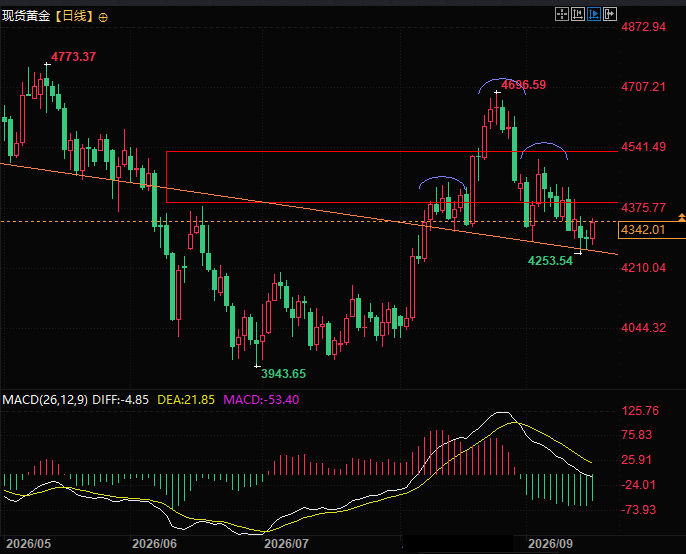 (Spot gold daily chart, source: EasyTrade) At 18:26 Beijing time, spot gold is currently trading at $4342 per ounce.
The core pricing logic in the market: Economic resilience supports high interest rates, suppressing gold price increases.
The current market's ability to accept the high-interest-rate environment in the US without experiencing systemic panic stems from the robust resilience of the US economy. Consumption is a core pillar of the US economy, accounting for nearly 70% of GDP. Previously stable household consumption, employment, and wage data demonstrate that the US economy can withstand the impact of high interest rates, with a low risk of recession. This is also the underlying logic behind the continued rise in US Treasury yields and the downward pressure on gold prices. Strong economic fundamentals allow the market to price in high interest rates for the long term, continuously suppressing gold's bullish trend. However, if core retail sales continue to weaken, it will be real-time evidence of a weakening economic fundamental, directly disproving the current high-interest-rate pricing logic, and having a more direct and severe impact on market expectations. The market will also cross-validate this with data such as non-farm payrolls, wages, and savings rates. A simultaneous weakening of consumption and employment will definitively establish a bullish trend for gold.Geopolitics and Energy: Fluctuating oil prices provide a floor for gold prices
Energy and geopolitics are important contributing factors to recent gold price increases. The core driver of this round of oil price increases was the restriction of crude oil supply and shipping routes due to geopolitical conflicts in the Middle East. The rigid supply contraction pushed up the geopolitical risk premium for crude oil, which at one point strengthened expectations of a rebound in inflation, supporting the Federal Reserve's tight monetary policy and significantly suppressing gold, a non-interest-bearing asset. However, the price increases driven by geopolitical conflicts were limited in duration. Coupled with a recovery in fundamentals such as inventory and diplomatic efforts to ease tensions, oil prices quickly surged before experiencing a correction. Currently, the energy sector is experiencing a back-and-forth struggle between bulls and bears, neither continuously pressuring gold prices nor driving a trend in gold prices; it can only provide bottom support for gold prices.Key short-term focus: Federal Reserve interest rate decision and dot plot guidance
The Federal Reserve's September interest rate decision tonight is the core focus of the short-term market, with the market widely expecting a 25 basis point rate hike. Compared to the actual rate hike, the market is more concerned about the Fed's dot plot update and the Chairman's post-meeting remarks. The dot plot represents the Fed officials' core expectations for the future path of interest rates and directly determines the subsequent monetary policy tone. If the dot plot raises the forward interest rate, releasing a hawkish signal of maintaining high interest rates for the long term, the dollar and US Treasury yields will strengthen again, and gold will continue to face downward pressure and fluctuate. If the dot plot is slightly adjusted to cool down and ease expectations of high interest rates, gold will see a short-term recovery and rebound.Breakthrough in the Market: Retail Sales Data Determines Gold's Trend
Compared to the short-term fluctuations caused by the Fed's interest rate decisions, US retail sales data is the true key to breaking the current gold price trend and a core indicator of the resilience of the US economy. Retail data directly reflects the current state of household consumption and directly determines the market's pricing logic for the US economy and long-term interest rates, with an influence far exceeding that of regular policy speeches. If core retail data weakens overall, not due to a single seasonal factor, car model, or oil price disturbance, but rather a general cooling of household consumption, it means that persistently high interest rates have begun to erode the real economy and squeeze household disposable income. At that time, the market will completely shake the core logic that "the economy can withstand high interest rates," the risk of recession will rise rapidly, the market will price in interest rate cuts in advance, and the Fed's room for interest rate hikes will be completely locked. For gold, recession trading combined with a decline in real interest rates is a very strong bullish factor, which will drive gold prices out of the consolidation pattern and start an upward trend.Summary and Outlook: Volatility Awaits Key Data for Breakthrough
Yesterday's article pointed out that the head and shoulders pattern here might be a bear trap, and indeed, gold prices bottomed out and rebounded. Overall, the current gold market is characterized by a geopolitical support level, continued high interest rates as downward pressure, and economic data determining the trend. Short-term price fluctuations are dominated by the Fed's dot plot and policy statements, determining the pace of any short-term rebound or downward pressure on gold prices; the medium- to long-term trend depends entirely on whether the resilience of US consumption can continue. Once core retail data continues to weaken, the US economic growth narrative collapses, the negative effects of high interest rates on the economy will fully manifest, and rising recession expectations will become the core driving force for gold prices to break out of the consolidation range and establish a trend. Technically: Spot gold has formed a head and shoulders bear trap at a low level; if the bulls exert their strength, a rapid rebound is possible. (Spot gold daily chart, source: EasyTrade) At 18:26 Beijing time, spot gold is currently trading at $4342 per ounce.
- Risk Warning and Disclaimer
- The market involves risk, and trading may not be suitable for all investors. This article is for reference only and does not constitute personal investment advice, nor does it take into account certain users’ specific investment objectives, financial situation, or other needs. Any investment decisions made based on this information are at your own risk.