Is the dot plot more deadly than interest rate hikes themselves? Gold is awaiting a path reassessment.
2026-09-16 19:28:10
On Wednesday, September 16th, spot gold was trading around $4350. The market's pricing focus was not on overnight fluctuations, but on the Federal Reserve's interest rate decision: the policy statement, summary of economic projections, and dot plot would be released simultaneously, followed by a press conference by Chairman Warsh. Interest rate futures indicated a greater than 90% probability of raising the target range for the federal funds rate by 25 basis points from 3.50% to 3.75%, to 3.75% to 4.00%, which could be the Fed's first rate hike since July 2023. Meanwhile, Brent crude oil remained around $107 per barrel, with the disruption to energy supply from the Middle East conflict showing no signs of abating. Gold faces the dual forces of cost reassessment and geopolitical premiums, compressing the pricing window to the policy text and the dot plot distribution. 
 Looking at a longer timeframe, spot gold briefly approached the $5,590 to $5,600 per ounce range in January before giving back some of its gains. It is currently still about 18% higher than the same period last year. Positioning structure and volatility both indicate that the market is using a higher interest rate path to discount the previously priced-in easing premium, while retaining a geopolitical premium.
Revaluation of policy texts, dot plots, and carrying costs
The key takeaway from this meeting wasn't the interest rate hikes themselves, but rather the path forward. In the June summary of economic projections, the 18 members who submitted the dot plot projected a median federal funds rate of 3.8% at the end of 2026, 3.6% at the end of 2027, and 3.4% at the end of 2028, with a long-term neutral level of 3.1%. At that time, 9 members believed at least one more rate hike was needed this year, 8 believed it could be maintained, and 1 saw a rate cut. Warsh himself did not submit a dot plot. The July meeting kept rates unchanged, but Harmark, Kashkari, and Logan voted for a 25 basis point hike, revealing their disagreement. The market is currently pricing in more rate hikes than the path implied in the June dot plot. Interest rate futures not only priced in the September hike but also raised the cumulative number of rate hikes from the end of 2026 to the end of 2027 to more than two. If the dot plot indicates only one or two rate hikes are needed in 2026 and 2027 combined, the gap with the futures curve will be interpreted as dovish; if the median rises to three or more, real interest rate expectations will be revised upwards. Gold, as a non-coupon asset, is more sensitive to changes in the real interest rate path than to the number of nominal rate hikes. At the Jackson Hole symposium, Warsh presented a very rigid framework: "The Fed's primary focus right now should be prices." "My standard is: we must be certain that underlying inflation is clearly and at a sufficient pace toward the target. Otherwise, we still have work to do." He also rejected forward guidance, stating that if policymakers give quasi-commitments during the cycle, it will limit their discretionary options. The press conference will most likely reiterate this stance rather than provide a tradable timeline. The key to how the cost of holding gold will be rewritten lies in the dispersion of the dot plot, the number of dissenting votes, and whether the statement includes energy shocks as a source of persistent inflation.Energy prices, sticky inflation, and the real interest rate channel
The US Personal Consumption Expenditures (PCE) price index rose 3.7% year-on-year in July, with the core index at 3.3%. Warsh also mentioned at Jackson Hole that the six-month annualized rate was approximately 4.1%. The August PCE was 3.4% year-on-year. The pace of inflation decline has not met the slope required for the Committee's 2% target. Energy is the main disruptor, but the core reading also did not show clear convergence. Brent crude oil regained the $100 per barrel mark on September 9th and remains above $107. Traffic in the Strait of Hormuz has contracted significantly following the escalation of the conflict, and the Red Sea alternative route has also been disrupted. Energy prices are keeping nominal inflation high, which the bond market is compensating with higher term premiums, while gold is simultaneously under pressure from rising real interest rates and hedging against safe-haven demand. These two forces are moving in opposite directions, and their final weight depends on whether the dot plot describes the energy shock as a one-off supply shock or as a second-round effect requiring interest rate tools. If the statement emphasizes that the supply shock will subside as the conflict eases, the upward revision of real interest rate expectations will be limited; if the transmission of energy to core services is described as a persistent risk, the discount rate channel will be steeper. Gold's recent pullback from its January high and its return to around $4,300 in early September reflects a repricing of this channel, rather than a pulse from a single news event.The fluctuation pattern shown by the daily chart structure
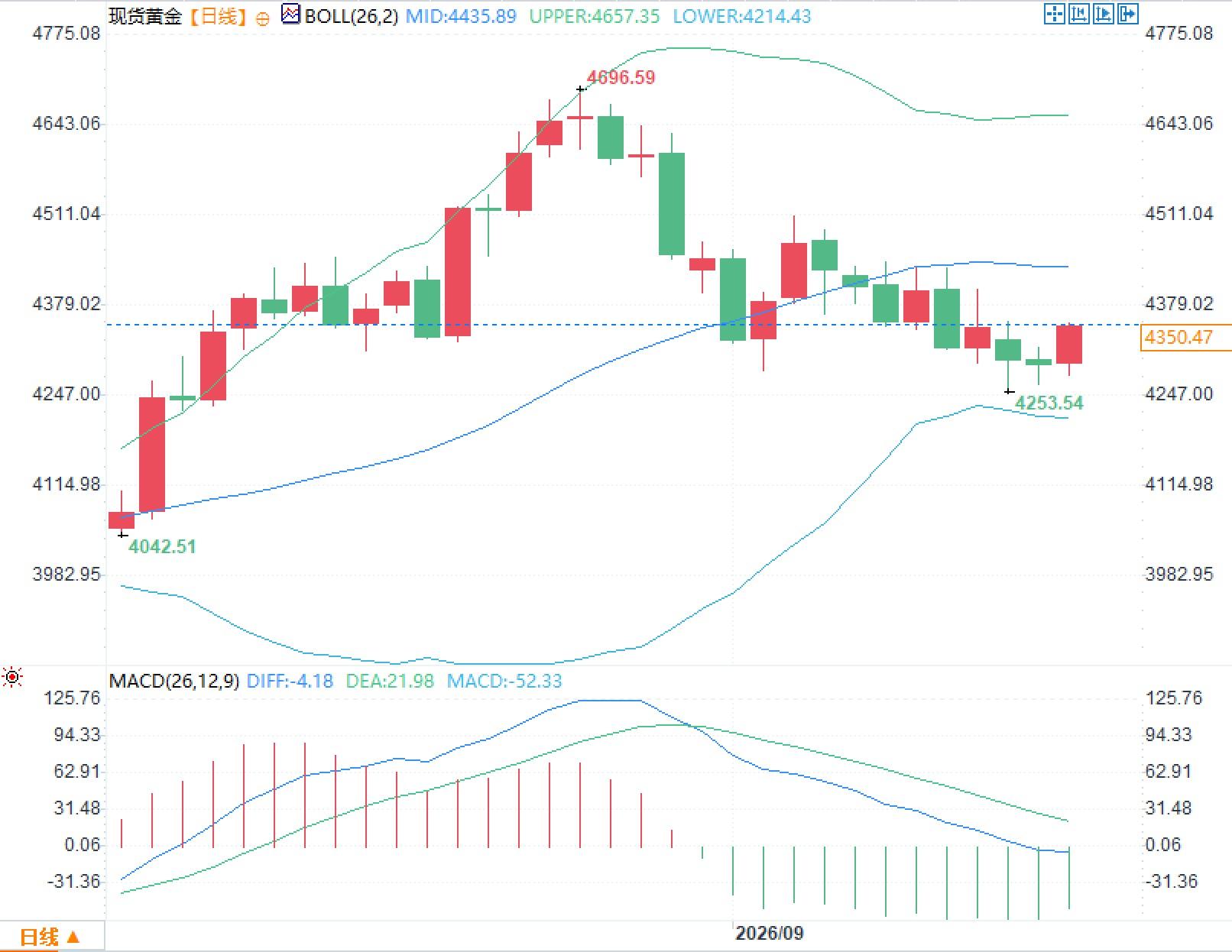
On the daily chart, spot gold briefly dipped to around $4250 in early September before consolidating above $4300. The Bollinger Bands have a middle band around $4436, an upper band around $4657, and a lower band around $4214. The price is currently below the middle band and close to the lower band. Both the MACD line and signal line are weakening near the zero line, and the histogram is negative, indicating that recent momentum is mainly converging and digesting rather than expanding unilaterally. Looking at a longer timeframe, spot gold briefly approached the $5,590 to $5,600 per ounce range in January before giving back some of its gains. It is currently still about 18% higher than the same period last year. Positioning structure and volatility both indicate that the market is using a higher interest rate path to discount the previously priced-in easing premium, while retaining a geopolitical premium.How Middle East conflicts are rewriting the macroeconomic function of gold
In recent weeks, crude oil has been the primary driver of cross-asset pricing. The spillover of conflict to shipping and refining has simultaneously pushed up inflation expectations and central bank reaction functions in oil prices. For gold, this isn't a simple "safe-haven buying" narrative: geopolitical premiums increase safe-haven demand, while oil prices raise nominal interest rates through inflation expectations; these two factors can offset each other on the same trading day. Therefore, gold's resilience to Middle East news depends on whether oil prices decline in tandem. If the conflict de-escalates and oil prices retreat from above $100, the interest rate path is repriced to a shallower level, lowering the cost of holding gold; if the conflict escalates and oil prices remain above $107, the dot plot and statements are more likely to favor more rate hikes, and gold will first have to digest real interest rates. In the current fundamental mix, energy supply constraints and expectations of policy tightening are parallel variables, neither of which can be omitted. If Warsh had clearly identified the energy shock as a supply factor to be observed at the press conference, rather than immediately using interest rates to hedge against overheated demand, the macroeconomic function for gold would have temporarily returned to the two-factor framework of "real interest rate and risk premium"; if sticky inflation were tied to energy, the function would be closer to interest rate dominance.- Risk Warning and Disclaimer
- The market involves risk, and trading may not be suitable for all investors. This article is for reference only and does not constitute personal investment advice, nor does it take into account certain users’ specific investment objectives, financial situation, or other needs. Any investment decisions made based on this information are at your own risk.