Gold Trading Alert: Fed's hawkish stance tears apart bullish defenses, gold prices hit a one-month low.
2026-09-17 07:46:10
On Wednesday (September 16), the global gold market experienced a dramatic rollercoaster ride. Spot gold rose more than 1% before the Federal Reserve's decision, reaching a high of $4,367.99 per ounce, but quickly reversed course and fell after the decision was announced, ultimately closing at $4,264.28 per ounce, a single-day drop of more than 1%. The intraday low touched $4,235.10, a new low since August 7. This sharp decline was the result of multiple pressures from the Fed's interest rate hike, a stronger dollar, persistent inflation, and geopolitical factors. As a traditional safe-haven asset, gold once again exposed the vulnerability of its non-interest-bearing characteristics in a rising interest rate environment. On Thursday (September 17) in early Asian trading, spot gold fluctuated slightly higher, currently trading around $4,270 per ounce. 
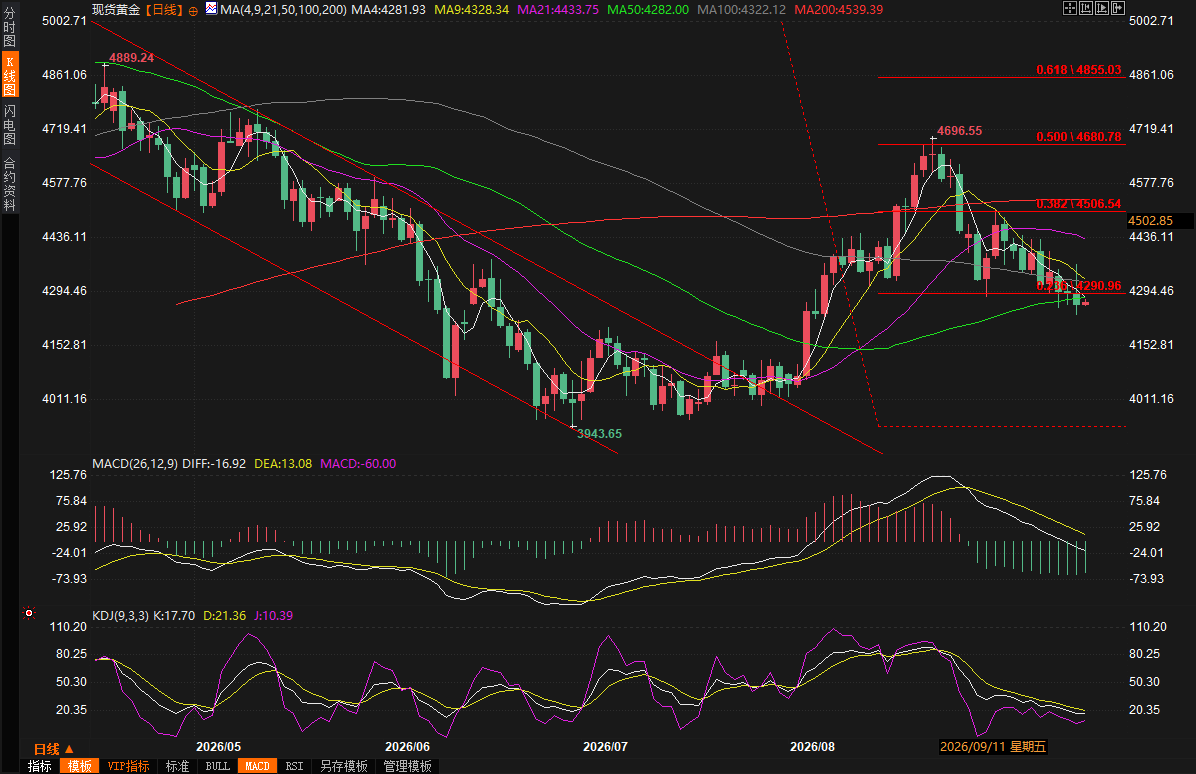 (Spot gold daily chart, source: FX678) At 07:42 Beijing time, spot gold is currently trading at $4272.90 per ounce.
The hawkish rate hike has been implemented, and gold prices immediately fell.
The Federal Reserve raised the target range for the federal funds rate by 25 basis points to 3.75%-4.00% on Wednesday, marking the first rate hike in three years and the first policy shift since new Chairman Kevin Warsh took office. The decision was unanimously approved. In the post-meeting press conference, Warsh clearly stated that the current focus is primarily on price stability within the mandate, emphasizing that inflation is too high and has persisted too long, and that data from this summer has not shown a significant improvement in the underlying trend. He stated bluntly, "Our primary focus is on price stability within our mandate," noting that the economy has strengthened, domestic consumption is resilient, productivity growth is robust, and capital investment is solid, all of which have contributed to inflationary pressures. The market quickly interpreted Warsh's remarks as a hawkish signal. Independent metals trader Tai Wong pointed out that Warsh's speech, coupled with the hawkish dot plot, reinforced expectations of further rate hikes in the coming meetings, which is boosting the dollar and putting pressure on metal prices in the short term. The dollar subsequently rose against the euro, increasing the cost for overseas buyers to purchase gold, further depressing gold prices. While gold has traditionally been seen as a hedge against inflation, the opportunity cost of holding non-interest-bearing gold increases significantly when interest rates rise, naturally driving funds towards higher-yielding assets. The latest economic projections from the Federal Reserve show that 16 of the 18 policymakers expect at least another 25 basis points of interest rate hikes by the end of this year, bringing the policy rate to the 4.00%-4.25% range and maintaining it at that level until the end of 2027. Inflation expectations have been revised upward to 3.7%, with a return to the 2% target not expected until 2029, a year later than previously anticipated. Economic growth expectations have been slightly revised upward to 2.3%, while the unemployment rate is projected to fall to 4.1%. These figures collectively paint a picture of "stubborn inflation but a resilient economy," completely dispelling the market's illusion that "one rate hike will end it all."Why is inflation so difficult to subside despite multiple shocks?
The backdrop to this interest rate hike is the combined effect of a series of policies and geopolitical events since the Trump administration took office. Global import tariffs, the energy shock caused by the US-Israel coalition's war against Iran, and the massive capital expenditure brought about by the artificial intelligence boom have all contributed to pushing up price levels. The Federal Reserve removed its previous statement attributing high inflation primarily to "supply shocks" (especially in the energy sector) in its policy statement, instead acknowledging that price pressures were too broad and unsettling. Warsh also explicitly stated that inflation is no longer solely due to oil prices or import tariffs; a range of data, including from the labor market, indicates that the economy has strengthened. Meanwhile, the situation in the Middle East has become further complicated. Clashes between the Iranian-backed Houthi rebels and Saudi Arabia have escalated, the war in Yemen has spread, with the Houthis launching drones and missiles at Saudi cities and seizing islands in the Bab el-Mandeb Strait, the gateway to the Red Sea. Saudi Arabia's East-West oil pipeline was briefly disrupted by attacks. Although there are reports that Saudi Arabia is providing additional crude oil shipments through Oman to alleviate supply concerns, Brent crude is still hovering above $105 per barrel, near recent highs. US diesel retail prices have even broken through $6.30 per gallon, setting a new record high. The persistently high energy prices have directly exacerbated inflationary pressures, forcing the Federal Reserve to adopt a more hawkish stance. Trump reacted swiftly to the interest rate hike, reiterating on the "Truth Social" platform that US interest rates should be significantly lowered to 1% or lower, arguing that the US has the best credit and that new investment is driving the country's prosperity. He even suggested that stopping trade with countries with trade deficits could generate $1.5 trillion annually. However, the Fed's actions contrasted sharply with the president's appeals. Under Warsh's leadership, the Fed chose to confront the reality of inflation rather than cater to political demands. This, to some extent, restored market confidence in the central bank's commitment to combating inflation, but also put greater pressure on gold in the short term.The US dollar and bond market are moving in tandem, clearly indicating downward pressure on gold.
Following the interest rate hike, the dollar index rose 0.7% to 100.35, hitting a near five-week high. The yield on the two-year U.S. Treasury note rose to 4.744%, its highest level since July 2024; the 10-year yield also remained above 5%. The yield curve flattened, reflecting market concerns about further rate hikes in the near term. The CME FedWatch tool showed that the probability of another 25 basis point rate hike before the end of the year remained at approximately 90%. The stronger dollar directly pushed up the cost of gold priced in dollars, and its non-yielding nature made gold less attractive in a rising interest rate environment. Although geopolitical risks and energy supply concerns remain, which should theoretically support gold's status as a safe-haven asset, these supporting factors have temporarily taken a backseat under the current "interest rate first" market pricing logic. Analysts pointed out that as long as the Fed continues to release hawkish signals, upward pressure on the dollar and real interest rates will continue to suppress gold prices.Short-term pressure exists, but long-term room for maneuver remains.
In summary, the Fed's rate hike marks the start of a new tightening cycle. Warsh's remarks and adjustments in market expectations have jointly pushed gold prices to a one-month low. In the short term, if subsequent economic data continues to show persistent inflation and strong economic resilience, the market may price in further rate hikes more aggressively, and gold prices will still face downside risks. If the situation in the Middle East continues to escalate and energy prices surge again, a new tug-of-war may form between inflation expectations and safe-haven demand; if the situation in the Middle East eases and oil prices fall sharply, easing inflation concerns, it could provide an opportunity for a rebound in gold prices. Moreover, the long-term logic for gold has not completely failed. If inflation ultimately proves to be more difficult to control than the Fed expects, or if geopolitical conflicts further escalate leading to increased systemic risks, gold's value as the ultimate safe-haven asset may still be highlighted again. The market is currently in a game of "interest rate suppression" and "risk premium," and gold price fluctuations will depend more on the Fed's subsequent policy path and the evolution of the Middle East situation. For investors, before the strong dollar and high-interest-rate environment reverse, the short-term performance of gold is unlikely to be easy. (Spot gold daily chart, source: FX678) At 07:42 Beijing time, spot gold is currently trading at $4272.90 per ounce.
- Risk Warning and Disclaimer
- The market involves risk, and trading may not be suitable for all investors. This article is for reference only and does not constitute personal investment advice, nor does it take into account certain users’ specific investment objectives, financial situation, or other needs. Any investment decisions made based on this information are at your own risk.