Crude Oil Trading Alert: Saudi Arabia's resumption of the East-West pipeline eases supply concerns; WTI oil prices surge and then retreat.
2026-09-17 09:40:09
International oil prices have rebounded after a period of adjustment, with WTI crude oil currently hovering around $101.95. The previous two trading days of downward pressure on oil prices were not primarily due to a complete resolution of global supply risks, but rather to the market's reassessment of the recovery capacity of Saudi Arabia's energy export system and the improvement in actual traffic volume across the Strait of Hormuz. Recent news indicates that Saudi Arabia is seeking to restore approximately half of the capacity of its east-west oil pipeline within days and plans to restore it to full operation within about six weeks. This pipeline, previously damaged by a drone attack, is a crucial export route bypassing the Strait of Hormuz; therefore, its repair progress directly impacts market assessments of the Middle East supply gap.  Meanwhile, Saudi Arabia is increasing its crude oil transport arrangements through the Strait of Hormuz and providing additional supplies to Asian refineries via ship-to-ship transshipment near Oman. U.S. Energy Secretary Chris Wright previously stated that approximately 18 million barrels of crude oil and refined products passed through the Strait of Hormuz earlier this week, with a seven-day average transport volume of about 11 million barrels per day. The recovery in transport traffic means that the market's biggest concern—a complete inability to transport supplies—has temporarily eased, and has also led to a certain degree of decline in the geopolitical risk premium in crude oil prices. U.S. inventory data also exerted short-term downward pressure on oil prices. The latest data from the U.S. Energy Information Administration shows that for the week ending September 11, U.S. commercial crude oil inventories decreased by approximately 640,000 barrels to 423.4 million barrels, but the decline was significantly smaller than the market's previous expectation of approximately 1.4 million to 1.62 million barrels. Meanwhile, the US refinery utilization rate fell to 96.8% from 97.8% the previous week, reducing crude oil processing by approximately 256,000 barrels per day; gasoline inventories, on the contrary, increased by approximately 794,000 barrels, and distillate fuel inventories increased by approximately 1.6 million barrels. These inventory changes indicate that the US refined product market has not shown a destocking pace entirely consistent with previous expectations of tight supply, thus cooling market sentiment regarding short-term demand strength. However, inventory data is insufficient to change the overall supply constraints in the crude oil market. The East-West pipeline is still under repair, and transportation through the Strait of Hormuz remains highly uncertain, while security risks near the Red Sea and the Bab el-Mandeb Strait continue to impact energy transportation. Previously, damage to the Saudi East-West pipeline had raised concerns about further pressure on global crude oil supply. This pipeline normally carries millions of barrels per day of transport capacity, making its recovery speed one of the most important indicators to watch in the current oil market. From a market sentiment perspective, the logic of crude oil trading has shifted from simply betting on supply disruptions to a two-way game between the speed of supply recovery and potential new risks. On the one hand, Saudi Arabia's ability to restore some pipeline capacity, increase alternative export channels, and the emergence of actual traffic flow in the Strait of Hormuz all help reduce market concerns about short-term physical supply gaps. On the other hand, as long as the risk of attack on key energy facilities remains, it will be difficult for oil prices to completely eliminate the geopolitical risk premium accumulated previously. Therefore, even if oil prices have recently corrected, it does not mean that supply risks have been completely eliminated. It is worth noting that after the previous rapid rise in oil prices, the market has accumulated a significant risk premium. WTI touched approximately $105.83 on September 15, and then fell significantly as expectations of supply recovery increased, closing at approximately $102.43 on September 16, a single-day drop of 3.2%. Currently, the price has returned to around $101.95, indicating that the $100 mark still has significant significance for the battle between bulls and bears. The macroeconomic level is also worth noting. High oil prices have already been transmitted to global inflation expectations through fuel, transportation, and production costs, and recent policy changes by the Federal Reserve have further increased the market's sensitivity to the linkage between energy prices and interest rates. For investors, it's crucial to move beyond just oil prices and simultaneously monitor US inventories, refinery operating rates, shipping traffic in the Strait of Hormuz, the progress of Saudi pipeline repairs, and any new supply disruptions in Middle Eastern energy facilities. Looking at the daily chart, WTI crude oil previously surged from around $90, briefly breaking the $100 mark and reaching a high of nearly $106, maintaining its overall medium-term upward trend. However, after a period of consolidation, prices have clearly retreated from their highs, with momentum weakening. Currently, prices have rebounded above $100 around $101.95, indicating that bulls are still vying for this key psychological level. Technically, the first resistance level to watch is $102.80-$104.80. A break above and hold above $104.80 would re-establish significant resistance at the previous high near $105.80; a further break above this level could lead to a retest of the $107-$110 area. The first support level to watch is the $100 mark, followed by the $97.9-$98.5 range, and then the $95.2 area. Technical models currently consider the $100.4 area a key support and the $102.8 area a short-term pivot zone. Looking at the 4-hour chart, WTI's previous rapid rise formed a clear short-term acceleration structure, but after falling back from above $105, the MACD momentum has shown signs of cooling, and the short-term bullish advantage has diminished. The current $101.95 area is a key zone after the correction. If the price can regain a foothold above $102.80 and further break through the $104 area, it may confirm the end of the pullback and resume its upward movement towards $105. Conversely, if $100 is breached, the 4-hour correction may widen further, with the $98 area becoming the next important area to watch. Overall, the short-term trend remains one of high-level wide-range fluctuations. The technical structure has not yet turned into a clear medium-term downtrend, but the price is close to the previous high, and the risk of volatility remains high.
 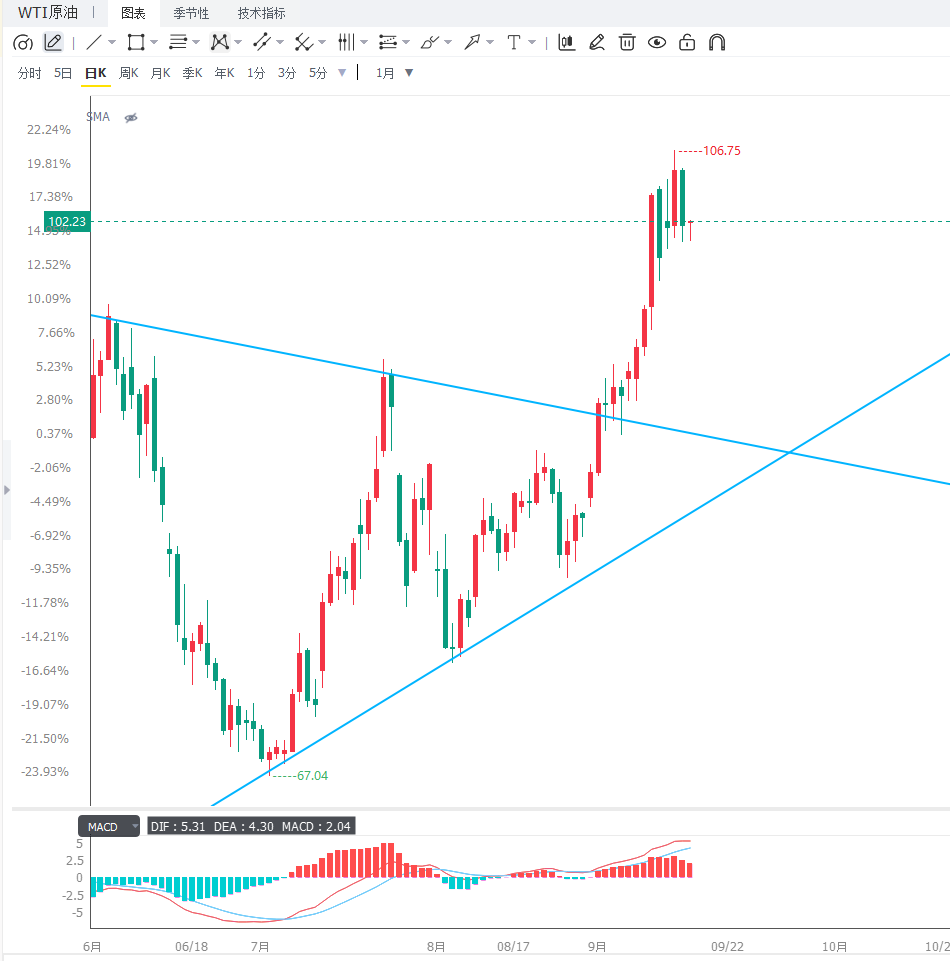 The editor's summary indicates that WTI crude oil's return to around $101.95 suggests that the market has not completely abandoned the previously established risk premium despite rising expectations of supply recovery. The repair of Saudi Arabia's east-west pipeline, the resumption of shipping in the Strait of Hormuz, and a smaller-than-expected decline in US crude oil inventories are easing short-term supply tensions, but uncertainties remain regarding energy infrastructure and key transportation routes. Whether oil prices can break through $105 again will depend on the interplay between the speed of supply recovery and new transportation risks; while whether $100 can be maintained is a crucial technical level to assess the depth of this round of high-level correction.
Meanwhile, Saudi Arabia is increasing its crude oil transport arrangements through the Strait of Hormuz and providing additional supplies to Asian refineries via ship-to-ship transshipment near Oman. U.S. Energy Secretary Chris Wright previously stated that approximately 18 million barrels of crude oil and refined products passed through the Strait of Hormuz earlier this week, with a seven-day average transport volume of about 11 million barrels per day. The recovery in transport traffic means that the market's biggest concern—a complete inability to transport supplies—has temporarily eased, and has also led to a certain degree of decline in the geopolitical risk premium in crude oil prices. U.S. inventory data also exerted short-term downward pressure on oil prices. The latest data from the U.S. Energy Information Administration shows that for the week ending September 11, U.S. commercial crude oil inventories decreased by approximately 640,000 barrels to 423.4 million barrels, but the decline was significantly smaller than the market's previous expectation of approximately 1.4 million to 1.62 million barrels. Meanwhile, the US refinery utilization rate fell to 96.8% from 97.8% the previous week, reducing crude oil processing by approximately 256,000 barrels per day; gasoline inventories, on the contrary, increased by approximately 794,000 barrels, and distillate fuel inventories increased by approximately 1.6 million barrels. These inventory changes indicate that the US refined product market has not shown a destocking pace entirely consistent with previous expectations of tight supply, thus cooling market sentiment regarding short-term demand strength. However, inventory data is insufficient to change the overall supply constraints in the crude oil market. The East-West pipeline is still under repair, and transportation through the Strait of Hormuz remains highly uncertain, while security risks near the Red Sea and the Bab el-Mandeb Strait continue to impact energy transportation. Previously, damage to the Saudi East-West pipeline had raised concerns about further pressure on global crude oil supply. This pipeline normally carries millions of barrels per day of transport capacity, making its recovery speed one of the most important indicators to watch in the current oil market. From a market sentiment perspective, the logic of crude oil trading has shifted from simply betting on supply disruptions to a two-way game between the speed of supply recovery and potential new risks. On the one hand, Saudi Arabia's ability to restore some pipeline capacity, increase alternative export channels, and the emergence of actual traffic flow in the Strait of Hormuz all help reduce market concerns about short-term physical supply gaps. On the other hand, as long as the risk of attack on key energy facilities remains, it will be difficult for oil prices to completely eliminate the geopolitical risk premium accumulated previously. Therefore, even if oil prices have recently corrected, it does not mean that supply risks have been completely eliminated. It is worth noting that after the previous rapid rise in oil prices, the market has accumulated a significant risk premium. WTI touched approximately $105.83 on September 15, and then fell significantly as expectations of supply recovery increased, closing at approximately $102.43 on September 16, a single-day drop of 3.2%. Currently, the price has returned to around $101.95, indicating that the $100 mark still has significant significance for the battle between bulls and bears. The macroeconomic level is also worth noting. High oil prices have already been transmitted to global inflation expectations through fuel, transportation, and production costs, and recent policy changes by the Federal Reserve have further increased the market's sensitivity to the linkage between energy prices and interest rates. For investors, it's crucial to move beyond just oil prices and simultaneously monitor US inventories, refinery operating rates, shipping traffic in the Strait of Hormuz, the progress of Saudi pipeline repairs, and any new supply disruptions in Middle Eastern energy facilities. Looking at the daily chart, WTI crude oil previously surged from around $90, briefly breaking the $100 mark and reaching a high of nearly $106, maintaining its overall medium-term upward trend. However, after a period of consolidation, prices have clearly retreated from their highs, with momentum weakening. Currently, prices have rebounded above $100 around $101.95, indicating that bulls are still vying for this key psychological level. Technically, the first resistance level to watch is $102.80-$104.80. A break above and hold above $104.80 would re-establish significant resistance at the previous high near $105.80; a further break above this level could lead to a retest of the $107-$110 area. The first support level to watch is the $100 mark, followed by the $97.9-$98.5 range, and then the $95.2 area. Technical models currently consider the $100.4 area a key support and the $102.8 area a short-term pivot zone. Looking at the 4-hour chart, WTI's previous rapid rise formed a clear short-term acceleration structure, but after falling back from above $105, the MACD momentum has shown signs of cooling, and the short-term bullish advantage has diminished. The current $101.95 area is a key zone after the correction. If the price can regain a foothold above $102.80 and further break through the $104 area, it may confirm the end of the pullback and resume its upward movement towards $105. Conversely, if $100 is breached, the 4-hour correction may widen further, with the $98 area becoming the next important area to watch. Overall, the short-term trend remains one of high-level wide-range fluctuations. The technical structure has not yet turned into a clear medium-term downtrend, but the price is close to the previous high, and the risk of volatility remains high. The editor's summary indicates that WTI crude oil's return to around $101.95 suggests that the market has not completely abandoned the previously established risk premium despite rising expectations of supply recovery. The repair of Saudi Arabia's east-west pipeline, the resumption of shipping in the Strait of Hormuz, and a smaller-than-expected decline in US crude oil inventories are easing short-term supply tensions, but uncertainties remain regarding energy infrastructure and key transportation routes. Whether oil prices can break through $105 again will depend on the interplay between the speed of supply recovery and new transportation risks; while whether $100 can be maintained is a crucial technical level to assess the depth of this round of high-level correction.
- Risk Warning and Disclaimer
- The market involves risk, and trading may not be suitable for all investors. This article is for reference only and does not constitute personal investment advice, nor does it take into account certain users’ specific investment objectives, financial situation, or other needs. Any investment decisions made based on this information are at your own risk.