The IMF has prescribed a remedy for the Reserve Bank of Australia: be prepared to raise interest rates at any time, while urging the government to cut spending.
2026-09-17 10:14:11
The International Monetary Fund (IMF) said on Thursday (September 17) that the Reserve Bank of Australia (RBA) should be prepared to raise interest rates further as needed, given persistent underlying inflationary pressures and uncertainty about whether financial conditions are sufficiently restrictive. The IMF lowered its 2027 economic growth forecast for Australia to 1.6%, a 0.1 percentage point reduction from its previous forecast, attributing the downward revision to the increased likelihood of another RBA rate hike. 
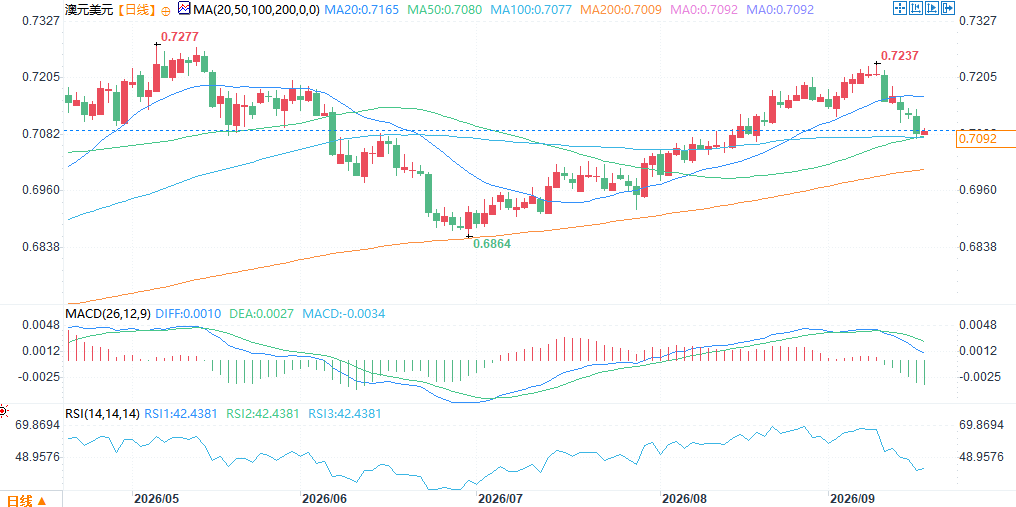 (AUD/USD daily chart, source: FX678)
IMF's key assessment: The Reserve Bank of Australia should be prepared to raise interest rates at any time.
Following its annual consultations with the Australian Treasury, the Reserve Bank of Australia (RBA), and the Prudential Regulation Authority (PRA), the IMF issued a concluding statement noting that persistent underlying inflationary pressures and uncertainty about whether financial conditions are sufficiently restrictive mean the RBA should be prepared to raise interest rates as needed. The IMF maintained its 2020 GDP growth forecast for Australia at 1.9%, but lowered its 2027 forecast to 1.6%, a 0.1 percentage point reduction, attributing the downward revision to the increased likelihood of another RBA rate hike. The IMF noted that inflation remains a key challenge, and weak productivity growth is dragging down economic potential.Key risk: A further surge in global energy prices could trigger a double-inflation effect.
The IMF specifically highlighted a risk: a further sharp rise in global energy prices could have a stronger second-side effect, pushing up inflation expectations and thus requiring further policy tightening by the Reserve Bank of Australia (RBA). The RBA's inflation target range is 2% to 3%. This risk is not hypothetical. Escalating conflict in the Middle East pushed Brent crude oil above $108 per barrel this week, up 35% since early August. Australian consumer prices rose more than expected in July due to a jump in fuel costs, and core inflation was also higher than predicted. Financial markets are pricing in an approximately 80% probability of a 25 basis point rate hike at the RBA's September 29 meeting, with some estimates as high as 87%, and expect the cash rate to reach 4.85% by early 2027. The Federal Reserve's rate hike on Wednesday—the first since 2023—further reinforced the global tightening backdrop facing the RBA.Fiscal Recommendation: Urge federal and state governments to cut spending
In addition to warnings about interest rates, the IMF urged the Australian federal and state governments to cut spending, arguing that a more disciplined budget would help curb rising debt and support inflation control. This assessment is a setback for the Treasurer, who is already under pressure to deliver a compelling narrative on living standards and prosperity. The IMF largely supports the government's adjustments to investor tax settings, while also highlighting some concerns about unintended consequences. The IMF mandate head stated that previous consultations had identified Australia's property tax settings (including negative gearing) as a factor incentivizing households to take on more leverage and invest in housing, thus exacerbating price pressures. He said the government's budget adjustments create a more balanced mix of incentives that could direct more investment to other parts of the economy, calling it a positive change in the tax system that could contribute to housing affordability.Impact on the Australian dollar: IMF warning reinforces hawkish expectations already priced into the market.
The Australian dollar has been declining against the US dollar recently, reaching its lowest point in nearly a month, primarily dragged down by expectations of a Federal Reserve rate hike. The Fed raised interest rates to 3.75%-4.00% on Wednesday, with the dot plot indicating one more rate hike this year. This provided broad support for the US dollar, putting pressure on the Australian dollar along with other non-US dollar currencies. Although the Reserve Bank of Australia's cash rate of 4.35% remains above the Fed's new target range, the interest rate differential advantage failed to materialize. However, domestic policy expectations in Australia are providing another supporting clue for the Australian dollar. On Thursday (September 17) in Asian trading, the Australian dollar fluctuated slightly higher against the US dollar, currently trading around 0.7094, up about 0.1%. The IMF's warning added institutional weight to already priced-in expectations—the RBA could raise rates as early as September 29. This strengthened the support for the Australian dollar to some extent, as the IMF highlighted upside inflation risks rather than downside growth risks as the dominant concern. For the Australian dollar in the near term, the bigger driver of volatility has been energy prices rather than the IMF statement itself, as the 35% surge in Brent crude since early August is, according to the IMF, a direct channel through which the RBA could be forced to act via a double-dip inflation effect. Against the backdrop of the Fed's recent rate hike, the RBA's hawkish stance will align Australia with a broader global tightening pulse, which should be a supportive combination for Australian dollar crosses funded by central bank currencies seen as nearing the end of tightening. (AUD/USD daily chart, source: FX678)In summary, energy prices are the core variable, and the probability of a rate hike by the Reserve Bank of Australia in September is high.
In summary, the IMF's warning provides institutional support for the Reserve Bank of Australia (RBA) to further raise interest rates. The core logic is that energy-driven inflation risks could spread through a second-party effect. The market is pricing in an approximately 80% probability of a rate hike on September 29th, with the cash rate potentially reaching 4.85% by early 2027. On the fiscal front, the IMF urged spending cuts to support inflation control while offering conditional support for tax adjustments for investors. For the Australian dollar, the IMF statement provides marginal support, but the real drivers are the energy price path and the RBA's actual actions. If Brent crude oil remains high or rises further, the probability of an RBA rate hike in September will continue to increase; if energy prices fall, concerns about a second-party effect may ease. The synchronicity of the RBA's September 29th decision with the global tightening pulse is key to determining the short-term direction of the Australian dollar. At 10:11 Beijing time, the Australian dollar was trading at 0.7093/94 against the US dollar.- Risk Warning and Disclaimer
- The market involves risk, and trading may not be suitable for all investors. This article is for reference only and does not constitute personal investment advice, nor does it take into account certain users’ specific investment objectives, financial situation, or other needs. Any investment decisions made based on this information are at your own risk.