Gold prices remained range-bound after the Fed's interest rate hike was announced.
2026-09-17 09:54:09
Spot gold continued to be under pressure in Asian trading on Thursday, with prices briefly approaching $4265 before rebounding back above $4300. Previously, gold prices rose to $4365.57 on September 16th, but following the Federal Reserve's interest rate hike announcement and hawkish signals from Chairman Kevin Warsh after the meeting, gold quickly gave back its gains, falling to around $4240 at one point during the session, a single-day drop of over 1%.  The Federal Reserve raised the target range for the federal funds rate by 25 basis points to 3.75%–4.00%, marking its first rate hike since July 2023. More importantly, the latest economic projections show that most policymakers expect further rate hikes this year, with a median year-end rate forecast of approximately 4.1%. This means that some of the upward momentum in gold prices previously driven by loose monetary policy is being repriced, and the high-interest-rate environment may persist for a longer period. From policy statements, inflation remains one of the Fed's most important policy considerations. Warsh stated that recent inflation data has not shown a sufficiently significant improvement in underlying price pressures and emphasized that the Fed still needs to promote price stability. This has increased market focus on further increases in future financing costs, supporting the dollar and pushing US Treasury yields to high levels. The 10-year Treasury yield previously broke through 5%, further increasing the opportunity cost of holding gold, a non-interest-bearing asset. The simultaneous strengthening of the dollar and yields is a significant direct factor in the recent gold price decline. Gold itself does not generate interest; when US Treasury yields rise, the opportunity cost for investors holding gold increases accordingly. Therefore, even with the Federal Reserve signaling further tightening of monetary policy, and despite continued safe-haven demand in global markets, gold is unlikely to completely escape the pressure from the dollar and real interest rates. However, gold is not currently solely controlled by negative factors. The situation in the Middle East and persistently high energy prices could still strengthen safe-haven demand and influence global interest rate markets through inflation expectations. In particular, with crude oil prices still above $100, energy costs have once again become a significant variable in the US and global inflation outlook. If oil prices rise further and fuel inflation expectations, it could prompt the market to continue pricing in a high-interest-rate environment; but at the same time, escalating geopolitical risks could increase the demand for gold as a safe haven, leading to a clear tug-of-war between bulls and bears in gold prices. The market's focus on gold has therefore shifted from a simple "interest rate cut trade" to a comprehensive interplay of "interest rates, the dollar, yields, and safe-haven demand." Previously, gold's sustained high levels were largely due to fiscal risks, geopolitical risks, and safe-haven inflows. However, with the current shift in the Fed's policy direction, the balance of power between these supporting factors and high interest rate pressures is being readjusted. From a short-term funding sentiment perspective, gold prices surged rapidly before the Fed's decision, followed by a significant pullback, indicating that some bullish funds chose to take profits after the policy was implemented. Data shows that spot gold quickly fell from its intraday high of around $4365 to around $4240, suggesting that the $4300 level has transformed from a previous price center into a crucial battleground between bulls and bears. Going forward, key factors to watch include the US dollar index, US Treasury yields, US inflation data, and subsequent speeches by Fed officials. If the dollar continues to strengthen and long-term yields remain high, the short-term rebound in gold may be limited; if yields fall while geopolitical risks escalate again, gold may regain safe-haven support. Meanwhile, whether oil prices continue to remain high will also influence gold's medium-term trend through inflation and monetary policy expectations. Looking at the daily chart, spot gold previously surged to around $4365 before quickly retreating, and is currently back above $4300, remaining within a short-term range. The current price is below the 100-day moving average, and the technical outlook remains in a correction phase. The Relative Strength Index (RSI) is around 42, not yet in severely oversold territory, indicating that there is still room for further selling pressure. The first resistance level to watch is around $4330, near the 100-day moving average, which has become a significant resistance level for short-term rebounds. Further up, the Bollinger Band middle line is around $4440; only a recapture of this area could significantly improve the weak daily chart structure. On the downside, the key support level is around $4200, near the lower Bollinger Band. If $4200 is breached, gold prices may seek support further towards $4150 or even $4100. Looking at the 4-hour chart, gold formed a temporary high near $4365 before declining rapidly. The short-term moving average structure has weakened, and market momentum is biased towards the bears. The $4300 level is currently a key observation area during this correction. If the price can regain above $4330, it indicates that short-term selling pressure is weakening, and there is a possibility of a rebound towards $4360. However, if the rebound is consistently resisted below $4330, and the $4200 support level is effectively broken, the 4-hour chart may open up further downside potential. Overall, the short-term technical structure remains bearish, but there is some support around $4200, so shorting should also be approached with caution, as a technical rebound is possible.
 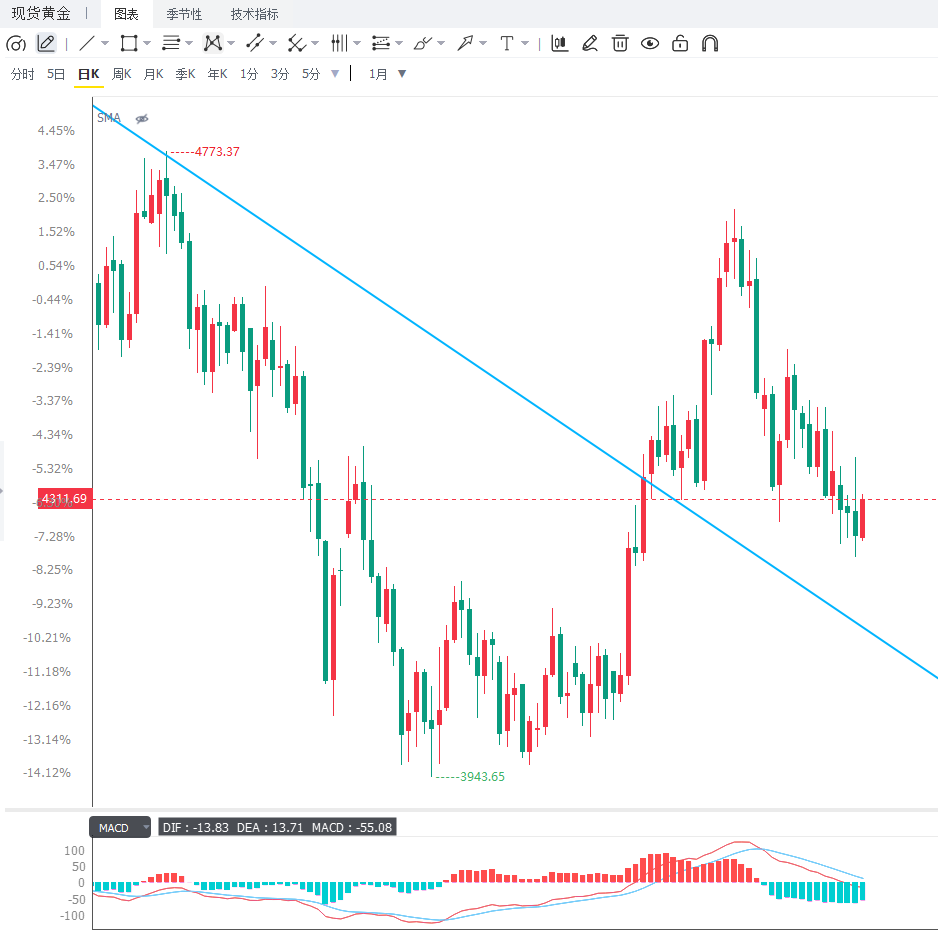 Editor's Summary: The Federal Reserve's interest rate hike after a three-year hiatus, coupled with signals of potential further tightening this year, has made the US dollar and US Treasury yields significant downward pressure on gold again. After falling below $4,300, gold prices haven't broken down significantly, maintaining a range-bound trading pattern. However, geopolitical risks, fiscal concerns, and safe-haven demand may still limit the speed of gold's decline. The key to gold's future direction depends not only on whether the Fed continues to raise rates but also on whether inflation, oil prices, and US Treasury yields can regain sustained upward pressure. $4,200 and $4,330 will be important short-term watch areas, while whether $4,360 can be recovered will be a crucial signal for determining whether gold has ended its current correction.
The Federal Reserve raised the target range for the federal funds rate by 25 basis points to 3.75%–4.00%, marking its first rate hike since July 2023. More importantly, the latest economic projections show that most policymakers expect further rate hikes this year, with a median year-end rate forecast of approximately 4.1%. This means that some of the upward momentum in gold prices previously driven by loose monetary policy is being repriced, and the high-interest-rate environment may persist for a longer period. From policy statements, inflation remains one of the Fed's most important policy considerations. Warsh stated that recent inflation data has not shown a sufficiently significant improvement in underlying price pressures and emphasized that the Fed still needs to promote price stability. This has increased market focus on further increases in future financing costs, supporting the dollar and pushing US Treasury yields to high levels. The 10-year Treasury yield previously broke through 5%, further increasing the opportunity cost of holding gold, a non-interest-bearing asset. The simultaneous strengthening of the dollar and yields is a significant direct factor in the recent gold price decline. Gold itself does not generate interest; when US Treasury yields rise, the opportunity cost for investors holding gold increases accordingly. Therefore, even with the Federal Reserve signaling further tightening of monetary policy, and despite continued safe-haven demand in global markets, gold is unlikely to completely escape the pressure from the dollar and real interest rates. However, gold is not currently solely controlled by negative factors. The situation in the Middle East and persistently high energy prices could still strengthen safe-haven demand and influence global interest rate markets through inflation expectations. In particular, with crude oil prices still above $100, energy costs have once again become a significant variable in the US and global inflation outlook. If oil prices rise further and fuel inflation expectations, it could prompt the market to continue pricing in a high-interest-rate environment; but at the same time, escalating geopolitical risks could increase the demand for gold as a safe haven, leading to a clear tug-of-war between bulls and bears in gold prices. The market's focus on gold has therefore shifted from a simple "interest rate cut trade" to a comprehensive interplay of "interest rates, the dollar, yields, and safe-haven demand." Previously, gold's sustained high levels were largely due to fiscal risks, geopolitical risks, and safe-haven inflows. However, with the current shift in the Fed's policy direction, the balance of power between these supporting factors and high interest rate pressures is being readjusted. From a short-term funding sentiment perspective, gold prices surged rapidly before the Fed's decision, followed by a significant pullback, indicating that some bullish funds chose to take profits after the policy was implemented. Data shows that spot gold quickly fell from its intraday high of around $4365 to around $4240, suggesting that the $4300 level has transformed from a previous price center into a crucial battleground between bulls and bears. Going forward, key factors to watch include the US dollar index, US Treasury yields, US inflation data, and subsequent speeches by Fed officials. If the dollar continues to strengthen and long-term yields remain high, the short-term rebound in gold may be limited; if yields fall while geopolitical risks escalate again, gold may regain safe-haven support. Meanwhile, whether oil prices continue to remain high will also influence gold's medium-term trend through inflation and monetary policy expectations. Looking at the daily chart, spot gold previously surged to around $4365 before quickly retreating, and is currently back above $4300, remaining within a short-term range. The current price is below the 100-day moving average, and the technical outlook remains in a correction phase. The Relative Strength Index (RSI) is around 42, not yet in severely oversold territory, indicating that there is still room for further selling pressure. The first resistance level to watch is around $4330, near the 100-day moving average, which has become a significant resistance level for short-term rebounds. Further up, the Bollinger Band middle line is around $4440; only a recapture of this area could significantly improve the weak daily chart structure. On the downside, the key support level is around $4200, near the lower Bollinger Band. If $4200 is breached, gold prices may seek support further towards $4150 or even $4100. Looking at the 4-hour chart, gold formed a temporary high near $4365 before declining rapidly. The short-term moving average structure has weakened, and market momentum is biased towards the bears. The $4300 level is currently a key observation area during this correction. If the price can regain above $4330, it indicates that short-term selling pressure is weakening, and there is a possibility of a rebound towards $4360. However, if the rebound is consistently resisted below $4330, and the $4200 support level is effectively broken, the 4-hour chart may open up further downside potential. Overall, the short-term technical structure remains bearish, but there is some support around $4200, so shorting should also be approached with caution, as a technical rebound is possible. Editor's Summary: The Federal Reserve's interest rate hike after a three-year hiatus, coupled with signals of potential further tightening this year, has made the US dollar and US Treasury yields significant downward pressure on gold again. After falling below $4,300, gold prices haven't broken down significantly, maintaining a range-bound trading pattern. However, geopolitical risks, fiscal concerns, and safe-haven demand may still limit the speed of gold's decline. The key to gold's future direction depends not only on whether the Fed continues to raise rates but also on whether inflation, oil prices, and US Treasury yields can regain sustained upward pressure. $4,200 and $4,330 will be important short-term watch areas, while whether $4,360 can be recovered will be a crucial signal for determining whether gold has ended its current correction.
- Risk Warning and Disclaimer
- The market involves risk, and trading may not be suitable for all investors. This article is for reference only and does not constitute personal investment advice, nor does it take into account certain users’ specific investment objectives, financial situation, or other needs. Any investment decisions made based on this information are at your own risk.