













The 30-point plunge in the pound is just the tip of the iceberg: the Bank of England is rewriting the QE exit script without raising interest rates, and the bond market is undergoing a repricing process.
2026-09-17 19:10:09
On Thursday (September 17th) at 19:00 Beijing time, the Bank of England announced its interest rate decision. Prior to the decision, the market was largely digesting the recent 25 basis point rate hike by the Federal Reserve, with the US dollar remaining relatively strong and risk asset sentiment leaning towards caution. The pound sterling fluctuated around 1.3400 against the dollar before the announcement, with market expectations largely consistent with surveys: the Monetary Policy Committee voted 6-3 to maintain the interest rate at 3.75%, while the wording regarding the inflation outlook became the focus.  Following the announcement of the decision, the pound fell sharply against the dollar by about 30 points, hitting a low of 1.3378. This immediate reaction was not simply due to the interest rate itself being "in line with expectations," but rather a result of the combined effect of a significant upward revision to the inflation path and hawkish signals in policy communication.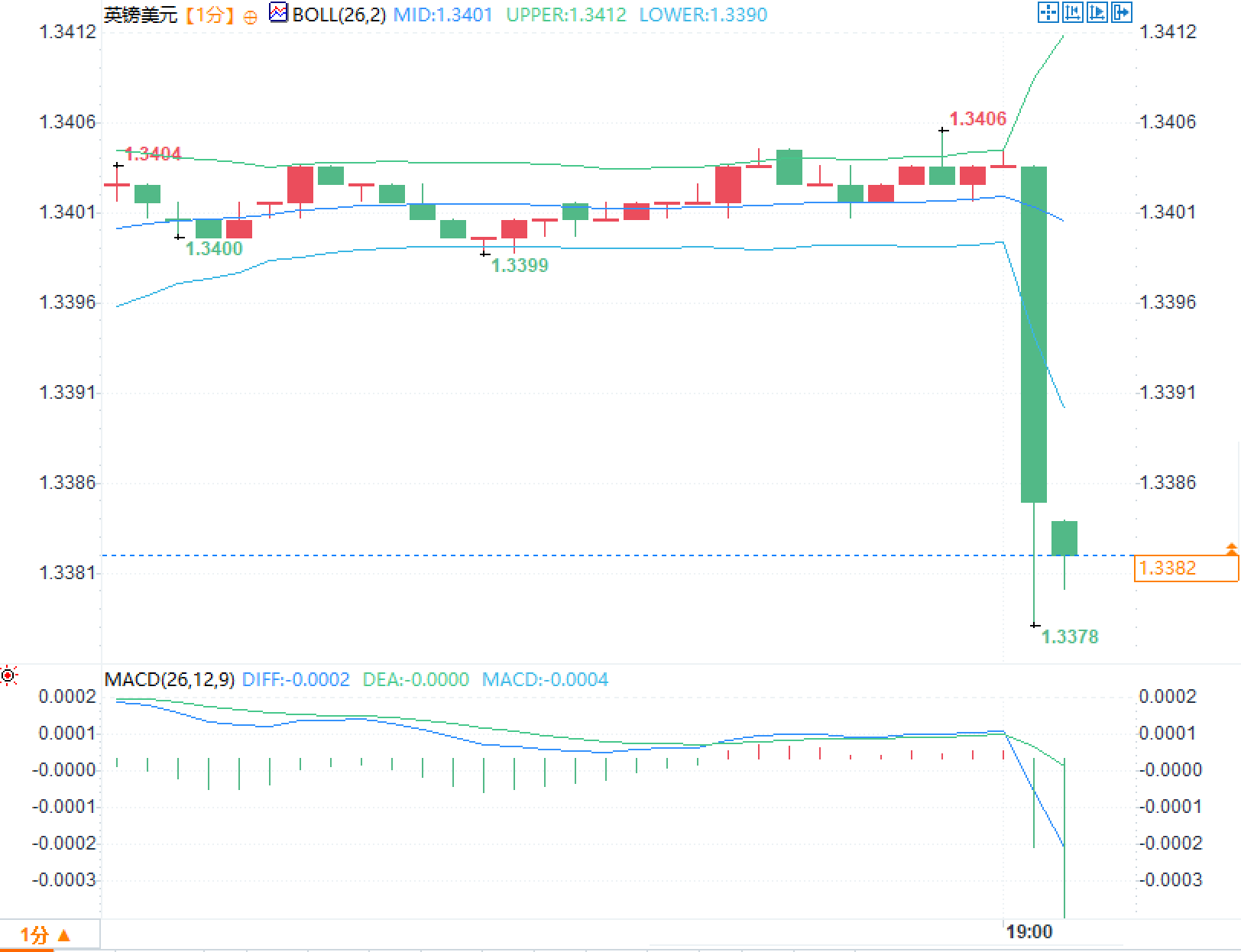
Following the announcement of the decision, the pound fell sharply against the dollar by about 30 points, hitting a low of 1.3378. This immediate reaction was not simply due to the interest rate itself being "in line with expectations," but rather a result of the combined effect of a significant upward revision to the inflation path and hawkish signals in policy communication. Deep interconnect analysis
On the fundamental front, the Bank of England's decision to maintain its interest rate at 3.75% was entirely in line with market expectations, with a 6-3 vote. The three members who voted to raise rates to 4% were Chief Economist Pierre, Green, and Mann, consistent with the survey. What truly changed market pricing was the synchronized adjustment of inflation and policy stance. The Bank of England explicitly stated that inflation risks have tilted further upward relative to its July forecast. The Consumer Price Index (CPI) is expected to exceed 4% in early 2027, significantly higher than the 3.2% peak projected in October-November 2026 in July. Simultaneously, the third-quarter GDP growth forecast was revised upward to 0.4%, up from the previous 0.1%. Governor Bailey directly stated in his statement that if the Middle East conflict persists for a longer period and the risk of a second round of inflation increases, policy tightening may be necessary. The minutes also emphasized that given the time lag in the emergence of a second round of inflation, it is not advisable to wait too long before taking action. Regarding quantitative tightening, the central bank announced a pace of £46 billion per year until 2034, with active sales set at £20 billion per year. It also suspended auctions of gilt-edged bonds through the asset purchase fund until April 2027 and is considering selling some bonds to the government rather than the market. Long-term bonds will continue to be held until maturity to support bank bond issuance. This adjustment reduced recent market supply pressure, but its impact on the interest rate path was overshadowed by inflation warnings. Technical analysis and real-time quotes show that the pound/dollar pair found brief support around 1.3400 before the decision, but after the upward revision of the inflation peak and Bailey's statement about a possible rate hike, the price quickly broke below the lower edge of the short-term trading range, reaching a low of 1.3378. Short-term bearish momentum mainly stemmed from the repricing of interest rate expectations, rather than a simple technical breakdown. For related instruments, this combination directly pressured the pound while providing upward support for gilt-edged bond yields. The contrasting viewpoints clearly reflect the expectation discrepancy. Prior to the decision, institutional accounts generally emphasized that "maintaining interest rates by a 6-3 vote and the wording regarding inflation are key," with most believing the central bank would continue its relatively cautious stance from July. Retail investors focused more on whether there would be a surprise rate hike or a rebound in the pound after the decision was made. After the decision, institutions quickly shifted their focus to the upward revision of inflation to over 4% and Bailey's explicit warnings about Middle East risks, viewing this as a hawkish shift. Retail investors were generally surprised by the rate decline despite maintaining the rate, concentrating on the core change that "inflation is stickier than expected." The difference in expectations mainly lies in the magnitude of the inflation path and the forward-looking nature of policy communication, rather than the interest rate decision itself.Trend Outlook
Short-term market movements will continue to price in upward revisions to the inflation peak and the potential risk of interest rate hikes. After hitting an immediate low of around 1.3378 against the US dollar, the price is likely to remain below the pre-decision trading range if no new easing signals emerge. Gilt bond yields react more directly to inflation warnings, and the repricing of short- and medium-term interest rates is still underway. The medium- to long-term logic depends on the evolution of the Middle East situation and whether a second-round effect truly emerges; central banks have clearly placed these two factors in a prominent position in their policy considerations. The market will prioritize reflecting this shift in communication rather than a single interest rate decision.Further Reading
Q: Why did maintaining interest rates cause the pound to fall? The market had already fully priced in the 6-3 vote to maintain 3.75%. What truly exceeded expectations was the upward revision of the inflation peak from 3.2% to over 4% in early 2027, and Bailey's explicit mention that policy tightening might be necessary if the Middle East conflict continued. Interest rates themselves are neutral; the simultaneous hawkish shift in inflation and policy stance led to an upward revision of interest rate expectations, thus suppressing the pound. Q: How significant was the influence of the rate-hike camp in the 6-3 vote? Pierre, Green, and Mann voted again to raise rates to 4%, consistent with July. More importantly, Bailey and several deputy governors increased the likelihood of future rate hikes in the minutes. The voting result remained unchanged, but the overall communication focus shifted from "wait and see" to "risks skewed to the upside." Q: What does the quantitative tightening adjustment mean for the market? The central bank set the pace of active sales at £20 billion per year and suspended auctions until April 2027, while considering sales to the government rather than the market. This reduced the recent supply pressure on gilts, but the dominant role of inflation warnings still overshadowed the easing effect on the supply side. Q: How do the upward revisions to Q3 GDP and inflation coexist? The central bank raised its Q3 growth forecast from 0.1% to 0.4%, indicating some improvement in demand. At the same time, the lagged effects of global energy price volatility are assessed as potentially pushing inflation above 4%. The simultaneous upward revisions to growth and inflation reinforce the logic that policy may need to maintain a restrictive stance for a longer period. Q: What is the core contradiction in market pricing after the decision? On one hand, there is the relatively moderate adjustment to the pace of quantitative tightening while maintaining interest rates; on the other hand, there is a significant upward revision to the inflation path and a clear warning of the risk of interest rate hikes. The market prioritizes the latter, leading to short-term pressure on the pound and a recalibration of interest rate expectations. Subsequent trends will depend on the actual evolution of the Middle East situation and the second-round effect.- Risk Warning and Disclaimer
- The market involves risk, and trading may not be suitable for all investors. This article is for reference only and does not constitute personal investment advice, nor does it take into account certain users’ specific investment objectives, financial situation, or other needs. Any investment decisions made based on this information are at your own risk.

