The US-Canada rivalry escalates: Canada turns to the EU.
2026-09-17 21:10:10
On the North American continent, the economic and geopolitical landscape deeply intertwined between the United States and Canada for decades is undergoing a radical transformation. Since the summer of 2026, the Trump administration has continuously imposed harsh trade sanctions on Canada, significantly raising import tariffs and introducing numerous import bans, plunging the once close North American bilateral trade into severe turmoil. The US has successively imposed a 50% tariff and announced a ban on the import of Canadian dairy products, alcoholic beverages, and high-displacement motorcycles starting at the end of September, escalating trade barriers layer by layer. Faced with unilateral pressure from the US, Canadian Prime Minister Carney responded forcefully, introducing retaliatory tariffs totaling approximately $20 billion, covering hundreds of categories of US goods including home appliances, furniture, agricultural products, steel, and daily necessities, officially launching a large-scale two-way trade war. Bilateral trade negotiations have completely broken down, the traditional tacit understanding between the US and Canada as important trading partners has shattered, and Canada has begun to accelerate its efforts to reduce its single economic dependence on the United States. 
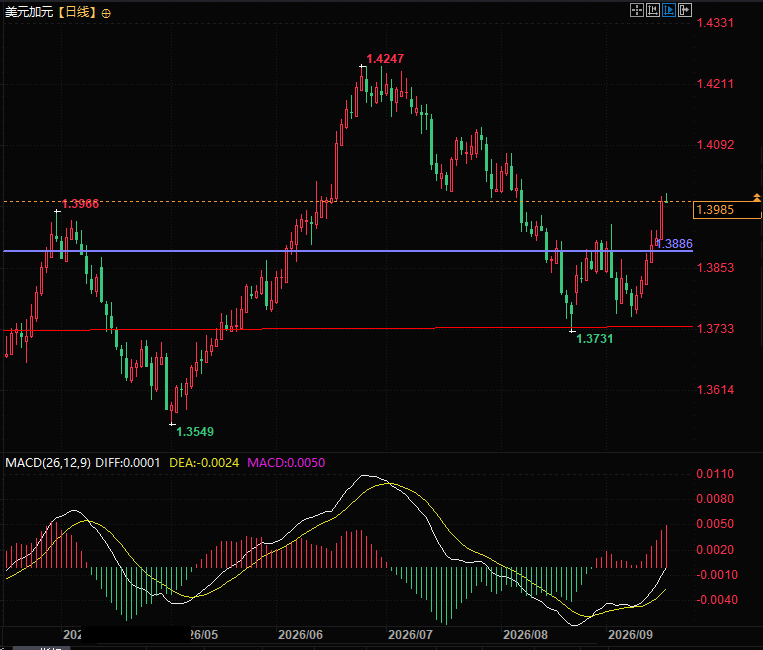 (USD/CAD daily chart, source: EasyForex) At 21:07 Beijing time, USD/CAD is currently trading at 1.3987/88.
Canada's alliance with the EU is impacting the existing trade structure between Europe and the US.
Amidst the continued deterioration of US-Canada relations, the EU has formally launched a major cooperation proposal to Canada. In her annual State of the Union address, European Commission President Ursula von der Leyen announced that the EU would push for Canada to become the first linked member state in its history, marking a shift in EU-Canada cooperation from traditional trade relations to a comprehensive strategic alliance encompassing economics, security, and technology. In fact, the EU and Canada already have a mature economic and trade foundation; the CETA comprehensive trade agreement, which came into effect provisionally in 2017, has achieved zero tariffs on 99% of goods. This linked member state cooperation will fundamentally upgrade the level of cooperation, with both sides planning to deeply integrate in areas such as high-end manufacturing, defense industry, artificial intelligence, climate change, Arctic security, and energy cooperation, building a new transatlantic economic and security community. It is noteworthy that the EU previously showed a lukewarm attitude towards the linked member state proposal for Ukraine, but now prioritizes Canada, fully reflecting the EU's new strategic approach of "diversifying partnerships and reducing single-source dependence." Meanwhile, Carney also met with the British Prime Minister to deepen multilateral defense and economic cooperation, further expanding Canada's diplomatic and economic footprint.Trump strongly opposed the deal, calling the Canada-EU cooperation "absurd and hostile."
Canada's strategic shift towards "leaving the US and aligning with the EU" has sparked strong discontent in the United States. Trump publicly ridiculed Canada's pursuit of EU membership as "ridiculous," calling Canada a "bad trading partner" and issuing severe trade threats. He stated that if the EU insists on pursuing this cooperation, it will be considered a hostile act against the US, leading to the imposition of high punitive tariffs on the EU and even a complete suspension of many US-EU trade agreements. This strong stance from the US has escalated the original bilateral trade conflict between the US and Canada into a geopolitical and economic game spanning the US, Canada, and the EU. Cracks have appeared in the traditional North American alliance system, and the long-standing US-dominated North American economic and trade order and transatlantic structure are showing signs of weakening.Canada takes a firm stance: upholding sovereignty and choosing its own partners.
Faced with extreme pressure and threats from the United States, Carney publicly defended Canada's diplomatic and economic sovereignty in the European Parliament. While not directly naming Trump, he precisely criticized the current global chaos: tariffs, financial instruments, and supply chains are being forcibly weaponized, becoming tools for major powers to coerce other countries. Carney emphasized that Canada will never accept external interference in its domestic and foreign policy choices, and no country can interfere with or influence Canada's culture, language, or international cooperation agreements. He also specifically clarified that the Canada-EU alliance is not about creating a new camp to confront the United States; Canada has no intention of seeking hegemony or containing other countries. Its core objective is to strengthen national resilience and sovereignty, preventing its market, democratic system, and territorial security from being controlled by a single external power. Furthermore, Carney explicitly stated that the cooperation framework between Canada and EU member states is not finalized and will undergo multiple rounds of debate and voting in the Canadian Parliament. The entire cooperation process will be open, transparent, and controllable.The geopolitical game has come to fruition, directly impacting the exchange rate trends of the US dollar and Canadian dollar.
Despite Canada's active engagement in European multilateral cooperation, the United States remains Canada's core trade, investment, and financial market. The deep economic ties between the US and Canada are unlikely to reverse in the short term, and this escalating geopolitical and trade rivalry has become the core pricing logic for the USD/CAD exchange rate. As a typical commodity currency, the Canadian dollar is highly dependent on exports to the US, the energy supply chain, and demand in the North American market. From an exchange rate perspective: when US-Canada trade friction intensifies, the US escalates tariffs, and the market worries about pressure on Canadian exports, the Canadian dollar generally weakens, and the USD/CAD exchange rate rises; conversely, when both sides release signals of easing tensions, and EU-Canada cooperation benefits Canadian economic diversification, the Canadian dollar gains support, and the USD/CAD exchange rate falls under pressure. The future trend of the USD/CAD exchange rate will be dominated by two main themes in the long term: first, the pace of the implementation of US-Canada tariff policies and geopolitical events such as the progress of negotiations between EU member states; and second, changes in the interest rate differential between the Federal Reserve and the Bank of Canada. Every escalation and easing of the North American geopolitical rivalry will continue to disrupt market expectations and determine the medium- to long-term fluctuation trend of the USD/CAD exchange rate. (USD/CAD daily chart, source: EasyForex) At 21:07 Beijing time, USD/CAD is currently trading at 1.3987/88.
- Risk Warning and Disclaimer
- The market involves risk, and trading may not be suitable for all investors. This article is for reference only and does not constitute personal investment advice, nor does it take into account certain users’ specific investment objectives, financial situation, or other needs. Any investment decisions made based on this information are at your own risk.