













Improved supply signals from Saudi Arabia and a decline in US Treasury yields have led to a temporary rebound in the rupee.
2026-09-18 15:32:13
The Indian rupee opened sharply higher against the US dollar on Friday (September 18), with the dollar/rupee pair retreating from a more than seven-week high of 96.10 reached on Thursday to around 95.80. The rupee benefited from a pause in the rise in oil prices and US Treasury yields. The rupee had previously fallen significantly this week, and Friday's rebound indicated a temporary easing of external pressure. The significant pullback in the dollar/rupee pair reflects a temporary reduction in selling pressure on the rupee. 
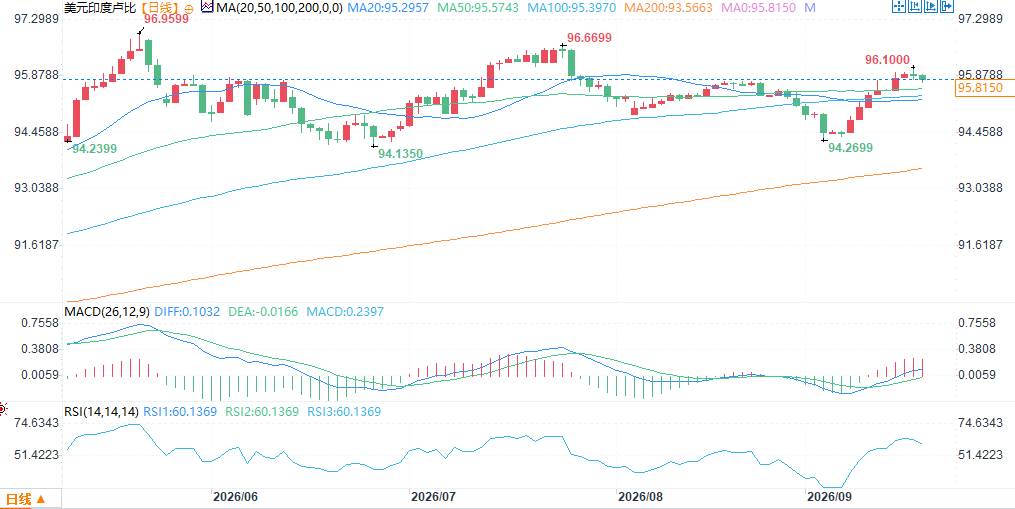 (USD/INR daily chart, source: FX678) At 15:28 Beijing time, the USD/INR exchange rate was 95.80/81.
Oil prices fell as Saudi supply signals improved the outlook for Middle East liquidity.
The MCX crude oil contract expiring on September 21 traded at around 9,688 rupees, having retreated from a multi-month high of 10,238 rupees reached earlier this week. The decline in oil prices provided relief for currencies in economies heavily reliant on oil for energy needs, such as India. Analysts from a prominent institution pointed to improved prospects for Middle Eastern oil flows as the price decline was attributed to Saudi Arabia increasing tanker loadings in the Gulf and ramping up crude oil sales outside the Strait of Hormuz, as Saudi Arabia sought to transport more barrels through the strait after the closure of the East-West pipeline. The institution added that the supply picture was further supported by reports that Saudi Arabia aimed to restore about half of the East-West pipeline's capacity within days and to full capacity within about six weeks. This eased concerns about escalating energy supply tensions following drone attacks by Houthi rebels in Yemen on pipeline facilities near Riyadh and Medina.US Treasury yields: have fallen from 2019 highs to around 4.94%.
U.S. Treasury yields cooled from their gains of the past few weeks after oil prices retreated. The 10-year Treasury yield traded near a weekly low of 4.94%, after hitting a 19-year high of 5.04% on Tuesday. Lower U.S. Treasury yields have increased the attractiveness of risk-sensitive assets such as the Indian rupee. Furthermore, market experts believe that the Federal Reserve's rate hike on Wednesday boosted the central bank's credibility, also putting downward pressure on U.S. Treasury yields. The decline in yields provided spread support for the rupee, easing the pressure from the earlier surge in U.S. Treasury yields this week.Institutional View: Hawkish Pricing, Credit Enhancement, and Growth Concerns Should Keep Yields Under Control
According to well-known institutions, the combination of a hawkish Fed pricing strategy, enhanced credibility as an inflation hedge, and concerns about the impact of higher interest rates on growth should help keep 10-year yields under control. This assessment provides support for the rupee's short-term outlook: if US Treasury yields do not surge further, the external pressure on the rupee will ease. While Fed rate hikes are theoretically bearish for emerging market currencies, if the hikes are successful in enhancing policy credibility and lowering long-term yields, the net impact on the rupee may be neutral or even positive.In summary, the decline in both oil prices and yields provided a breather for the rupee, but its sustainability depends on two major variables.
In summary, the Indian rupee rebounded on Friday from a seven-week high, primarily driven by a pause in the rise of both oil prices and US Treasury yields. Improved Saudi supply signals and expectations of pipeline resumption pressured oil prices, while the Fed's rate hike boosted credibility and growth concerns weighed on yields. This provided a short-term respite for the rupee, but its sustainability depends on two variables: whether the Saudi pipeline resumption will proceed as expected and whether oil prices can maintain their decline; and whether US Treasury yields can remain under control as institutions anticipate. If both continue to improve, the rupee may further recover its losses this week; if oil prices surge again or yields rise again, the rupee will face renewed pressure. Going forward, attention should be paid to the progress of the Saudi pipeline resumption, the trend of US Treasury yields, the pricing of the Fed's October rate hike, and whether the Reserve Bank of India will continue to intervene. (USD/INR daily chart, source: FX678) At 15:28 Beijing time, the USD/INR exchange rate was 95.80/81.
- Risk Warning and Disclaimer
- The market involves risk, and trading may not be suitable for all investors. This article is for reference only and does not constitute personal investment advice, nor does it take into account certain users’ specific investment objectives, financial situation, or other needs. Any investment decisions made based on this information are at your own risk.

