













Falling oil prices cooled US Treasury yields, while silver rebounded sharply, returning to the upper edge of its trading range.
2026-09-18 15:50:09
Silver prices continued their rebound in Asian trading on Friday, with spot silver briefly approaching the $67 mark again, marking its second consecutive day of gains. Recent declines in oil prices from their highs have eased market concerns about further inflation driven by energy prices, leading to a drop in US Treasury yields and providing some support for silver, a non-interest-bearing asset.  The decline in oil prices is related to the gradual recovery of Saudi Arabia's crude oil transportation capacity. Previously, the market was highly wary of global supply risks and further energy price increases due to damage to Saudi Arabia's East-West pipeline. However, with Saudi Arabia's efforts to restore some transportation capacity, supply tightness expectations have eased, leading to a continuous decline in international oil prices. Cooling energy prices not only directly alleviate inflationary pressures but also reduce market concerns about further tightening of monetary policy by major central banks globally, thereby improving the interest rate environment for precious metals. Changes in the US bond market further reinforce this logic. The yield on the 10-year US Treasury note briefly broke through 5% during the week before falling back to around 4.93%. Lower yields mean a lower opportunity cost for holding non-interest-bearing assets like silver, thus providing new buying support for silver. Recently, both gold and silver have seen significant rebounds, as the market reassesses the impact of the Fed's interest rate hikes on real interest rates and economic growth. However, the rise in silver prices does not mean that the hawkish pressure from the Fed has disappeared. The Fed raised its policy rate by 25 basis points this week to 3.75%-4.00% and signaled that further rate hikes are possible this year. Federal Reserve Chairman Warsh emphasized that U.S. inflation remains high, and recent summer data has not shown a significant improvement in underlying inflation trends. The hawkish policy stance keeps the market focused on the future path of interest rate hikes. CME FedWatch data shows that the market currently expects a 53.1% probability of another Fed rate hike in October, up from 44% the previous day. This means that while recent declines in oil prices and yields have provided support for silver, the interest rate market has not fully shifted to easing. If subsequent U.S. inflation data continues to be high, and U.S. Treasury yields approach 5% again, silver may face renewed pressure. It is worth noting that silver has a more pronounced industrial attribute compared to gold; therefore, its price is not only affected by the dollar, real interest rates, and monetary policy, but also closely related to global economic growth expectations. With major central banks worldwide maintaining tight policies, if high interest rates persist longer than previously expected, industrial demand may be suppressed, thus limiting silver's medium-term upside potential. However, recent price performance suggests that silver's ability to absorb the hawkish Fed stance has improved. Following the Fed's rate hike on September 16th, silver initially fell to around $61.90, but subsequently rebounded quickly to around $66, indicating some buying support at lower levels. While digesting the impact of the rate hike, the market is also refocusing on the positive effects of declining oil prices, falling yields, and a dollar adjustment. Silver's subsequent movement is therefore caught in a tug-of-war between these two forces. On one hand, lower oil prices can alleviate inflationary pressures and push down US Treasury yields, providing direct support for silver prices; on the other hand, the Fed may still raise rates further, and if the dollar and real interest rates strengthen again, silver's rebound could be suppressed. From a market sentiment perspective, silver has rebounded significantly from this week's lows recently, and after the short-term gains expanded, profit-taking should be watched closely. If oil prices continue to fall and US yields remain below 5%, silver may continue to test higher resistance levels; if yields rise rapidly again, the support near previous lows should be retested. On the daily chart, silver has rebounded rapidly from around $61.90, currently standing above $65 and extending towards $67. The short-term price structure has improved significantly, with buying pressure regaining control of the market. $67 is a key short-term resistance level; a decisive break above this level would target $68.00 and then $70.00. Technical data suggests that silver's break above $66.56 could open up further upside potential. The first support level to watch is around $5.50, close to the recent breakout area; further support lies in the $62.80-$63.00 area, followed by this week's low near $61.90. If silver falls below $62.80 again, the recent rebound may weaken significantly, and a retest of $61 or even $60 is possible. On the 4-hour chart, silver maintains a clear upward trend in the short term, with the price regaining its position above the upper edge of the recent consolidation range, and short-term moving averages beginning to correct upwards. $67 forms the first resistance zone. If the price breaks through $67 on the 4-hour chart, the bulls may continue to test $68.00 and $70.00. If the price rises and then falls back below $65, the short-term uptrend may enter a correction phase. Overall, silver is currently in a crucial confirmation phase after a rapid rebound. $67 is an important level for judging whether the short-term uptrend can continue, while $62.80 to $63.00 is a relatively important support zone for pullbacks.
 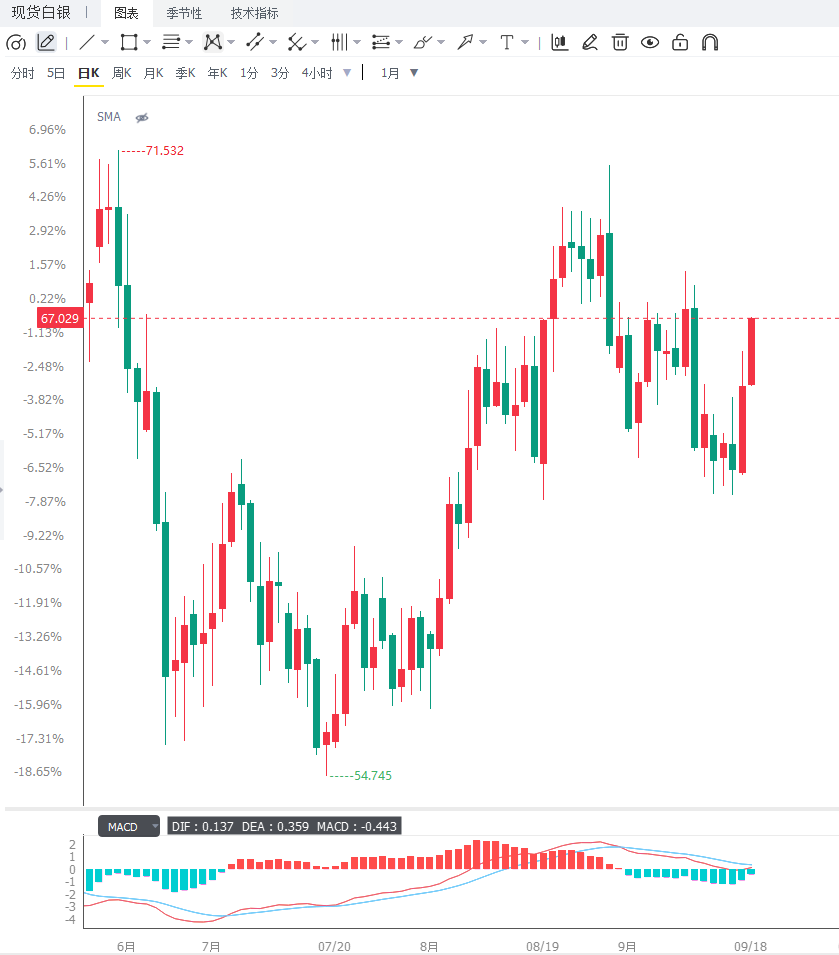 Editor's Summary: Falling oil prices eased inflation concerns, and the US 10-year Treasury yield retreated from around 5% to approximately 4.93%, creating a favorable short-term macroeconomic environment for a silver rebound. Silver subsequently rose for the second consecutive day, approaching the $67 mark again. However, the Federal Reserve raised interest rates by 25 basis points this week and continued to release hawkish signals, with market expectations for another rate hike in October rising to around 53.1%. Therefore, silver is currently in an environment of balancing interest rate pressure and yield decline support. The key focus in the short term is whether $67 can be effectively broken. If oil prices continue to fall and the dollar and US Treasury yields weaken simultaneously, the silver rebound may extend to the $68 or even $70 area; conversely, if US yields re-expose 5% and push the dollar stronger, silver may retest the support around $63.
The decline in oil prices is related to the gradual recovery of Saudi Arabia's crude oil transportation capacity. Previously, the market was highly wary of global supply risks and further energy price increases due to damage to Saudi Arabia's East-West pipeline. However, with Saudi Arabia's efforts to restore some transportation capacity, supply tightness expectations have eased, leading to a continuous decline in international oil prices. Cooling energy prices not only directly alleviate inflationary pressures but also reduce market concerns about further tightening of monetary policy by major central banks globally, thereby improving the interest rate environment for precious metals. Changes in the US bond market further reinforce this logic. The yield on the 10-year US Treasury note briefly broke through 5% during the week before falling back to around 4.93%. Lower yields mean a lower opportunity cost for holding non-interest-bearing assets like silver, thus providing new buying support for silver. Recently, both gold and silver have seen significant rebounds, as the market reassesses the impact of the Fed's interest rate hikes on real interest rates and economic growth. However, the rise in silver prices does not mean that the hawkish pressure from the Fed has disappeared. The Fed raised its policy rate by 25 basis points this week to 3.75%-4.00% and signaled that further rate hikes are possible this year. Federal Reserve Chairman Warsh emphasized that U.S. inflation remains high, and recent summer data has not shown a significant improvement in underlying inflation trends. The hawkish policy stance keeps the market focused on the future path of interest rate hikes. CME FedWatch data shows that the market currently expects a 53.1% probability of another Fed rate hike in October, up from 44% the previous day. This means that while recent declines in oil prices and yields have provided support for silver, the interest rate market has not fully shifted to easing. If subsequent U.S. inflation data continues to be high, and U.S. Treasury yields approach 5% again, silver may face renewed pressure. It is worth noting that silver has a more pronounced industrial attribute compared to gold; therefore, its price is not only affected by the dollar, real interest rates, and monetary policy, but also closely related to global economic growth expectations. With major central banks worldwide maintaining tight policies, if high interest rates persist longer than previously expected, industrial demand may be suppressed, thus limiting silver's medium-term upside potential. However, recent price performance suggests that silver's ability to absorb the hawkish Fed stance has improved. Following the Fed's rate hike on September 16th, silver initially fell to around $61.90, but subsequently rebounded quickly to around $66, indicating some buying support at lower levels. While digesting the impact of the rate hike, the market is also refocusing on the positive effects of declining oil prices, falling yields, and a dollar adjustment. Silver's subsequent movement is therefore caught in a tug-of-war between these two forces. On one hand, lower oil prices can alleviate inflationary pressures and push down US Treasury yields, providing direct support for silver prices; on the other hand, the Fed may still raise rates further, and if the dollar and real interest rates strengthen again, silver's rebound could be suppressed. From a market sentiment perspective, silver has rebounded significantly from this week's lows recently, and after the short-term gains expanded, profit-taking should be watched closely. If oil prices continue to fall and US yields remain below 5%, silver may continue to test higher resistance levels; if yields rise rapidly again, the support near previous lows should be retested. On the daily chart, silver has rebounded rapidly from around $61.90, currently standing above $65 and extending towards $67. The short-term price structure has improved significantly, with buying pressure regaining control of the market. $67 is a key short-term resistance level; a decisive break above this level would target $68.00 and then $70.00. Technical data suggests that silver's break above $66.56 could open up further upside potential. The first support level to watch is around $5.50, close to the recent breakout area; further support lies in the $62.80-$63.00 area, followed by this week's low near $61.90. If silver falls below $62.80 again, the recent rebound may weaken significantly, and a retest of $61 or even $60 is possible. On the 4-hour chart, silver maintains a clear upward trend in the short term, with the price regaining its position above the upper edge of the recent consolidation range, and short-term moving averages beginning to correct upwards. $67 forms the first resistance zone. If the price breaks through $67 on the 4-hour chart, the bulls may continue to test $68.00 and $70.00. If the price rises and then falls back below $65, the short-term uptrend may enter a correction phase. Overall, silver is currently in a crucial confirmation phase after a rapid rebound. $67 is an important level for judging whether the short-term uptrend can continue, while $62.80 to $63.00 is a relatively important support zone for pullbacks. Editor's Summary: Falling oil prices eased inflation concerns, and the US 10-year Treasury yield retreated from around 5% to approximately 4.93%, creating a favorable short-term macroeconomic environment for a silver rebound. Silver subsequently rose for the second consecutive day, approaching the $67 mark again. However, the Federal Reserve raised interest rates by 25 basis points this week and continued to release hawkish signals, with market expectations for another rate hike in October rising to around 53.1%. Therefore, silver is currently in an environment of balancing interest rate pressure and yield decline support. The key focus in the short term is whether $67 can be effectively broken. If oil prices continue to fall and the dollar and US Treasury yields weaken simultaneously, the silver rebound may extend to the $68 or even $70 area; conversely, if US yields re-expose 5% and push the dollar stronger, silver may retest the support around $63.
- Risk Warning and Disclaimer
- The market involves risk, and trading may not be suitable for all investors. This article is for reference only and does not constitute personal investment advice, nor does it take into account certain users’ specific investment objectives, financial situation, or other needs. Any investment decisions made based on this information are at your own risk.

