













Escalating US-Iran financial sanctions and multi-country consultations lower oil risk premium
2026-09-18 16:08:09
On Friday (September 18th) during the Asian and European sessions, international oil prices continued to decline. The WTI crude oil October futures contract fell, almost erasing all of Thursday's rebound. Currently, WTI October futures are trading around 99.52, while the November contract, currently the most actively traded, has fallen to around 94.88. The market expects the overall upward trend in oil prices to slow over the next two months. The US-Iran conflict has entered a critical stage of competition, with signals of diplomatic easing and Middle East geopolitical risks offsetting each other. The sudden seizure of a ship in the Strait of Hormuz and the Houthi attacks on Saudi energy facilities pushed up oil prices, but Saudi Arabia's implementation of measures to guarantee oil exports, combined with the opening of the diplomatic window at the UN General Assembly, led to a decline in international oil prices from their highs, resulting in a short-term marginal easing of tensions in the Middle East oil supply chain. Generally, when oil prices are high, attention is focused on US and international developments; when oil prices fall, attention is focused on Iran's retaliation. 
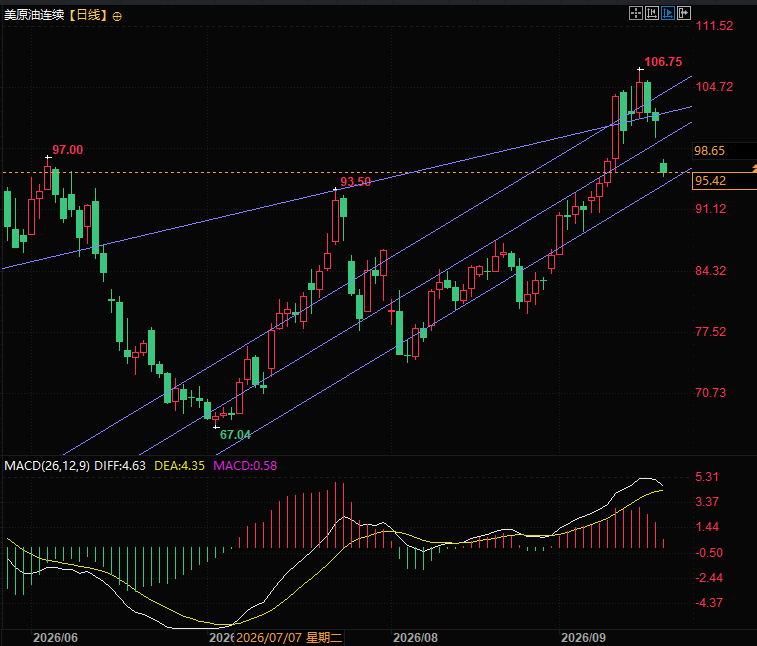 (WTI crude oil futures daily chart, the main contract is the November contract, source: EasyTrade) WTI crude oil futures are currently trading at $95.43 per barrel.
Turbulence reignites in the Strait of Hormuz, keeping shipping risks high.
On September 18, Iran seized the Togolese oil tanker "M/T Trend," accusing it of illegally transiting the Strait of Hormuz. The incident occurred 16 nautical miles northeast of Hasab, Oman. British maritime authorities have confirmed the incident. Due to the conflict, commercial traffic through the strait has drastically decreased, with many oil tankers turning off their positioning systems and navigating covertly, disrupting navigation. As a core global energy corridor, the disruption to strait transport continues to put pressure on the global crude oil supply chain, directly impacting port operations, shipping costs, fuel prices, and import/export trade in the Gulf region.The UN General Assembly opens a diplomatic window, and multilateral consultations between the US and Iran, and in the Gulf are about to be finalized.
The biggest positive development in this round is the thawing of diplomatic tensions: the US allowed the Iranian delegation to attend the UN General Assembly in New York, and the Iranian president will deliver a speech on September 23, opening a formal window for dialogue between the US and Iran. Trump stated that Iran is willing to reach a ceasefire agreement but will not accept the US terms for the time being, and confirmed that he has made direct contact with Iranian officials. There has been no official response from Iran yet. Next week during the UN General Assembly, Trump will meet with the leaders of the six Gulf Cooperation Council (GCC) member states to focus on core issues such as Gulf energy security, the restoration of shipping in the Strait of Hormuz, the threat of Iranian-linked armed groups, oil price volatility, and the post-war regional security landscape. At the regional level, the UAE adheres to a strategy of "deterrence and self-defense + diplomatic dialogue." The Crown Prince of Abu Dhabi has previously met with the Iranian president, and multiple countries have simultaneously intervened in mediation to help de-escalate the situation.Saudi Arabia's crude oil exports were put under pressure due to continued Houthi attacks, but the country quickly took measures to mitigate the impact.
The Houthi rebels in Yemen continue their attacks on Saudi Arabia's energy and security systems, recently seizing a strategic Red Sea port and gaining control of shipping in the Bab el-Mandeb Strait, effectively blocking Saudi Arabia's Red Sea oil export route. On the 18th, debris from a Houthi drone attack landed in Saudi Arabia's Taif province, resulting in one death, two serious injuries, and damage to construction vehicles, further escalating regional military tensions. The previously attacked Saudi East-West oil pipeline (with a daily capacity of 4-5 million barrels, a core export pipeline bypassing the Strait of Hormuz) was temporarily shut down, leading to the cancellation of multiple European crude oil shipments and triggering market supply panic. Pipeline repairs are progressing steadily and are expected to be completed within days, potentially restoring a daily capacity of 2-2.5 million barrels. Simultaneously, Saudi Arabia quickly activated its backup plan, conducting ship-to-ship crude oil transshipment in the Gulf of Oman, bypassing high-risk shipping lanes to ensure Asian crude oil supplies and effectively alleviating market anxiety. Analysts indicate that the continued improvement in navigation in the Strait of Hormuz will further mitigate the geopolitical risk premium associated with crude oil.The US has escalated financial sanctions and blocked channels for Iranian oil transactions.
On September 18, the United States announced sanctions against Iranian cryptocurrency exchanges, accusing them of channeling approximately $1 billion to the Iranian Revolutionary Guard Corps (IRGC) and providing covert settlement channels for crude oil trade to circumvent shipping and financial sanctions. This is a significant blow to the IRGC's cash flow. These sanctions precisely target Iran's safe-haven trading channels, further compressing its crude oil exports and cash flow, exacerbating economic pressure on Iran, and increasing its bargaining power in subsequent US-Iran negotiations.Market Summary and Outlook
Benefiting from the repair of Saudi energy facilities, the relocation of crude oil supplies, and expectations of diplomatic easing, international oil prices ended a three-week winning streak and entered a weekly correction. However, due to lingering risks in the Strait of Hormuz and the Red Sea, and recurring regional military conflicts, the downside potential for crude oil is limited, and it is expected to maintain a high-level fluctuation pattern. Current oil prices still directly reflect the relative strengths and weaknesses of the US-Iran situation. The US tends to manipulate oil prices when they rise, while Iran seizes opportunities to exert pressure when prices fall. However, high energy prices are detrimental to the interests of most countries globally, so persistently high oil prices face considerable pressure. The market has already priced November oil prices around $95. Next week's multilateral consultations at the UN General Assembly and interactions between the US and Iran will be crucial in determining the future situation in the Middle East and the trend of oil prices. (WTI crude oil futures daily chart, the main contract is the November contract, source: EasyTrade) WTI crude oil futures are currently trading at $95.43 per barrel.
- Risk Warning and Disclaimer
- The market involves risk, and trading may not be suitable for all investors. This article is for reference only and does not constitute personal investment advice, nor does it take into account certain users’ specific investment objectives, financial situation, or other needs. Any investment decisions made based on this information are at your own risk.

