Easing geopolitical tensions reduced oil price risks, and multiple macroeconomic factors combined to drive gold prices higher against the trend.
2026-09-18 18:00:09
On Friday (September 18), spot gold rose for the second consecutive day, repeatedly hitting new weekly highs, and is currently trading at $4391 per ounce. This round of market movement is highly distinctive: yields on US Treasury bonds (2-30 years) are rising across the board, and the US dollar index is strengthening in tandem, yet gold is rising against the trend, breaking the traditional interest rate pricing framework. Behind this is a confluence of multiple factors, including Middle East geopolitical tensions, marginal changes in global inflation, the repair of the US Treasury yield curve, a rebound in risk appetite, and policy maneuvering. 
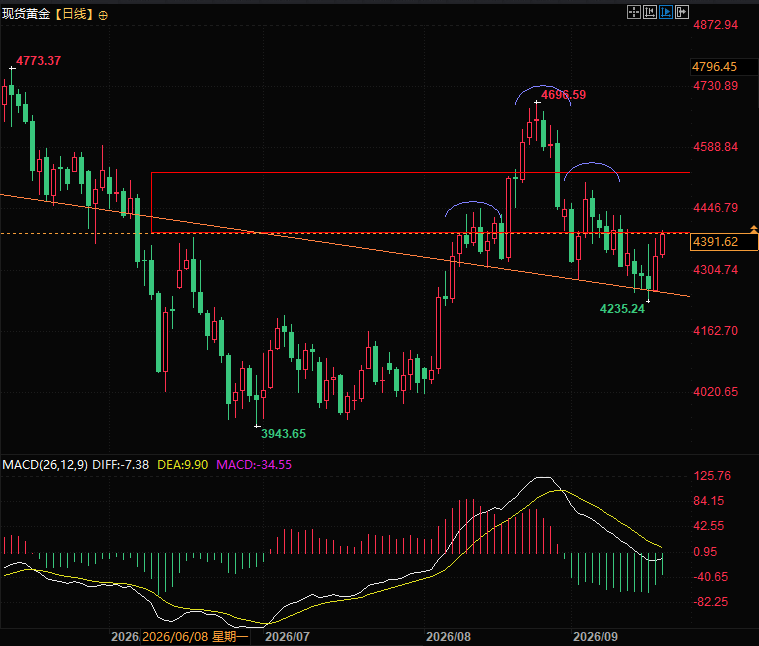 (Spot gold daily chart, source: EasyTrade) At 17:55 Beijing time, spot gold is currently trading at $4391 per ounce.
Diplomatic signals from the Middle East have eased the tail risks of rising oil prices.
The United States has agreed to allow Iranian leaders to attend the UN General Assembly in New York, with the Iranian president scheduled to address the assembly on September 23. Trump has stated that he is making a major decision regarding war with Iran and plans to consult with the six Gulf states on the aftermath of the conflict during the General Assembly; simultaneously, he has signaled that the US maintains direct communication with Iran and that there is room for negotiation. Market interpretation suggests that the probability of a large-scale military escalation in the short term has decreased, significantly reducing the tail risk of the surge in oil prices. Previously, the core concern suppressing gold prices was that the Strait of Hormuz conflict would push up oil prices, forcing global central banks to maintain a longer tightening cycle; the easing of oil price expectations directly removes this major negative factor.A stronger dollar failed to suppress gold prices, with strong buying pressure from bulls.
Japan's August CPI fell short of expectations, initially boosting the US dollar index. However, the stronger dollar did not suppress gold, and gold prices continued to rise. This phenomenon indicates that gold bulls are actively positioning themselves, willing to bear higher dollar costs to buy, demonstrating strong buying resilience.The slowdown in the second derivative of global inflation confirms that the oil price shock was a one-off event.
Both Japan's August CPI and the Eurozone's August inflation data released in early September showed a simultaneous slowdown in the second derivative of inflation, indicating that the acceleration of price increases has begun to decline. This data confirms that the current inflation rebound is essentially a one-off supply shock caused by oil prices, rather than sustained endogenous inflation fueled by overheated domestic demand. Even including energy price increases in the statistics, Japan's overall inflation growth rate has still slowed. The weakening marginal momentum of inflation and easing concerns about high inflation in the medium to long term are supporting gold prices.The recovery of the steepening US Treasury yield curve is beneficial for long-duration assets.
Yields on US Treasury bonds ranging from 2 to 30 years rose in tandem, but the steepening of the yield curve continued to improve. The steeper curve eased valuation pressures on long-duration assets, benefiting gold and highly valued tech stocks. In non-extreme scenarios, the easing of the steeper curve offset today's collective rise in 2-30 year Treasury yields.Risk appetite rises, stocks and funds rebound in tandem
Global capital markets rebounded in unison, and overall market risk appetite improved. At this point, gold was no longer just a safe-haven asset, but rather a component of asset allocation, rising alongside risk assets, resulting in a simultaneous rise in both stocks and gold.Policy divergence between the Federal Reserve and the White House; expectations of long-term easing support assets.
The Federal Reserve's September meeting released hawkish signals, with the dot plot retaining the option of another rate hike this year; however, the White House is more inclined to avoid excessive tightening that could drag down the economy. The market is betting on further policy intervention from the White House, and long-term easing expectations are being repriced, which is beneficial to both gold and technology growth stocks.Summary and Technical Analysis:
Readers who have been consistently following the gold price movements should be quite aware of the trends, which align with previous analyses. Even those holding tech stocks rather than gold likely didn't sell easily during this asset rebound, as the logic is very similar to gold's. This round of gold price increases is not driven by a single factor, but rather by a confluence of factors: easing geopolitical tensions reducing oil price inflation risks, a slowdown in global inflation momentum, the repair of the US Treasury yield curve, a recovery in market risk appetite, and policy maneuvering. Continued monitoring of the Middle East situation, European and American inflation data, and long-term US Treasury yields is crucial, as these variables will determine whether this gold rebound can continue. Technically, spot gold is largely following the trend analyzed in previous articles, currently facing resistance at the lower boundary of its trading range. Whether it can break through the upper boundary depends heavily on oil-related events. (Spot gold daily chart, source: EasyTrade) At 17:55 Beijing time, spot gold is currently trading at $4391 per ounce.
- Risk Warning and Disclaimer
- The market involves risk, and trading may not be suitable for all investors. This article is for reference only and does not constitute personal investment advice, nor does it take into account certain users’ specific investment objectives, financial situation, or other needs. Any investment decisions made based on this information are at your own risk.