Reports indicate that the Bank of Japan conducted a "currency inquiry," but this move was "too late and had little effect."
2026-09-19 01:56:10
On Friday (September 18), Japan's Nikkei reported that the Bank of Japan conducted a currency inquiry in the foreign exchange market, which halted the yen's decline.  Unsurprisingly, this news immediately reversed the yen's earlier sharp decline. Friday's rate hike was already expected by the market, but traders had anticipated clearer guidance from the central bank indicating further rate hikes to stabilize inflation. This disappointment led to the yen's plunge. What the market ultimately saw was two board members appointed by the extremely dovish Prime Minister Sanae Takaichi voting against the rate hike; two more board members will be leaving next year, and their successors are likely to be equally dovish, directly lowering market expectations for continued rate hikes. The purpose of this type of intervention is to squeeze out speculative short positions in the yen, accelerating a market reversal in a illiquid market. However, whether the intervention can lead to a sustained trend rebound still depends on monetary policy. Even if the Bank of Japan completes its rate hike on Friday, the new round of tightening by the Federal Reserve will keep the USD/JPY interest rate differential high, and investors will still have the incentive to borrow yen to allocate to higher-yielding assets in other markets. Current speculative positions are already smaller than before the last round of intervention. Data from the U.S. Commodity Futures Trading Commission (CFTC) showed that leveraged funds' short positions in the yen halved in the week ending September 8. This means that even if the authorities intervene again, the number of short positions available for squeeze has decreased. At approximately 12:30 PM Eastern Time, the yen fell 0.6% against the dollar, to 156.83 yen to the dollar; it had earlier fallen as much as 1.3%. The Nikkei reported that the Bank of Japan inquired about exchange rate levels from market participants but did not disclose the source of the information. Historically, such inquiries have often been a precursor to official market intervention. Win Singh, chief economist at Bank of Nassau 1982, stated, "This move is too late and will have little effect. The Bank of Japan has once again missed an opportunity for significant action, just like in July. If they really wanted to boost the yen, they should have raised interest rates more than the market expected, coupled with large-scale foreign exchange market intervention." The Bank of Japan raised interest rates, but Governor Kazuo Ueda's signals regarding the subsequent path of interest rate hikes were ambiguous, causing the yen to depreciate to 158 yen to the dollar at one point. While Ueda stated that the policy-making environment has changed, he also indicated that it is difficult to determine the terminal interest rate of this tightening cycle. Analysts believe that his remarks did not meet the market's increasingly hawkish expectations. Japan is about to enter a holiday period until next Wednesday. Market liquidity decreases during the holiday, and if the authorities intervene, market volatility will be amplified. During this year's Golden Week, the authorities used a similar window of opportunity: the yen fell below the 160 mark on the eve of the holiday, and Japan intervened in the market for the first time; then, during the quiet holiday period, they intervened again. Of course, the first two interventions were unsuccessful, and this time it is unlikely to be effective either. This summer, Japan and the United States jointly implemented a coordinated intervention to buy yen, the first time since 1998, exposing traders betting on a falling yen to higher risks. Data from the Japanese Ministry of Finance shows that in the month ending August 26, Japan injected a record 15.4 trillion yen into the foreign exchange market. Since then, US Treasury Secretary Scott Bessenter has continued to send signals supporting a stronger yen.
 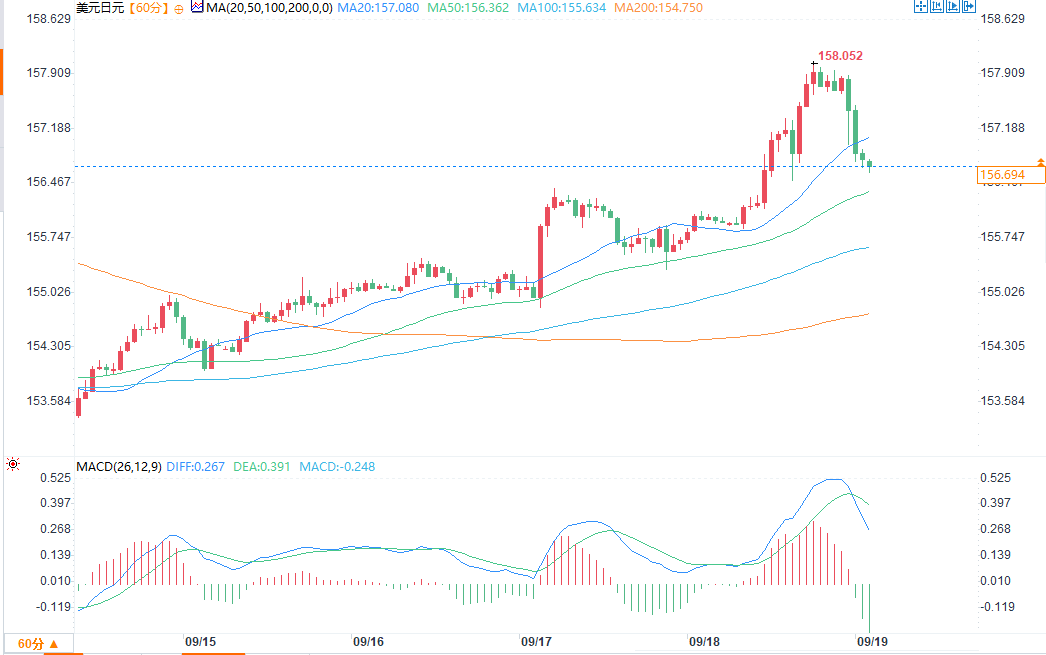 (USD/JPY 1-hour chart source: EasyForex) Despite coordinated efforts from multiple countries to boost the yen, fundamental pressures weighing on the yen remain: the significant interest rate gap between Japan and other major economies, market concerns about the fiscal outlook under Prime Minister Sanae Takashi's expansionary fiscal spending plan, and—undoubtedly—the largest government debt in history. Every interest rate hike significantly increases Japan's interest payments.
Unsurprisingly, this news immediately reversed the yen's earlier sharp decline. Friday's rate hike was already expected by the market, but traders had anticipated clearer guidance from the central bank indicating further rate hikes to stabilize inflation. This disappointment led to the yen's plunge. What the market ultimately saw was two board members appointed by the extremely dovish Prime Minister Sanae Takaichi voting against the rate hike; two more board members will be leaving next year, and their successors are likely to be equally dovish, directly lowering market expectations for continued rate hikes. The purpose of this type of intervention is to squeeze out speculative short positions in the yen, accelerating a market reversal in a illiquid market. However, whether the intervention can lead to a sustained trend rebound still depends on monetary policy. Even if the Bank of Japan completes its rate hike on Friday, the new round of tightening by the Federal Reserve will keep the USD/JPY interest rate differential high, and investors will still have the incentive to borrow yen to allocate to higher-yielding assets in other markets. Current speculative positions are already smaller than before the last round of intervention. Data from the U.S. Commodity Futures Trading Commission (CFTC) showed that leveraged funds' short positions in the yen halved in the week ending September 8. This means that even if the authorities intervene again, the number of short positions available for squeeze has decreased. At approximately 12:30 PM Eastern Time, the yen fell 0.6% against the dollar, to 156.83 yen to the dollar; it had earlier fallen as much as 1.3%. The Nikkei reported that the Bank of Japan inquired about exchange rate levels from market participants but did not disclose the source of the information. Historically, such inquiries have often been a precursor to official market intervention. Win Singh, chief economist at Bank of Nassau 1982, stated, "This move is too late and will have little effect. The Bank of Japan has once again missed an opportunity for significant action, just like in July. If they really wanted to boost the yen, they should have raised interest rates more than the market expected, coupled with large-scale foreign exchange market intervention." The Bank of Japan raised interest rates, but Governor Kazuo Ueda's signals regarding the subsequent path of interest rate hikes were ambiguous, causing the yen to depreciate to 158 yen to the dollar at one point. While Ueda stated that the policy-making environment has changed, he also indicated that it is difficult to determine the terminal interest rate of this tightening cycle. Analysts believe that his remarks did not meet the market's increasingly hawkish expectations. Japan is about to enter a holiday period until next Wednesday. Market liquidity decreases during the holiday, and if the authorities intervene, market volatility will be amplified. During this year's Golden Week, the authorities used a similar window of opportunity: the yen fell below the 160 mark on the eve of the holiday, and Japan intervened in the market for the first time; then, during the quiet holiday period, they intervened again. Of course, the first two interventions were unsuccessful, and this time it is unlikely to be effective either. This summer, Japan and the United States jointly implemented a coordinated intervention to buy yen, the first time since 1998, exposing traders betting on a falling yen to higher risks. Data from the Japanese Ministry of Finance shows that in the month ending August 26, Japan injected a record 15.4 trillion yen into the foreign exchange market. Since then, US Treasury Secretary Scott Bessenter has continued to send signals supporting a stronger yen. (USD/JPY 1-hour chart source: EasyForex) Despite coordinated efforts from multiple countries to boost the yen, fundamental pressures weighing on the yen remain: the significant interest rate gap between Japan and other major economies, market concerns about the fiscal outlook under Prime Minister Sanae Takashi's expansionary fiscal spending plan, and—undoubtedly—the largest government debt in history. Every interest rate hike significantly increases Japan's interest payments.
- Risk Warning and Disclaimer
- The market involves risk, and trading may not be suitable for all investors. This article is for reference only and does not constitute personal investment advice, nor does it take into account certain users’ specific investment objectives, financial situation, or other needs. Any investment decisions made based on this information are at your own risk.