Gold Trading Alert: Fed Rate Hike Fails to Halt Rally, Gold Prices Rebound to a One-Week High! Market Bullish Sentiment Heats Up
2026-09-21 07:30:10
After weeks of adjustment, the global gold market finally saw a long-awaited weekly gain. Spot gold surged to a one-week high on Friday, recording its first weekly increase in four weeks. This performance not only surprised some short sellers but also reignited market attention on precious metals. Despite the Federal Reserve's recent rate hike of its first in three years, pushing policy rates to the 3.75%-4% range and signaling a possible further tightening in the coming months, gold prices did not fall into a sustained sell-off. Instead, they rebounded strongly, aided by a decline in oil prices and short covering. Meanwhile, escalating tensions in the Middle East, including attacks by the Houthi rebels in Yemen on the Saudi capital and Aramco oil facilities, and Iran's downing of a reconnaissance drone in the Strait of Hormuz, are injecting new uncertainty into the oil and gold markets. Gold, a traditional safe-haven and inflation hedge, is standing at a critical juncture where multiple forces converge. On Monday (September 21) in early Asian trading, spot gold traded in a narrow range, currently above $4370. 
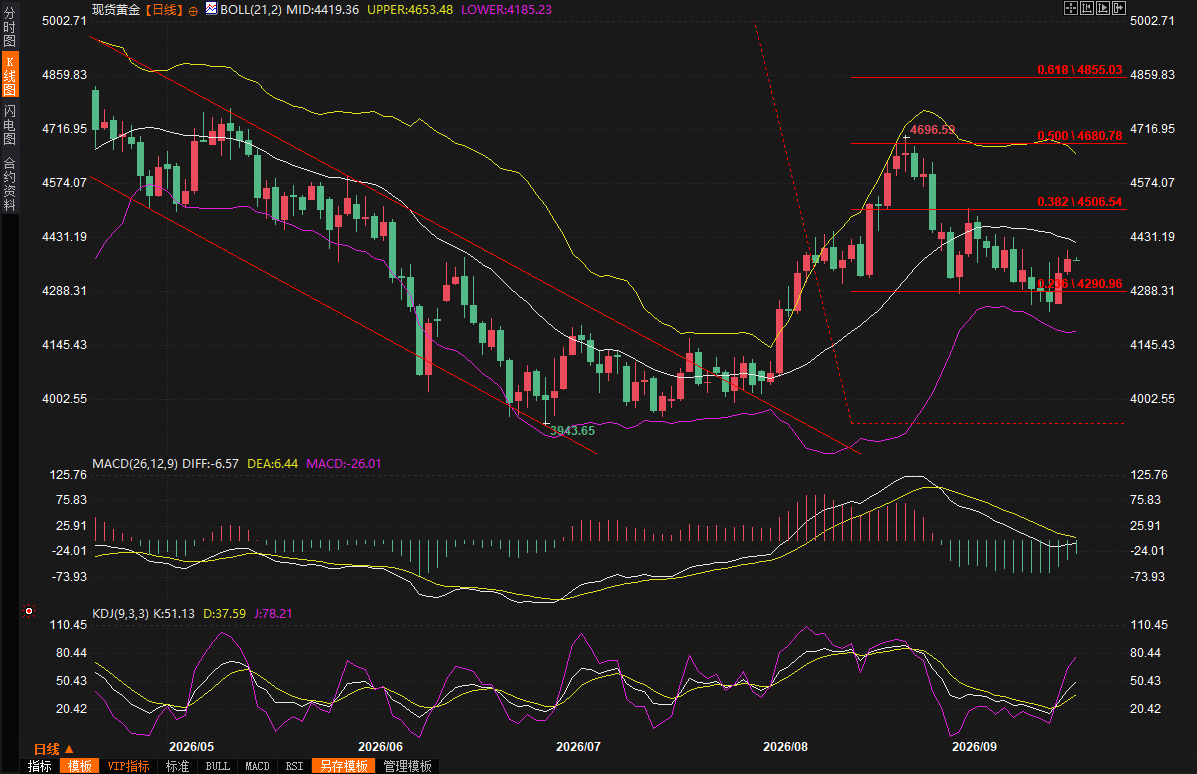 (Spot gold daily chart, source: FX678) At 07:26 Beijing time, spot gold is currently trading at $4372.26 per ounce.
Gold prices strengthen on a weekly chart: Cooling oil prices and short covering create a synergy.
Spot gold rose 0.84% on Friday, closing at $4,378.29 per ounce, after hitting a high of $4,399.49 during the session, its highest level since September 11. The cumulative gain for the week reached 1%, successfully reversing a four-week losing streak. Gold futures also rose, closing up 0.6% at $4,424.90. The most direct driving force behind this performance was the decline in oil prices. Brent crude fell for the third consecutive trading day as market concerns about Saudi supply disruptions eased, outweighing worries about a potential escalation of conflict in the Middle East. As a significant driver of overall inflation, the cooling of oil prices has alleviated market concerns about persistently high inflation, thus providing breathing room for gold. Chris Gaffney, President of Global Markets at EverBank, pointed out incisively that the decline in oil prices eased inflationary pressures, and the positions previously established by precious metal investors in anticipation of a Fed rate hike, attempting to profit from gold sales, have now been quickly closed. Short covering and buying interest, combined with fundamental support from cooling oil prices, propelled gold prices to a strong recovery on Friday. Although the dollar rose to a more than seven-week high during the same period, making gold more expensive for holders of other currencies, this downward pressure did not completely offset the aforementioned positive forces. Regional demand revealed a divergence in the market. Indian gold demand was weak last week, with buyers hesitant to purchase due to expectations of further price declines; while the Chinese gold premium remained stable, with strong investment demand providing support. This structural difference suggests that global gold demand has not collapsed across the board, and investment enthusiasm in some key markets continues to provide a floor for prices.Interest Rate Environment and Treasury Bond Market: A Complex Game Under the Shadow of Interest Rate Hikes
The Federal Reserve raised interest rates by 25 basis points last Wednesday and hinted at further action in the coming months. The CME Group's FedWatch tool shows that traders currently expect a roughly 55% probability of another rate hike in October and a roughly 90% probability of at least one more rate hike this year. Traditionally, rising interest rates increase the attractiveness of interest-bearing assets, thus weakening gold's relative advantage as a non-interest-bearing asset. This theoretically puts pressure on gold prices, but the actual market performance shows a more complex dynamic. Meanwhile, the US bond market also released important signals. The two-year Treasury yield rose to its highest level since July 2024 last Friday, the 10-year yield was around 5%, and the 30-year yield rose in tandem. The spread between the two-year and 10-year yields narrowed to 23.8 basis points at one point, the flattest level since June 25. Molly Brooks, US interest rate strategist at TD Securities, said that the two-year yield will fluctuate in tandem with rate hike expectations, and the market is currently more inclined to price in more rate hike expectations. The Bank of Japan raised interest rates to their highest level in 31 years on the same day, with its governor emphasizing that it had entered a new phase of preventing inflation from exceeding its target. The synchronized tightening by major central banks globally further reinforced expectations of rising interest rates. However, the Federal Reserve meeting somewhat alleviated market anxieties about runaway long-term inflation, thus curbing the rise in long-term government bond yields. Unexpectedly weak manufacturing data and other economic signals also made the market cautious in assessing the path of further interest rate hikes. This combination of rapidly rising short-term interest rates and relatively restrained long-term interest rates means that the trend of real interest rates does not entirely suppress gold. Some investors are beginning to reassess: if interest rate hikes can effectively curb inflation, and geopolitical risks persist, the value of gold as a hedging tool may actually become more prominent.Escalating Middle East tensions: Geopolitical risks inject new variables into gold and oil markets
Just as gold prices rebounded on the back of falling oil prices, tensions in the Middle East escalated rapidly over the weekend. The Houthi rebels in Yemen announced two military operations on the evening of the 19th, attacking "sensitive targets" in Riyadh, the Saudi capital, and Saudi Aramco facilities in Yanbu, using a large number of ballistic missiles, cruise missiles, and drones. The Houthis claimed this was a response to continued Saudi airstrikes and stated they would continue their policy of "blockade for blockade, escalation for escalation." Saudi Arabia, meanwhile, continued its airstrikes on northern Yemen and other areas, reportedly exceeding 760 times and causing casualties. The oil market reacted swiftly. Oil prices rose on Monday, as markets worried that a further escalation of the Middle East conflict could impact energy supplies. Meanwhile, the Iranian military announced the downing of an advanced reconnaissance drone over the Strait of Hormuz, and Qatar revealed that the US and Iran were still communicating through multiple channels, with the US hoping to reach an agreement and end the conflict. These events, intertwined, have transformed Middle East geopolitical risks from "potential threats" back into "real disturbances." For gold, geopolitical tensions typically provide support. On the one hand, heightened risk aversion will directly push up gold prices; on the other hand, if conflict leads to a renewed rise in oil prices, inflation expectations may resurface, thereby strengthening gold's appeal as an inflation hedge. Currently, gold prices are testing resistance around $4400-$4440 per ounce. Gaffney believes that a successful breakout above this range could open up further upside potential. The escalation of geopolitical events could very well act as a catalyst for breaking through technical resistance.Market Sentiment and Future Focus: Wall Street and Main Street Both Bullish
Sentiment also conveyed positive signals. A Kitco News gold survey showed that 100% of the 16 analysts surveyed last week expected gold prices to rise further in the coming week. In an online poll, 58% of retail traders were also bullish, only 24% expected a decline, and 19% expected sideways movement. The fact that the Fed's rate hike failed to halt gold's momentum has created a rare consensus among Wall Street and Main Street investors. Looking ahead to the coming week, global markets are focused on a series of events. The meeting between the leaders of China and the US, developments in the Middle East conflict, PMI data from major economies, interest rate decisions from the central banks of Switzerland, Sweden, and Norway, and the talks between Trump and Gulf leaders will all be important variables influencing risk appetite and commodity prices. The US will also release preliminary manufacturing PMI data, initial jobless claims, durable goods orders, and the University of Michigan consumer sentiment index. Several Fed officials will also speak, and the market will look for policy clues. In summary, last week's rebound in gold prices was not driven by a single factor, but rather by a combination of factors including cooling oil prices, short covering, regional demand support, and renewed geopolitical risks. Interest rate pressures from the Fed's rate hikes persist, but haven't translated into overwhelming selling pressure. The ongoing tensions in the Middle East provide gold with additional safe-haven premium. In the short term, the battle for the $4400-$4440 resistance level will be crucial; if geopolitical risks continue to ease and pressure oil prices, or if economic data releases more softening signals, gold prices could open up upward potential. In the medium to long term, gold will continue to find its direction amidst the tug-of-war between "interest rate suppression" and "inflation and geopolitical support." Investors need to closely monitor oil prices, Fed officials' statements, and the latest developments in the Middle East, seizing structural opportunities amidst volatility. This weekly strengthening of gold may only be the beginning of a more complex game. (Spot gold daily chart, source: FX678) At 07:26 Beijing time, spot gold is currently trading at $4372.26 per ounce.
- Risk Warning and Disclaimer
- The market involves risk, and trading may not be suitable for all investors. This article is for reference only and does not constitute personal investment advice, nor does it take into account certain users’ specific investment objectives, financial situation, or other needs. Any investment decisions made based on this information are at your own risk.