The US urged its citizens to leave Iran, but Brent crude oil fell by more than 1%, as the market did not believe the situation was escalating.
2026-09-21 11:10:10
The US virtual embassy in Iran urged Americans to leave immediately, warning of flight cancellations and airspace closures. Ahead of his speech at the UN this week, Trump is weighing Tehran's terms for ending the conflict, sent through Qatar. Brent crude futures opened sharply higher in Asian trading on Monday (September 21) with a risk premium, but subsequently retreated, currently trading around $101.60 per barrel, down more than 1%. This alert seems to increase the sense that Washington is preparing for a possible escalation, but such warnings have been issued multiple times and are not decisions in themselves. 
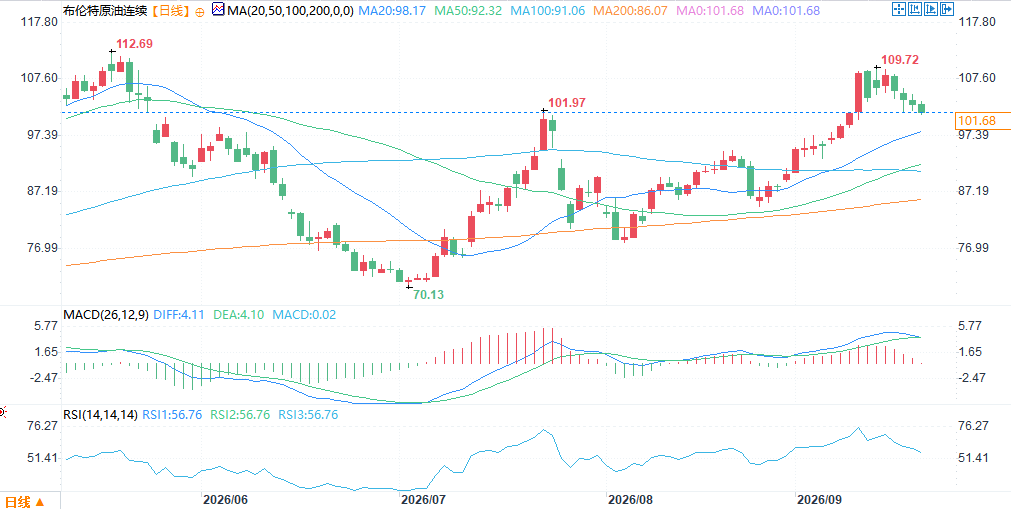 (Brent crude oil futures daily chart, source: EasyTrade) At 11:08 Beijing time, Brent crude oil futures were trading at $101.73 per barrel.
Key Event: The United States urges its citizens to leave Iran immediately.
The U.S. virtual embassy in Iran issued a security alert urging U.S. citizens to leave Iran immediately, warning of potential flight cancellations, airspace closures, and other travel disruptions. The alert states that Americans should not travel to Iran for any reason, and those already in Iran should leave immediately. Washington has no diplomatic or consular presence in Iran; Swiss diplomats serve as its protectorate. This alert follows another State Department notification on Saturday, advising Americans in the Middle East to be vigilant and prepare for possible travel disruptions following new Houthi attacks on Saudi Arabia.Iran's conditions: Seven core demands to be submitted through Qatar, awaiting Trump's response.
The secretary of Iran's Supreme National Security Council stated that the conditions included a ceasefire on all fronts, the unfreezing of Iranian funds, and the end of the US naval blockade. Tehran is awaiting a response from Trump. Reports indicate that Iran has put forward seven core demands. Trump returned to the White House early on Saturday night (September 19), after leaving Camp David. He stated that he was in decision-making mode, weighing military action, continued economic pressure, or reaching an agreement, and told the media on Sunday that "very important things could happen very soon." Iran's foreign minister has traveled to New York to attend the UN General Assembly, and Turkey stated that it is working with other countries to push for a new proposal for a US-Iran agreement.Military pressure intensifies: The US tightens blockade, diverting over 100 ships.
Military pressure continues in parallel. U.S. Central Command stated that its naval forces have diverted more than 100 ships and tightened the blockade of Iranian ports. The U.S. State Department also advised Americans in the Middle East to be on high alert last Saturday following new attacks by the Iranian-backed Houthi rebels on Saudi Arabia, including a ballistic missile aimed at Riyadh that was intercepted by Saudi forces. These military and economic pressure measures, alongside diplomatic proposals, demonstrate Washington's two-track strategy of negotiation and pressure.Market Implications: Oil Price Risk Premium and Binary Choice
Oil prices opened the week with a risk premium, initially gapping up slightly after Houthi attacks on the three capitals of the Gulf, but subsequently retreating. This alarm bells seem to have increased the sense that Washington is preparing for a possible escalation, but such warnings have been issued repeatedly and are not decisive in themselves. A clearer price driver is the binary choice described by Trump—military action, continued economic pressure, or a deal—making the UN General Assembly week central to oil and gas risk. Credible progress in negotiations will ease the premium, while any strikes or new attacks on Gulf infrastructure will prolong it. Airspace closures warrant attention, as they affect regional aviation and shipping, consequently impacting fuel demand and freight costs.Historical Context and Subsequent Concerns: Warning wording is not a reliable signal; timing is key.
The virtual embassy has repeatedly urged Americans to leave Iran this year, including during the turmoil in January and before the February negotiations in Oman, so the wording itself is not a reliable signal that action is imminent. What is different is the timing—it coincides with Iran's unresponsive proposals, the tightening blockade, and the Houthi attacks on Saudi Arabia. The mention of airspace closures is a noteworthy detail. Focus shifts to Trump's response to Iran's conditions, his UN speech, and whether negotiations through Qatar or Turkey can make progress. Any new strikes or attacks on Gulf energy infrastructure would increase the risk of further supply disruptions, while taking a step towards an agreement would mitigate that risk.Summary: Diplomatic proposals and military pressure proceed in tandem; UN General Assembly sets tone on oil prices this week.
In summary, the US urged its citizens to leave Iran immediately, and Trump weighed the ceasefire conditions submitted by Tehran through Qatar. Iran demanded a ceasefire on all fronts, the unfreezing of funds, and an end to the naval blockade, awaiting Trump's response. The US tightened its blockade, diverted over 100 ships, and the Houthi attacks on Saudi Arabia continued. Trump's UN speech this week will set the tone. Oil prices opened with a risk premium but retreated, making the UN General Assembly week a center of risk for oil and gas. Warning rhetoric is not a reliable signal; timing is key. Going forward, attention should be paid to Trump's response, his UN speech, progress in negotiations with Qatar or Turkey, and the impact of any strikes or attacks on Gulf infrastructure on supply risks. (Brent crude oil futures daily chart, source: EasyTrade) At 11:08 Beijing time, Brent crude oil futures were trading at $101.73 per barrel.
- Risk Warning and Disclaimer
- The market involves risk, and trading may not be suitable for all investors. This article is for reference only and does not constitute personal investment advice, nor does it take into account certain users’ specific investment objectives, financial situation, or other needs. Any investment decisions made based on this information are at your own risk.