Institutions predict gold prices will reach $4,750 in the fourth quarter and $5,250 in the third quarter of next year, while copper prices will simultaneously enjoy a long-term upward trend.
2026-09-21 10:44:14
With interest rate hikes continuing at several central banks globally, a new tightening cycle has begun. The research team at Société Générale suggests that even with continued monetary tightening, inflationary pressures are unlikely to be quickly suppressed, thus providing solid support for gold's investment value. In its latest asset allocation report, targeting the fourth quarter of 2026, the bank remains optimistic about equities and commodities, focusing on gold and copper, while reducing its government bond holdings . This portfolio adjustment strategy provides a new reference point for current asset allocation.
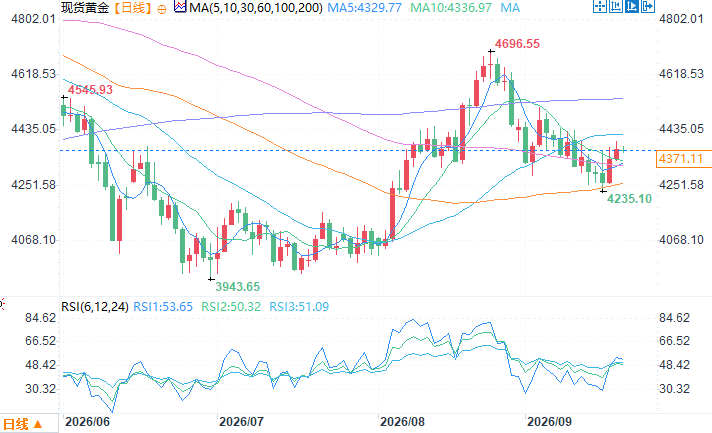 Spot gold daily chart source: FX678. At 10:42 AM Beijing time on September 21, spot gold was trading at $4366.11 per ounce.
Asset rebalancing: Increase allocation to equities and reduce holdings of government bonds
Societe Generale stated that in its asset allocation for the fourth quarter, the allocation ratios for gold and broad commodities remained unchanged at 10%, the same as in the third quarter. The allocation to equities was increased from 55% to 58%, while holdings of government bonds were reduced from 15% to 12%, with an additional 5% allocation to inflation-protected bonds and 5% to corporate bonds. The bank's analysts stated in a report: "So far in 2026, asset classes have shown significant divergence, with stocks and commodities performing strongly, while the bond market has remained under pressure. Our SGMAP portfolio, centered on equities and commodities, has achieved considerable returns in this market environment. Looking ahead, commodities are an indispensable asset for hedging against geopolitical and climate risks. A portfolio of 60% equities, 20% bonds, and 20% commodities will be more suitable for the current macroeconomic environment. "Multiple factors are converging, opening up further upside potential for gold.
Gold continues to hold a significant position in multi-asset portfolios. Societe Generale believes that the trend of currency devaluation is returning. Geopolitical fragmentation, coupled with escalating concerns about the soundness of US fiscal policy and the credibility of the US dollar, has led global funds to reduce traditional reserve assets and accelerate asset diversification. Analysts at the bank stated, "Central banks are continuously purchasing gold while reducing their holdings of US Treasury bonds. Geopolitical divergence, coupled with market concerns about fiscal and monetary credibility, has fueled strong demand for alternative reserve assets." In addition to the structural support from continued central bank gold purchases, cyclical positive factors are also accumulating. The bank predicts that the decline in real interest rates in the latter half of the cycle will reduce the opportunity cost of holding non-interest-bearing assets like gold, and a weaker dollar and the return of funds to ETFs will further boost gold prices. Global gold ETF holdings have rebounded to nearly 3,000 tons, confirming a recovery in investment demand. Based on the above assessment, Societe Generale predicts that gold prices will reach $4,750 per ounce in the fourth quarter of 2026, surpass $5,000 in the second quarter of 2027, and further rise to $5,250 in the third quarter. For the full year, the average gold price is projected to be $4,500 per ounce in 2026 and $5,125 per ounce in 2027. Although US Treasury yields are hovering below 5%, and conventionally, high yields are unfavorable for gold, the current rise in interest rates also reflects market concerns about the sustainability of sovereign debt.The copper supply and demand situation is tight, and the release of new production capacity is a long way off.
Copper is also a key sector favored by the bank. Analysts believe that the large-scale construction of AI data centers will drive long-term demand for key industrial metals like copper, while supply is struggling to keep pace with this expansion. Copper mine production declined by 1.1% year-on-year in the first half of 2026, and this year may see the first full-year production contraction since 2017. A deeper contradiction stems from insufficient industry investment over the past decade and a scarcity of new project reserves. While price increases can stimulate mining willingness, substantial new capacity is unlikely to materialize before 2030. Price forecasts indicate that copper prices are expected to reach $14,750 per ton in the fourth quarter of 2026, remain at that level in the first quarter of 2027, rise to $15,000 in the second quarter, and reach $15,250 in the third quarter; the full-year forecast is $14,000 per ton in 2026 and $15,125 per ton in 2027.The hidden dangers of US debt remain unresolved, and debt interest has become a new risk factor.
The report also warns of the risks associated with US debt. The US now faces not only a primary fiscal deficit but also significant pressure from interest payments. The Congressional Budget Office estimates that while the primary fiscal deficit is lower than previous crisis peaks, with interest payments continuing to rise, net interest payments will approach 5% of GDP by the mid-2030s, and the overall fiscal deficit will remain above 6% of GDP for a long period. The bank's interest rate team analyzes that among developed economies, the US has the highest risk of debt sustainability. The average interest rate on US outstanding debt is approximately 4%, far below the 2.3% needed to stabilize the debt ratio, and only a step away from the 4.1% threshold where debt payments become unsustainable . These concerns are unlikely to dissipate for the remainder of this year.Conclusion
Amid a complex environment of rising interest rates, high bond yields, and geopolitical tensions, Societe Generale has chosen to reduce its holdings of government bonds and increase its positions in equities and commodities, while offering very optimistic price forecasts for gold and copper. Gold is expected to benefit from long-term central bank gold purchases, concerns about the credibility of the US dollar, and declining real interest rates, while copper is supported by the rigid demand and supply bottlenecks brought about by AI infrastructure development. Of course, commodity prices are highly volatile, and institutional forecasts do not guarantee that market movements will materialize. Changes in various macroeconomic variables can alter the subsequent trajectory of asset prices, and investors should remain cautious. Spot gold daily chart source: FX678. At 10:42 AM Beijing time on September 21, spot gold was trading at $4366.11 per ounce.
- Risk Warning and Disclaimer
- The market involves risk, and trading may not be suitable for all investors. This article is for reference only and does not constitute personal investment advice, nor does it take into account certain users’ specific investment objectives, financial situation, or other needs. Any investment decisions made based on this information are at your own risk.