The Bank of Japan's rate hike failed to boost the yen, and the USD/JPY pair fluctuated at high levels after approaching the 157 mark.
2026-09-21 10:14:14
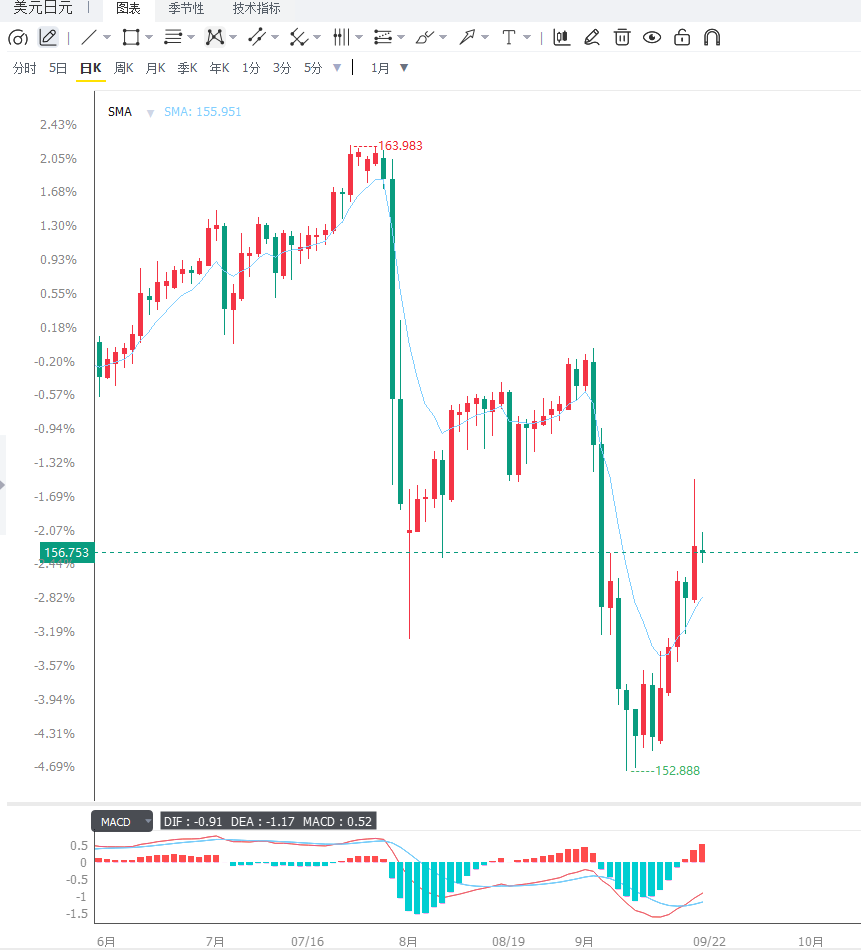
The USD/JPY pair maintained high levels at the beginning of the week, rising to around 157.10 during the Asian session before retreating to around 156.8. The pair remains near recent highs, with market focus on the Bank of Japan's policy path following its rate hike, expectations for future Federal Reserve interest rates, and changes in global risk sentiment. Currently, the USD/JPY pair has not experienced a sustained decline despite the Bank of Japan's rate hike; instead, it has shown strong resilience at higher levels, reflecting that the USD/JPY interest rate differential and safe-haven flows remain important factors influencing the exchange rate.  On September 18, the Bank of Japan (BOJ) raised its short-term policy rate by 25 basis points to 1.25%, the highest level in 31 years, in line with market expectations. At the same time, the BOJ reiterated that future policy adjustments will depend on factors such as economic activity, price trends, and financial conditions. Notably, the decision was passed by a 7-2 vote, with two members opposing the rate hike. This has led the market to focus more on whether the BOJ will quickly move towards further tightening policies, rather than solely on the rate hike itself to determine the yen's direction. Market reaction suggests that the BOJ rate hike did not generate sustained yen buying. The USD/JPY pair had previously risen back to around 158 after the BOJ's announcement, indicating lingering concerns among investors about the pace of future policy normalization. While the BOJ has entered a new policy phase, a significant gap remains between its interest rate level and that of the US, and the domestic economic and inflationary environment in Japan still requires further observation, preventing a complete reversal of carry trades. Meanwhile, US interest rate expectations continue to influence the dollar's performance. The yield on the 2-year US Treasury note rose to approximately 4.76%, while the dollar index remained around 100, prompting the market to reassess the possibility of further rate hikes this year. A renewed hawkish shift in interest rate expectations means that the cost of dollar funding and the yield advantage of holding dollar assets remain, providing significant support for the USD/JPY pair to maintain its high levels. Geopolitical risks have also increased the safe-haven demand for the dollar. The situation in the Middle East continues to influence energy prices and global risk appetite, with oil prices remaining at high levels. Rising energy costs may also affect the policy decisions of major central banks through inflation. In this environment, the dollar's safe-haven attributes and interest rate advantage have a combined effect, while the yen, although traditionally a safe-haven asset, is limited by the Bank of Japan's slow policy pace and rising energy import costs. The market will also be focused on the upcoming meeting between the leaders of the US and major Asian powers. Recent news indicates that the two sides have engaged in further dialogue on issues such as artificial intelligence, and the market will closely monitor subsequent economic policies and changes in trade concerns. These developments may affect risk appetite in Asian markets and indirectly impact the USD/JPY pair through dollar demand and capital flows. From a capital flow perspective, the recent rise in USD/JPY does not entirely mean that the market has completely abandoned the yen. Japanese financial authorities have been paying close attention to the rapid depreciation of the yen, and the market has begun to discuss the risks of exchange rate intervention. Market reports on September 21st indicated that discussions surrounding potential measures by Japanese authorities to stabilize the exchange rate had intensified following a significant decline in the yen the previous week. Therefore, the closer USD/JPY gets to its previous highs, the more investors need to pay attention to potential policy responses. From a daily chart perspective, USD/JPY is currently maintaining high levels, with an overall trend that is temporarily bullish, but the 157-158 area has gradually become a significant resistance zone. If the exchange rate can stably hold above 157.50 and further break through the 157.61 area, where the 200-period simple moving average is located on the 4-hour chart, then the short-term bulls may continue to test the 78.6% Fibonacci retracement level near 158.75, with further upside potential targeting the previous swing high of 160.36. Conversely, if the 157.50-157.60 area continues to suppress the exchange rate, and USD/JPY falls back below 156.60, then short-term downward pressure may gradually increase. The 4-hour chart shows that USD/JPY previously rose to around 157.10 before pulling back, and is currently approaching the 156.75-156.80 area again. Technical indicators show that although the exchange rate is still at a relatively high level, there are signs of slowing upward momentum. The 61.8% Fibonacci retracement level around 157.49 and the 200-period moving average around 157.61 form a relatively dense resistance zone. Only a decisive break and hold above this area can open up further upside potential to 158.75 and even 160.36. On the downside, the first support level to watch is the 50% retracement level around 156.60, followed by the 38.2% retracement level around 155.72, with further support at 154.62. If market risk sentiment improves significantly and the US dollar experiences a substantial pullback, the key Fibonacci anchor point around 152.85 will become a deeper support area.
  Editor's Summary: The USD/JPY pair is currently in a phase influenced by the combined effects of the Bank of Japan's interest rate hike, Federal Reserve interest rate expectations, and global safe-haven demand. The Bank of Japan's increase in interest rates to 1.25% indicates that policy normalization is still progressing, but the 7-2 vote and uncertainty surrounding the subsequent policy pace mean that the yen currently lacks a policy catalyst for sustained strength. Meanwhile, hawkish US interest rate expectations and persistently high US Treasury yields continue to support the US dollar. In the short term, the 157.50-157.60 area is a crucial technical zone for determining whether USD/JPY can further open up upward space, while 156.60 is a key support level for observing the strength of short-term corrections. Future exchange rate movements will still require close monitoring of the USD/JPY interest rate differential, central bank policy signals, global risk sentiment, and the Japanese financial authorities' reaction to the rapid depreciation of the yen.
On September 18, the Bank of Japan (BOJ) raised its short-term policy rate by 25 basis points to 1.25%, the highest level in 31 years, in line with market expectations. At the same time, the BOJ reiterated that future policy adjustments will depend on factors such as economic activity, price trends, and financial conditions. Notably, the decision was passed by a 7-2 vote, with two members opposing the rate hike. This has led the market to focus more on whether the BOJ will quickly move towards further tightening policies, rather than solely on the rate hike itself to determine the yen's direction. Market reaction suggests that the BOJ rate hike did not generate sustained yen buying. The USD/JPY pair had previously risen back to around 158 after the BOJ's announcement, indicating lingering concerns among investors about the pace of future policy normalization. While the BOJ has entered a new policy phase, a significant gap remains between its interest rate level and that of the US, and the domestic economic and inflationary environment in Japan still requires further observation, preventing a complete reversal of carry trades. Meanwhile, US interest rate expectations continue to influence the dollar's performance. The yield on the 2-year US Treasury note rose to approximately 4.76%, while the dollar index remained around 100, prompting the market to reassess the possibility of further rate hikes this year. A renewed hawkish shift in interest rate expectations means that the cost of dollar funding and the yield advantage of holding dollar assets remain, providing significant support for the USD/JPY pair to maintain its high levels. Geopolitical risks have also increased the safe-haven demand for the dollar. The situation in the Middle East continues to influence energy prices and global risk appetite, with oil prices remaining at high levels. Rising energy costs may also affect the policy decisions of major central banks through inflation. In this environment, the dollar's safe-haven attributes and interest rate advantage have a combined effect, while the yen, although traditionally a safe-haven asset, is limited by the Bank of Japan's slow policy pace and rising energy import costs. The market will also be focused on the upcoming meeting between the leaders of the US and major Asian powers. Recent news indicates that the two sides have engaged in further dialogue on issues such as artificial intelligence, and the market will closely monitor subsequent economic policies and changes in trade concerns. These developments may affect risk appetite in Asian markets and indirectly impact the USD/JPY pair through dollar demand and capital flows. From a capital flow perspective, the recent rise in USD/JPY does not entirely mean that the market has completely abandoned the yen. Japanese financial authorities have been paying close attention to the rapid depreciation of the yen, and the market has begun to discuss the risks of exchange rate intervention. Market reports on September 21st indicated that discussions surrounding potential measures by Japanese authorities to stabilize the exchange rate had intensified following a significant decline in the yen the previous week. Therefore, the closer USD/JPY gets to its previous highs, the more investors need to pay attention to potential policy responses. From a daily chart perspective, USD/JPY is currently maintaining high levels, with an overall trend that is temporarily bullish, but the 157-158 area has gradually become a significant resistance zone. If the exchange rate can stably hold above 157.50 and further break through the 157.61 area, where the 200-period simple moving average is located on the 4-hour chart, then the short-term bulls may continue to test the 78.6% Fibonacci retracement level near 158.75, with further upside potential targeting the previous swing high of 160.36. Conversely, if the 157.50-157.60 area continues to suppress the exchange rate, and USD/JPY falls back below 156.60, then short-term downward pressure may gradually increase. The 4-hour chart shows that USD/JPY previously rose to around 157.10 before pulling back, and is currently approaching the 156.75-156.80 area again. Technical indicators show that although the exchange rate is still at a relatively high level, there are signs of slowing upward momentum. The 61.8% Fibonacci retracement level around 157.49 and the 200-period moving average around 157.61 form a relatively dense resistance zone. Only a decisive break and hold above this area can open up further upside potential to 158.75 and even 160.36. On the downside, the first support level to watch is the 50% retracement level around 156.60, followed by the 38.2% retracement level around 155.72, with further support at 154.62. If market risk sentiment improves significantly and the US dollar experiences a substantial pullback, the key Fibonacci anchor point around 152.85 will become a deeper support area. Editor's Summary: The USD/JPY pair is currently in a phase influenced by the combined effects of the Bank of Japan's interest rate hike, Federal Reserve interest rate expectations, and global safe-haven demand. The Bank of Japan's increase in interest rates to 1.25% indicates that policy normalization is still progressing, but the 7-2 vote and uncertainty surrounding the subsequent policy pace mean that the yen currently lacks a policy catalyst for sustained strength. Meanwhile, hawkish US interest rate expectations and persistently high US Treasury yields continue to support the US dollar. In the short term, the 157.50-157.60 area is a crucial technical zone for determining whether USD/JPY can further open up upward space, while 156.60 is a key support level for observing the strength of short-term corrections. Future exchange rate movements will still require close monitoring of the USD/JPY interest rate differential, central bank policy signals, global risk sentiment, and the Japanese financial authorities' reaction to the rapid depreciation of the yen.
- Risk Warning and Disclaimer
- The market involves risk, and trading may not be suitable for all investors. This article is for reference only and does not constitute personal investment advice, nor does it take into account certain users’ specific investment objectives, financial situation, or other needs. Any investment decisions made based on this information are at your own risk.