Crude oil trading alert: Easing Middle East supply concerns and rising diplomatic expectations helped WTI crude oil halt its four-day losing streak and hover around $93.
2026-09-22 10:00:13
WTI crude oil halted its four-day losing streak during Asian trading hours on Tuesday, with the November contract briefly trading around $92.30. Latest market data shows that the November WTI contract rose slightly to around $92.80 in early trading on Tuesday, but the previous consecutive declines had already pushed oil prices significantly lower than recent highs. The market's core concern has gradually shifted from whether there will be further supply disruptions to whether Middle Eastern oil transportation can continue to recover and whether diplomatic progress can reduce geopolitical risk premiums.  One of the key reasons for the recent downward pressure on oil prices is the emerging signs of improvement in the actual transportation of Middle Eastern crude oil. Saudi crude oil shipments through the Strait of Hormuz have averaged approximately 2.9 million barrels per day over the past six days, significantly higher than the monthly average of approximately 700,000 barrels per day in August. Meanwhile, satellite data shows that the total loading capacity of supertankers docked at Saudi Gulf export terminals over the weekend was approximately 14 million barrels, the highest level since at least June. This indicates that although regional conflicts are not yet over, some previously disrupted supply chains are resuming operation. The recovery in Saudi exports has had a particularly significant impact on oil prices. Following the attacks on the East-West pipeline, Saudi Arabia had to rely on the Persian Gulf for some of its crude oil exports, and the rebound in shipping volume through the Strait of Hormuz has reduced market concerns about a sharp contraction in short-term supply. Related data shows that Saudi crude oil exports recovered to over 4 million barrels per day in September, compared to approximately 2.4 million barrels per day in August. With marginal improvements on the supply side, some of the geopolitical risk premium previously priced into oil prices has begun to be rapidly squeezed out. At the same time, diplomatic expectations have become another important factor suppressing the risk premium in oil prices. US President Donald Trump will address the UN General Assembly and has expressed openness to meeting with Iranian President Masoud Pezechiyan. Iran has also conveyed its conditions for resuming negotiations through intermediary channels. The market is awaiting clearer diplomatic progress during the UN General Assembly; if further contact is established, concerns about long-term supply disruptions in the oil market may continue to ease. However, diplomatic expectations have not eliminated the actual supply risks in the Middle East oil market. The Houthi rebels in Yemen have recently continued to claim attacks on Riyadh and Saudi Aramco facilities, putting continued pressure on maritime transport security in the Red Sea and surrounding areas. Due to damage to Saudi Arabia's East-West pipeline, some exports have re-entered reliance on the Strait of Hormuz, which has actually increased the importance of maritime transport routes. If major energy facilities or shipping lanes are attacked again, the currently recovering supply chain could be quickly disrupted. Therefore, the current drop in oil prices does not mean that supply risks have completely disappeared. Instead, the market is reassessing the gap between the "actual speed of supply recovery" and the "potential new infrastructure risks." While exports from the Gulf region are improving, shipping costs, route adjustments, and ship-to-ship transshipment remain constrained. Data shows that ship-to-ship crude oil transshipment in the Middle East rose to approximately 2.5 million barrels per day in September, up from about 1.4 million barrels per day in August, indicating that the trade and logistics system remains abnormal. The funding situation is also worth noting. The rapid rise in oil prices previously attracted a large amount of speculative capital into the crude oil market, but as oil prices have fallen from their highs, systemic funds have begun to reduce some long positions. Market analysts point out that while the net speculative long position in crude oil is still increasing recently, trend-following funds such as CTAs have begun to reduce their previously established WTI long positions. This indicates a decline in confidence in a continued rapid rise in oil prices in the short term, and makes the market more sensitive to any new news of supply improvement. Looking at recent price performance, WTI has clearly fallen from its mid-September high of over $100. On Monday, the WTI October contract closed down about 4.5% at $95.78, while the November contract, which is about to become the main contract, once fell to around $92. A slight rebound occurred in early trading on Tuesday, which is more likely a technical correction after short covering rather than a fundamental shift in the fundamentals. The market will continue to closely monitor diplomatic developments during the UN General Assembly, the recovery of Saudi exports, and shipping safety in the Hormuz and the Red Sea. From a daily chart perspective, WTI crude oil prices have been retracing after forming a temporary high above $106, breaking below several recent short-term moving averages, indicating increased short-term downward pressure. However, the technical structure has not yet fully shifted to a medium- to long-term downtrend. Previous analysis indicated that the 38.2% Fibonacci retracement level around $91.13 is currently a significant support level, while the 100-day moving average around $85.14 still forms an important defensive line for the medium-term trend. The current price around $92.30 is close to the $91.13 to $92 support zone. If this zone holds, there is potential for a technical rebound in oil prices; however, if the daily chart breaks below $91, the next stage may see further testing of the $87.80 area, or even a move towards the $84.50 to $85 zone. The first resistance level to watch is around $95, a key price area broken recently. If WTI regains hold above $95, the next resistance level to watch is the $98.50 to $100 range. Only a recapture of the $100 level could significantly repair the short-term downtrend. The previous high around $106 forms further resistance. Looking at the 4-hour chart, after four consecutive days of decline, short-term selling pressure has clearly subsided, with some support appearing around $92. Short-term moving averages are still trending downwards, indicating that a clear trend reversal signal has not yet emerged. However, if the price can stabilize in the $91-$92 range and break above $94-$95, the potential for a technical rebound could expand. Conversely, if the support around $92 is breached and breaks down decisively, the market may further test the $90 psychological level. Both technical and fundamental factors suggest that WTI remains in a high-volatility consolidation phase in the short term, with diplomatic news and supply data potentially causing significant intraday price fluctuations.
 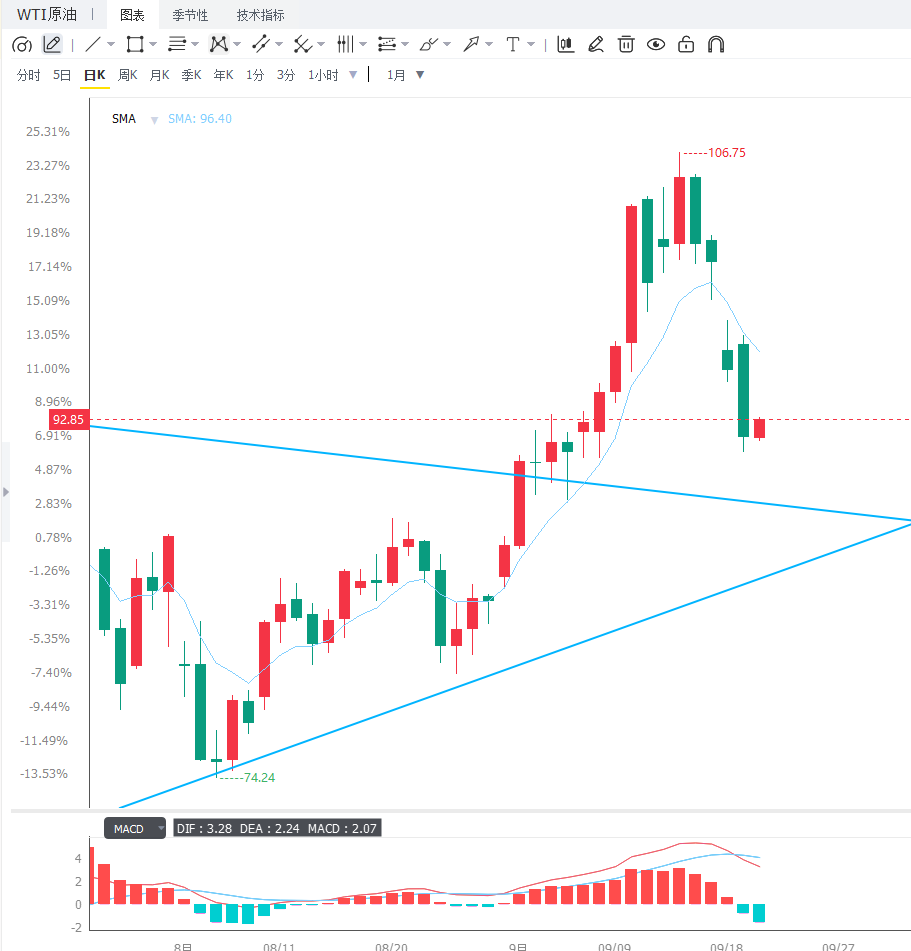 The core issue for WTI crude oil has shifted from previous concerns about supply disruptions to a coexistence of supply recovery and geopolitical risks. A significant increase in Saudi crude oil shipments via the Strait of Hormuz, coupled with potential diplomatic engagement between the US and Iran, has weakened the previously accumulated risk premium for crude oil. However, uncertainties remain regarding Red Sea security, Saudi energy infrastructure, and shipping through the Strait of Hormuz, meaning there is still fundamental support for oil prices. In the short term, the $92 and $91 areas are key support levels, while $95 to $100 constitutes the main resistance zone during any rebound. Whether oil prices can stabilize depends crucially on the speed of actual supply recovery in the Middle East and whether diplomatic progress can translate into sustained improvements in transportation and production.
One of the key reasons for the recent downward pressure on oil prices is the emerging signs of improvement in the actual transportation of Middle Eastern crude oil. Saudi crude oil shipments through the Strait of Hormuz have averaged approximately 2.9 million barrels per day over the past six days, significantly higher than the monthly average of approximately 700,000 barrels per day in August. Meanwhile, satellite data shows that the total loading capacity of supertankers docked at Saudi Gulf export terminals over the weekend was approximately 14 million barrels, the highest level since at least June. This indicates that although regional conflicts are not yet over, some previously disrupted supply chains are resuming operation. The recovery in Saudi exports has had a particularly significant impact on oil prices. Following the attacks on the East-West pipeline, Saudi Arabia had to rely on the Persian Gulf for some of its crude oil exports, and the rebound in shipping volume through the Strait of Hormuz has reduced market concerns about a sharp contraction in short-term supply. Related data shows that Saudi crude oil exports recovered to over 4 million barrels per day in September, compared to approximately 2.4 million barrels per day in August. With marginal improvements on the supply side, some of the geopolitical risk premium previously priced into oil prices has begun to be rapidly squeezed out. At the same time, diplomatic expectations have become another important factor suppressing the risk premium in oil prices. US President Donald Trump will address the UN General Assembly and has expressed openness to meeting with Iranian President Masoud Pezechiyan. Iran has also conveyed its conditions for resuming negotiations through intermediary channels. The market is awaiting clearer diplomatic progress during the UN General Assembly; if further contact is established, concerns about long-term supply disruptions in the oil market may continue to ease. However, diplomatic expectations have not eliminated the actual supply risks in the Middle East oil market. The Houthi rebels in Yemen have recently continued to claim attacks on Riyadh and Saudi Aramco facilities, putting continued pressure on maritime transport security in the Red Sea and surrounding areas. Due to damage to Saudi Arabia's East-West pipeline, some exports have re-entered reliance on the Strait of Hormuz, which has actually increased the importance of maritime transport routes. If major energy facilities or shipping lanes are attacked again, the currently recovering supply chain could be quickly disrupted. Therefore, the current drop in oil prices does not mean that supply risks have completely disappeared. Instead, the market is reassessing the gap between the "actual speed of supply recovery" and the "potential new infrastructure risks." While exports from the Gulf region are improving, shipping costs, route adjustments, and ship-to-ship transshipment remain constrained. Data shows that ship-to-ship crude oil transshipment in the Middle East rose to approximately 2.5 million barrels per day in September, up from about 1.4 million barrels per day in August, indicating that the trade and logistics system remains abnormal. The funding situation is also worth noting. The rapid rise in oil prices previously attracted a large amount of speculative capital into the crude oil market, but as oil prices have fallen from their highs, systemic funds have begun to reduce some long positions. Market analysts point out that while the net speculative long position in crude oil is still increasing recently, trend-following funds such as CTAs have begun to reduce their previously established WTI long positions. This indicates a decline in confidence in a continued rapid rise in oil prices in the short term, and makes the market more sensitive to any new news of supply improvement. Looking at recent price performance, WTI has clearly fallen from its mid-September high of over $100. On Monday, the WTI October contract closed down about 4.5% at $95.78, while the November contract, which is about to become the main contract, once fell to around $92. A slight rebound occurred in early trading on Tuesday, which is more likely a technical correction after short covering rather than a fundamental shift in the fundamentals. The market will continue to closely monitor diplomatic developments during the UN General Assembly, the recovery of Saudi exports, and shipping safety in the Hormuz and the Red Sea. From a daily chart perspective, WTI crude oil prices have been retracing after forming a temporary high above $106, breaking below several recent short-term moving averages, indicating increased short-term downward pressure. However, the technical structure has not yet fully shifted to a medium- to long-term downtrend. Previous analysis indicated that the 38.2% Fibonacci retracement level around $91.13 is currently a significant support level, while the 100-day moving average around $85.14 still forms an important defensive line for the medium-term trend. The current price around $92.30 is close to the $91.13 to $92 support zone. If this zone holds, there is potential for a technical rebound in oil prices; however, if the daily chart breaks below $91, the next stage may see further testing of the $87.80 area, or even a move towards the $84.50 to $85 zone. The first resistance level to watch is around $95, a key price area broken recently. If WTI regains hold above $95, the next resistance level to watch is the $98.50 to $100 range. Only a recapture of the $100 level could significantly repair the short-term downtrend. The previous high around $106 forms further resistance. Looking at the 4-hour chart, after four consecutive days of decline, short-term selling pressure has clearly subsided, with some support appearing around $92. Short-term moving averages are still trending downwards, indicating that a clear trend reversal signal has not yet emerged. However, if the price can stabilize in the $91-$92 range and break above $94-$95, the potential for a technical rebound could expand. Conversely, if the support around $92 is breached and breaks down decisively, the market may further test the $90 psychological level. Both technical and fundamental factors suggest that WTI remains in a high-volatility consolidation phase in the short term, with diplomatic news and supply data potentially causing significant intraday price fluctuations. The core issue for WTI crude oil has shifted from previous concerns about supply disruptions to a coexistence of supply recovery and geopolitical risks. A significant increase in Saudi crude oil shipments via the Strait of Hormuz, coupled with potential diplomatic engagement between the US and Iran, has weakened the previously accumulated risk premium for crude oil. However, uncertainties remain regarding Red Sea security, Saudi energy infrastructure, and shipping through the Strait of Hormuz, meaning there is still fundamental support for oil prices. In the short term, the $92 and $91 areas are key support levels, while $95 to $100 constitutes the main resistance zone during any rebound. Whether oil prices can stabilize depends crucially on the speed of actual supply recovery in the Middle East and whether diplomatic progress can translate into sustained improvements in transportation and production.
- Risk Warning and Disclaimer
- The market involves risk, and trading may not be suitable for all investors. This article is for reference only and does not constitute personal investment advice, nor does it take into account certain users’ specific investment objectives, financial situation, or other needs. Any investment decisions made based on this information are at your own risk.