Can Ueda's "not ruling out any options" hold up the yen?
2026-09-23 11:12:13
The US dollar rose to around 157.60 against the Japanese yen in early Asian trading on Wednesday (September 23). The yen continued its decline due to the lack of clear hawkish guidance from the Bank of Japan following last week's rate hike. The preliminary reading of the US Purchasing Managers' Index will be released later on Wednesday. Markets remain highly vigilant regarding potential intervention by Japanese authorities in the currency market. 
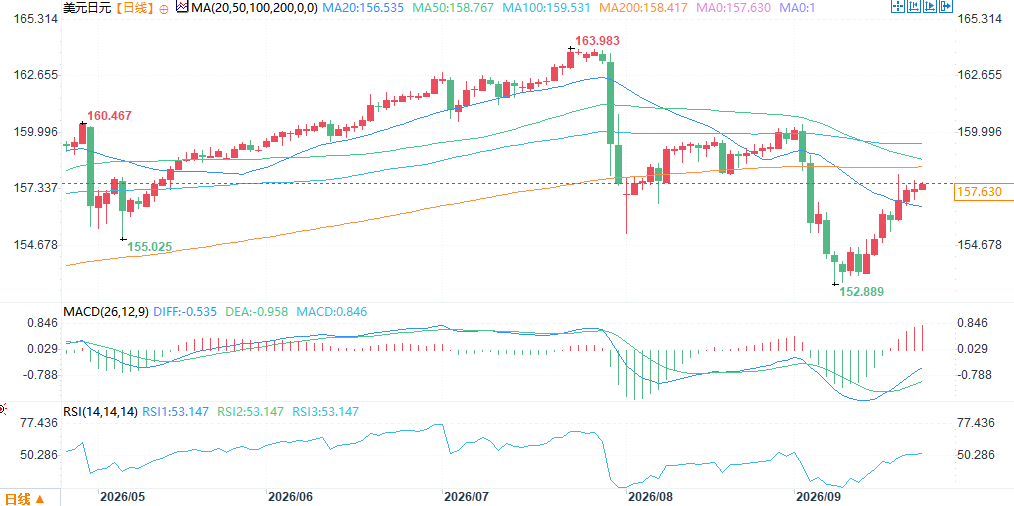 (USD/JPY daily chart, source: FX678) At 11:11 Beijing time, USD/JPY was trading at 157.63/64.
The Bank of Japan's 7-2 vote has raised questions about the extent of future interest rate hikes.
Last week, the Bank of Japan raised its policy rate by 25 basis points to 1.25%, the highest level since 1995. However, the vote was 7-2, with board members Toshiro Asada and Ayano Sato voting against it. The market interpreted the two policymakers' dissent as a warning that further rate hikes might be more difficult to implement, putting pressure on the yen. When asked about the possibility of consecutive rate hikes or larger moves, Bank of Japan Governor Kazuo Ueda stated that the central bank would not rule out any specific policy options before the board meeting. Wells Fargo's chief Asia-Pacific strategist said, "Ueda's press conference showed hawkish signs, but not enough to support the market's aggressive hawkish expectations." The divided vote exposed differing assessments within the policy committee regarding economic resilience and inflation sustainability, with the dissenting votes likely reflecting concerns that tightening too quickly could stifle growth. As a result, the market lowered its bets on consecutive rate hikes this year, putting short-term pressure on the yen. Investors are now paying closer attention to subsequent data and subtle changes in Ueda's statements to determine whether the policy path remains consistent.Increased risk of intervention; interest rate checks seen as a harbinger.
Traders remain highly vigilant about potential intervention by Japanese authorities to support the yen. Japanese media reported last week that Japanese officials conducted currency checks. These checks, involving authorities requesting currency quotes from banks to assess market conditions, are seen by traders as a precursor to currency intervention. If the yen continues to weaken, Japanese authorities may take concrete action, potentially limiting the upside potential of the USD/JPY pair. Historically, currency checks have often been a prelude to verbal or actual market intervention, especially when the yen is depreciating rapidly, import costs are rising, and inflationary pressures are intensifying. Currently, the USD/JPY interest rate differential remains high, and capital outflow pressures persist. If the dollar strengthens due to a hawkish stance from the Federal Reserve, the yen's depreciation could accelerate, increasing the probability of actual intervention. Therefore, while the market is chasing dollar gains, it remains wary of sudden buying, making intervention risk a significant constraint on further upside for the USD/JPY pair.OCBC Bank: Short-term headwinds, but the Bank of Japan's tightening intentions are strengthening.
OCBC strategists acknowledge that the recent 7-2 split vote at the Bank of Japan (BOJ) may remain a short-term headwind for the yen, with a divided board potentially dampening immediate monetary support. However, they emphasize that "the more important conclusion is that the BOJ appears increasingly willing to tighten policy at a faster pace." In their view, this evolving stance "should alleviate concerns about the BOJ lagging behind the yield curve," reinforcing expectations that a more proactive policy path will gradually support the yen, even amidst continued short-term volatility. The strategists point out that while the dissenting votes reflect internal caution, a majority of members still support raising interest rates to a 30-year high, indicating a shift in policy focus from long-term easing to normalization. If subsequent wage growth and core inflation remain resilient, the BOJ may continue tightening, thereby narrowing the interest rate differential with the Federal Reserve. The yen may face short-term pressure due to the split, but a medium-term policy shift is expected to provide fundamental support for the currency; investors need to distinguish between short-term noise and medium- to long-term trends.Collins' hawkish remarks reinforce the Fed's hawkish tone
Federal Reserve Chair Janet Collins explicitly supported last week's rate hike and warned of an increased possibility of inflation significantly exceeding 2%. Her framed policy stance prioritizes a timely return to price stability once the labor market appears to be in a more favorable position. Her emphasis on a "slightly more restrictive" federal funds rate suggests a preference for maintaining higher interest rates for a longer period, a message that typically supports the dollar and puts pressure on risk-sensitive assets. Collins' remarks echo the overall dot plot expectations, indicating that policymakers are more concerned with sticky inflation rather than a premature shift, thus providing sustained support for the dollar and increasing pressure on the yen from the US-Japan interest rate differential.Summarize
The Japanese yen is currently facing dual pressures from the Bank of Japan's lack of hawkish guidance and the Federal Reserve's hawkish tone. The 7-2 split in the vote has led the market to question the extent of the Bank of Japan's subsequent rate hikes, while Collins' hawkish remarks and a rise in the Fed's sentiment index have further supported the dollar. However, the risk of intervention by Japanese authorities and OCBC Bank's assessment of a stronger tightening intention from the Bank of Japan provide some potential support for the yen. In the short term, the USD/JPY pair may continue to rise, but if Japanese authorities intervene or the Bank of Japan releases a clearer tightening signal, the yen may find some respite. Going forward, attention should be paid to US PMI data, statements from Fed officials, whether Japanese authorities take concrete action, and whether subsequent Bank of Japan meetings provide a clearer path for rate hikes. (USD/JPY daily chart, source: FX678) At 11:11 Beijing time, USD/JPY was trading at 157.63/64.
- Risk Warning and Disclaimer
- The market involves risk, and trading may not be suitable for all investors. This article is for reference only and does not constitute personal investment advice, nor does it take into account certain users’ specific investment objectives, financial situation, or other needs. Any investment decisions made based on this information are at your own risk.