Strategist: The real yield on 10-year US Treasury bonds hit a 20-year high, but gold ETFs continued to increase their holdings in the opposite direction.
2026-09-23 13:26:12
Ole Hansen, Head of Commodity Strategy at Saxo Bank, released his latest analysis of the gold market. He observed a highly unusual market phenomenon: the real yield on 10-year US Treasury bonds has climbed to a 20-year high, while global gold ETF holdings continue to rise. This divergence suggests that market concerns about the sustainability of US fiscal policy are rewriting the long-standing negative correlation between real yields and gold, leading to a profound change in the pricing logic of gold.
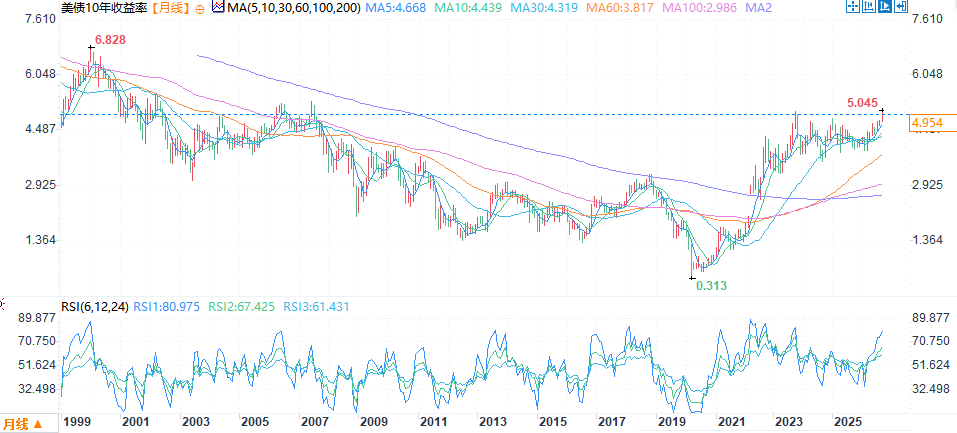 Monthly chart of 10-year US Treasury yield. Source: EasyTrade. At 13:23 Beijing time on September 23, the 10-year US Treasury yield was 4.954%.
A rare divergence has emerged: real interest rates are rising, yet gold ETFs are increasing instead of decreasing.
Ole Hansen stated that the real yield on 10-year US Treasury bonds reached 2.63% last Friday, a new high in over two decades, rising 76 basis points since the beginning of the year. Conversely, gold ETFs, after a round of reductions in the first half of 2026, are currently in a recovery phase. These two sets of data present a stark contrast, clearly demonstrating that the previously strong inverse relationship between gold demand and real yields is loosening. Real yield is the actual return on bonds to investors after adjusting for inflation. Hansen explained that historically, real yield has always been a core indicator determining gold price trends. Precious metals like gold, silver, and platinum do not generate interest or dividends. When real yields rise, bond returns are higher, and funds often choose to abandon gold and shift to bonds, typically putting downward pressure on gold prices—this is the opportunity cost logic of gold investment. Looking back at the Fed's aggressive interest rate hike cycle of 2022-2023, real yields surged rapidly, leading to a large number of investors withdrawing from gold ETFs and a corresponding decline in holdings. However, during that market rally, gold prices did not experience a sharp decline. Central banks around the world made large-scale gold purchases, offsetting the selling pressure caused by ETF outflows. Simply put, at that time, gold prices and real yields simply decoupled, while ETF holdings still followed the traditional interest rate logic.This round of decoupling has gone a step further: ETF funds are no longer afraid of high real interest rates.
Hansen believes the current market environment is fundamentally different from the previous interest rate hike cycle. Influenced by sticky inflation and a renewed surge in long-term US Treasury yields, the 10-year real yield has continued to rise, hitting a 20-year high. However, the market has not witnessed a repeat of the large-scale liquidation of ETFs, and investment demand for gold has shown remarkable resilience. This time, not only has the spot price of gold deviated from the constraints of real yields, but the holding behavior of gold ETFs has also broken the old framework. This change indicates that the opportunity cost logic of "rising real yields and declining attractiveness of gold" is no longer the primary factor dominating the market. Hansen states that the most important explanation behind this is the growing market concern about the sustainability of US fiscal policy and the continued expansion of government debt. Today, investors no longer simply view rising long-term yields as a superior investment option to gold, but rather as a warning sign of fiscal risk, increasing debt repayment pressure, and questionable financial stability. In this environment, gold, as an asset independent of the traditional financial system, continues to highlight its allocation value. The sources of funding supporting gold are now more diversified. Central banks’ demand for gold remains stable, funds are flowing back into Western ETFs, and Asian investors have maintained strong long-term demand for allocation. Compared to 2022-2023, the buyer base for gold has expanded significantly, and the demand foundation is more solid.The Fed's interest rate hikes are largely priced in, and underlying demand supports a positive medium- to long-term outlook for gold prices.
Following the Fed's rate hike last week, Hansen observed the gold market's performance and believes that the Fed's hawkish monetary policy had largely been priced in by the market. He stated on Friday that gold's reaction to the rate hike was muted before the weekend, having largely absorbed the negative impact of the policy. With the Fed not releasing any unexpected signals, new investment demand has become the new focus of observation. Even with recent gold price corrections, gold ETF holdings have climbed to their highest level in seven months, demonstrating a significant influx of long-term funds insensitive to interest rate changes. Hansen compared the market performance in 2022 and 2023, pointing out that the Fed's aggressive rate hikes in those years, which pushed up US Treasury yields, did not lead to a sustained sharp decline in gold prices. It was precisely this underlying demand, insensitive to interest rates, that offset traditional macroeconomic headwinds. He said that this underlying buying power remains solid. While the rate hike will slow the upward pace of gold, it will not reverse the medium- to long-term trend, and he maintains his optimistic outlook on gold.Conclusion
In summary, the simultaneous emergence of high real yields and increased holdings in gold ETFs represents the most noteworthy structural change in the gold market in recent years. Fiscal risk has gradually surpassed opportunity cost, becoming a significant driver of capital allocation to gold, necessitating a re-evaluation of the old trading framework. In the short term, US Treasury real yields will continue to influence gold price fluctuations, and the lingering effects of interest rate hikes will periodically disrupt the market. However, the diversified demand base comprised of central banks, long-term Asian funds, and European and American ETF funds provides strong support for gold. Going forward, observing the gold market should not solely focus on real interest rates; the evolution of US fiscal debt risk will be a key variable determining the extent of this gold bull market. Monthly chart of 10-year US Treasury yield. Source: EasyTrade. At 13:23 Beijing time on September 23, the 10-year US Treasury yield was 4.954%.
- Risk Warning and Disclaimer
- The market involves risk, and trading may not be suitable for all investors. This article is for reference only and does not constitute personal investment advice, nor does it take into account certain users’ specific investment objectives, financial situation, or other needs. Any investment decisions made based on this information are at your own risk.