Iran's deterrent influence is waning; oil prices await diplomatic signals from the US and Iran.
2026-09-22 15:44:12
International crude oil prices rose slightly on Tuesday (September 22), as the ongoing shipping risks in the Strait of Hormuz once again weighed on market sentiment. Investors closely monitored security developments in the strait while awaiting signals from US-Iran diplomatic negotiations. Despite the Revolutionary Guard's earlier announcement of expanding its strike range, oil prices continued to fall, indicating a weakening market reaction to Iran. In early European trading, Brent crude futures rose as much as 1.7% to $102.07 per barrel, while WTI crude also rose 1.7% to $97.4 per barrel. The market is caught in a two-way struggle between Middle East supply risks and expectations of diplomatic easing: a renewed escalation of conflict would continue to push up oil prices; however, if the US and Iran begin direct dialogue at this year's UN General Assembly, the market would anticipate improved regional oil supply, thus suppressing prices. UN Secretary-General Guterres stated that while US-Iran dialogue is necessary, it is highly unlikely to take place in New York. 
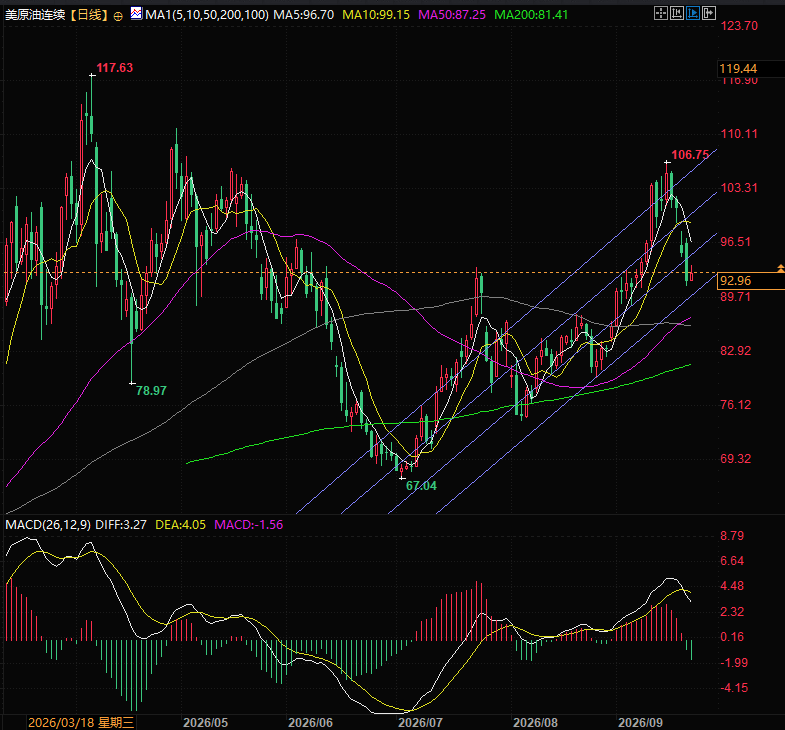 (WTI crude oil futures contract daily chart, source: EasyTrade) At 15:39 Beijing time, the WTI crude oil futures contract is currently trading at $92.97 per barrel.
The conflict over navigation across the Taiwan Strait has become prominent: attacks have occurred frequently, but navigation has not been completely suspended.
The current state of navigation in the Strait of Hormuz presents contradictory characteristics. On Monday, an oil tanker was attacked by projectiles while entering the strait, resulting in minor injuries to two crew members. Another oil tanker was hit by debris, maintaining a high level of shipping risk, although the strait is not completely closed. Data from the U.S. Central Command shows that the total volume of oil and gas and cargo passing through the Strait of Hormuz in the past two weeks has reached a six-month high. Vance, when discussing Iran, indicated that oil is still flowing normally. Some ships are navigating with their Automatic Identification Systems (AIS) turned off, and traditional ship tracking data cannot fully account for all shipping traffic. There are also a few approved passage cases, such as a liquefied natural gas carrier from Qatar bound for Pakistan successfully passing through the strait over the weekend. However, overall shipping has not returned to normal, the scale of commercial vessel passage is limited, and the risks for crew members, cargo ships, and marine insurance remain high.Saudi Arabia's export routes are restricted, and tanker transshipment is increasing freight rates and putting pressure on shipping capacity.
Saudi Arabia's crude oil exports are heavily reliant on the Strait of Hormuz. The country's east-west oil pipeline was shut down preventatively due to previous attacks, and the Bab el-Mandeb Strait route has been restricted by Houthi attacks, putting continued pressure on alternative export routes. In the past two weeks, approximately 2.4 million barrels of Saudi crude oil and condensate have been transported daily via the Strait of Hormuz, returning to early July levels. Saudi Aramco has opted to load crude oil at its Persian Gulf terminals, then conduct ship-to-ship transshipment off the coast of Oman before delivering it to Asian customers. Ship-to-ship transshipment volumes in the Gulf of Oman have reached record highs; if capacity remains strained, some transshipment business may further shift to western India or even Malaysia. Longer transshipment distances will consume significant amounts of Very Large Crude Carrier (VLCC) capacity, driving up tanker demand and causing shipping costs to surge. Data from the head of commodities research at Societe Generale shows that the cost of a single voyage of crude oil from Ras Tanura, Saudi Arabia, to Ningbo, China, has soared from approximately $4.5 million before the conflict to nearly $63 million.The US and Iran continue their power struggle, with Iran employing both soft and hard tactics to gain influence.
The United States, along with several other countries, continues to exert pressure on Iran. The US has imposed navigation restrictions on ships traveling to and from Iranian ports, and Iraq has announced the suspension of flights from Iranian airlines sanctioned by the US. Diplomatic relations between the US and Iran are at an impasse. The Iranian Revolutionary Guard and senior officials have issued a series of strong statements, saying that if the US continues to escalate its actions, Iran will change the scope of the war; they also emphasized that normal navigation in the Strait of Hormuz cannot be restored unless the US meets Iran's demands, such as lifting the naval blockade and related restrictions. The Speaker of the Iranian Parliament also clearly stated that Iran will not return to the original negotiation framework until its demands are met. Meanwhile, Iran values its international voice, and the Iranian Presidential Office accused the US of attempting to suppress Iran's voice at the United Nations by denying visas to its media team.Multinational coordinated action: The UN General Assembly becomes an arena for diplomatic maneuvering.
During the UN General Assembly, French President Macron and US President Trump reached a consensus, agreeing to coordinate actions to ease tensions in the energy market, protect critical infrastructure in the Middle East, and ensure freedom of navigation in the Strait of Hormuz. The two countries also agreed to jointly promote a halt to attacks on Ukrainian energy and civilian facilities and to initiate peace talks between Russia and Ukraine as soon as possible. Overall, the crude oil market will continue to be affected by the potential attack in the Strait in the short term, but the market is no longer easily over-pricing Iran's verbal threats. The key variable for future oil prices will depend on whether the US and Iran can achieve substantive diplomatic dialogue.Shifting Market Sentiment: The Influence of Iranian Deterrence on Oil Prices Gradually Declines
The US and its allies have been exerting increasing pressure on Iran through various means, including the recent disruption of Iranian flights. However, these measures are unlikely to substantially improve oil shipping capacity in the Strait of Hormuz. The market's sensitivity to Iran's unilateral blockade of the Strait and its potential impact on oil supply is also decreasing. Iran hopes to leverage its influence over Strait shipping to attract global market attention and drive up oil prices, but the impact of this tactic is also waning. Technically: As previously indicated, a break below the channel line would signal a trend reversal. The recent decline in oil prices has significantly damaged the upward trend. We await price consolidation; it is highly likely that prices will stabilize near the lower channel line before resuming their upward trend. (WTI crude oil futures contract daily chart, source: EasyTrade) At 15:39 Beijing time, the WTI crude oil futures contract is currently trading at $92.97 per barrel.
- Risk Warning and Disclaimer
- The market involves risk, and trading may not be suitable for all investors. This article is for reference only and does not constitute personal investment advice, nor does it take into account certain users’ specific investment objectives, financial situation, or other needs. Any investment decisions made based on this information are at your own risk.