Hawks are unable to raise interest rates; UN reduces geopolitical premium; real interest rates have peaked.
2026-09-22 22:00:13
On September 22nd, during the European and American trading sessions, the UN General Assembly led to a marginal easing of global geopolitical risks, a decline in geopolitical inflation premiums, and a rebound in spot gold after hitting a low, demonstrating the market's resilience. As previously discussed, with the clearing of IRP (Inflation Risk Premium, i.e., broad inflation expectations equal actual inflation expectations plus IRP inflation risk premium), the current near-real interest rate of TIPS is a good observation point. Calculations show that 10-year forward inflation is locked at around 2.33%. Real interest rate equals nominal interest rate minus inflation expectations. With forward inflation at 2.33%, it's difficult for inflation expectations to fall further, essentially locking them in. Meanwhile, nominal interest rates are constrained by the substantial impact of high interest rates on the real economy and high fiscal debt, ultimately making it difficult for real interest rates to continue rising. Currently, it has begun to form a top, and gold prices may have completely ended their one-sided decline and entered a crucial window for consolidation and bottoming out. 
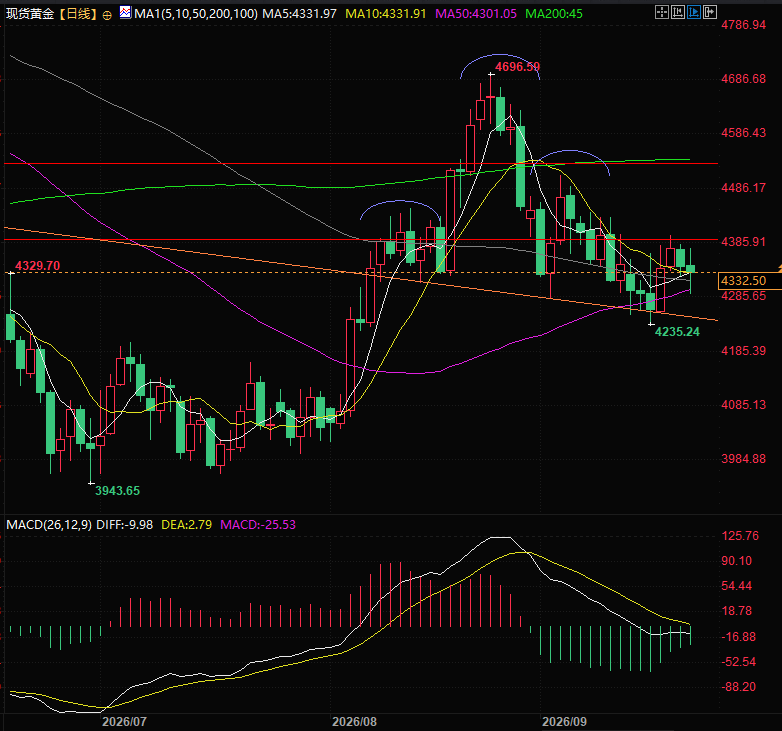 (Spot gold daily chart, source: EasyTrade) At 21:57 Beijing time, spot gold is currently trading at $4337 per ounce.
Federal Reserve officials are issuing a series of hawkish statements: anchoring to endogenous inflation and end-user demand.
Recently, St. Louis Fed President Musalaim and Chicago Fed President Goolsby have both released hawkish signals. They pointed out that the current inflation driver has shifted from geopolitical and energy exogenous shocks to endogenous inflation in the service sector and refined oil products driven by overheated domestic demand in the United States. This means that interest rate hikes are not targeting a one-off energy shock but rather the spread of inflation. Although Bessant's energy strategy has suppressed upstream crude oil, refinery capacity mismatch has led to high refined oil cracking margins, resulting in extremely sticky terminal inflation. Therefore, the Fed's policy is entirely anchored to inflation control, maintaining a tight stance and retaining room for gradual interest rate hikes, resolutely unaffected by market calls for rate cuts. Under these circumstances, the yields on 2-30 year Treasury bonds have recently begun to soften, indicating that the Fed's influence on real yields has reached its limit. Bessant's top-level control: compressing the IRP premium and solidifying the gold base. The core change in this round of market changes lies in Bessant's macroeconomic control: on the one hand, steadily promoting the opening of the Strait of Hormuz and stabilizing crude oil supply; on the other hand, through fiscal debt expectation management, significantly compressing investors' risk compensation (IRP) for hedging against runaway inflation. While this failed to eliminate endogenous inflation, it completely blocked the upside potential of TIPS real interest rates, reversing the one-sided bearish trend for gold.Core Pricing Analysis: IRP Convergence and Peak in Real Interest Rates
The core macroeconomic pricing formula is: TIPS rate = Nominal interest rate - Real endogenous inflation expectations - IRP. The Federal Reserve supports high nominal interest rates, but Bessant's intervention has led to a contraction in IRP, with the 10-year forward inflation expectation anchored steadily at 2.33%. The TIPS real interest rate (approximately 2.68%) and nominal yield have both formed a double-top pattern on the daily chart, indicating weakening upward momentum in interest rates and effectively capping downside potential for gold. Meanwhile, the extremely high TIPS real interest rate of over 2% implies extremely high real social financing costs for the real economy, which will ultimately be transmitted to corporate debt renewals, consumer credit, and the real estate market, exerting substantial pressure on the macroeconomy. The unsustainability of fiscal debt interest payments: Given the high level of US debt, maintaining high nominal and high real interest rates will lead to an explosive increase in US fiscal interest payment costs, forcibly squeezing fiscal spending space. The fiscal side urgently needs a decline in real interest rates to alleviate this pressure. Evolution Path: In the short term, inflation expectations are anchored at 2.33%, and the Federal Reserve maintains high nominal interest rates due to the stickiness of the service sector. The real interest rate of TIPS will remain sticky in the short term, suppressing the explosive power of gold. In the medium to long term, the Federal Reserve's use of monetary policy to combat supply-side (refinery mismatch) inflation is a mismatch of tools. When the constraints of the real economy and fiscal policy erupt, nominal interest rates will experience a "recession-style correction," driving a trend of sharp decline in the real interest rate of TIPS, triggering a strong rebound in gold.Market Outlook:
In conclusion, the Federal Reserve's influence on interest rates has largely subsided. Currently, only the growth of the real economy can affect real interest rates. High interest rates naturally constrain the real economy, ultimately leading to a short-term peak in real interest rates. Unless there is explosive economic growth, real interest rates are likely to begin to decline, directly benefiting gold. Technology stocks and equities may benefit even more, as these companies benefit regardless of whether there is explosive economic growth. Note: The 2.33% 10-year forward inflation estimate is calculated by assuming IRP is approximately zero and using the difference between the closing prices of 10-year TIPS and 10-year Treasury yields. (Spot gold daily chart, source: EasyTrade) At 21:57 Beijing time, spot gold is currently trading at $4337 per ounce.
- Risk Warning and Disclaimer
- The market involves risk, and trading may not be suitable for all investors. This article is for reference only and does not constitute personal investment advice, nor does it take into account certain users’ specific investment objectives, financial situation, or other needs. Any investment decisions made based on this information are at your own risk.