One chart: Freight rates across all vessel types strengthened, with the Baltic Dry Index climbing to a one-week high.
2026-09-22 22:48:11
Latest data shows that the Baltic Dry Index (BDI) reached 3432 points on September 22, 2026, a new high since September 14, 2026, up 0.97% month-on-month, the largest increase since September 18, 2026, and the fourth consecutive day of increase (including zero growth). Looking at the short-term charts, the recent 11 BDI data points show: 6 positive increases, 5 negative increases, and 0 zero increases. Specifically, the Panamax Freight Index (BPI) was 2299 points, up 1.95% from the previous value; the Capesize Freight Index (BCI) was 5892 points, up 0.91%; and the Supramax Freight Index (BSI) was 1776 points, up 0.28%. For detailed 720-day and 10-year trend charts of the Baltic Dry Index and its three sub-indices, please refer to the charts specially prepared by FX678. 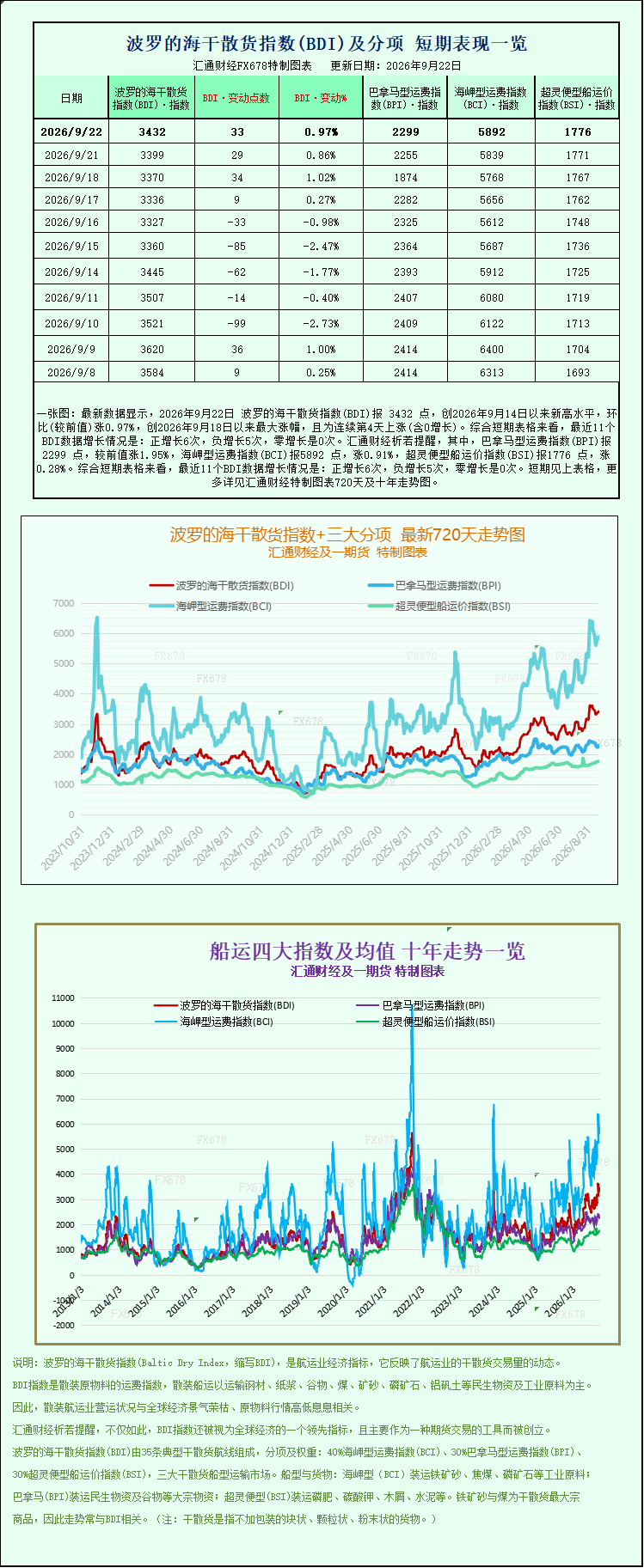 The international dry bulk shipping market has recently seen a comprehensive recovery, with freight rates for all vessel types strengthening simultaneously. Multiple positive factors have combined to drive a sustained rebound in market sentiment. On Tuesday, the Baltic Dry Index (BDI) rose across the board, with the composite index climbing to a one-week high, completely reversing the previous pattern of slight fluctuations and weakness, demonstrating a strong recovery at the start of the traditional peak season. This round of price increases is not a structural rise in a single vessel type, but rather a strengthening across all categories, including Capesize, Panamax, and Supramax, highlighting the overall characteristics of steady release of global bulk shipping demand and a tight market capacity. Data shows that the Baltic Dry Index (BDI), which tracks freight rates for the three major vessel types (Capesize, Panamax, and Supramax), rose 33 points, or about 1%, to close at 3432 points, the highest level in a week since September 14. This index rise has a solid market foundation. Entering mid-to-late September, global dry bulk shipping officially enters its traditional peak season. The combined effects of winter stockpiling in Europe and the US, concentrated global grain shipments, and demand for transporting industrial raw materials like iron ore and coal have continuously driven up global cargo volumes. Meanwhile, affected by El Niño, the Panama Canal has experienced persistent drought and reduced capacity, coupled with longer ocean shipping distances, resulting in a temporary loss of effective market capacity. This further supports a steady rise in freight rates, driving the index to continue its recovery and increase. Capesize vessels, the mainstay of large ocean shipping, led this round of gains, becoming the core driver of the index's rise. On that day, the Capesize vessel index rose 53 points, or 0.9%, to 5892 points, continuing its strong performance. For Capesize vessels primarily engaged in the ocean shipping of 150,000-ton iron ore, coal, and other bulk industrial raw materials, average daily revenue increased by $488 to $49,938, approaching the $50,000 mark, indicating a continued improvement in profitability. From the demand side, Brazilian iron ore exports are steadily increasing, Atlantic ocean freight volume continues to expand, and domestic steel mills' restocking demand is supporting active ocean freight bookings, extending the demand per ton-mile and continuously benefiting freight rates for large vessels. It is worth noting that the strengthening of ocean freight rates and upstream commodity prices are showing a short-term divergence. With the continued rise in ocean freight rates, iron ore futures prices came under pressure and fell on the day, ending the previous four-day upward trend. This iron ore price correction is mainly due to weak market demand expectations, a slow recovery in downstream real estate and infrastructure, and steel mills' raw material restocking mainly driven by immediate needs, with no large-scale concentrated stockpiling yet. The weak long-term demand outlook continues to suppress commodity prices. At the same time, the strengthening of the RMB exchange rate further compresses the price space of RMB-denominated iron ore contracts. The combination of multiple factors has put short-term pressure on the iron ore market, resulting in a typical divergence trend of "rising ocean freight rates and falling freight rates." The performance of Panamax vessels, the main medium-sized vessel type, is even more impressive, leading the price increases across all vessel types. The Panamax index surged 44 points, or 1.9%, significantly outperforming the broader market, closing at 2299 points. This vessel type primarily handles 60,000 to 70,000-ton bulk cargo transportation of coal, grain, and fertilizer, covering multiple core routes in the Atlantic and Pacific Oceans. It combines industrial raw material and agricultural product transport capabilities, making it highly adaptable to the market. Its average daily revenue on spot routes increased by $390 to $20,687. This round of Panamax freight rate increases was primarily driven by the start of the global autumn/winter grain export peak season, concentrated grain shipments from North America and the Black Sea region, coupled with a surge in winter coal stockpiling demand in Europe. This resulted in a dense influx of small and medium-sized cargoes, significantly boosting demand for medium-sized vessels and driving a rapid rebound in freight rates. The small bulk carrier market also showed a steady improvement, continuing its moderate recovery. The Supramax index rose slightly by 5 points, or 0.3%, closing at 1776 points, marking several consecutive days of slight increases. Compared to the strong rebound of large and medium-sized vessels, the increase in smaller vessel sizes was relatively moderate, mainly due to their more dispersed routes and greater reliance on short-haul trade cargoes, resulting in smaller market fluctuations. However, the overall strengthening trend fully confirms the continued improvement in the supply and demand structure of the current dry bulk shipping market, with no obvious weaknesses and widespread industry prosperity. In summary, the recent rebound of the Baltic Dry Index (BDI) at a high level over the past week is the result of multiple factors, including seasonal demand recovery, contraction in shipping capacity, and upgrading demand in long-distance shipping. In the short term, the traditional peak shipping season effect in September and October will continue to intensify, and mineral shipments are expected to further increase after the West African rainy season ends, providing continued support for global bulk cargo shipping demand. However, uncertainties remain in the market. Factors such as the pace of recovery in downstream commodity demand, fluctuations in global monetary policy, and changes in shipping lanes may continue to influence subsequent freight rate trends. Overall, the current dry bulk shipping market has entered an upward cycle, with a stable and rising freight rate pattern across all vessel types. The index is expected to maintain a high-level fluctuation trend in the future.
The international dry bulk shipping market has recently seen a comprehensive recovery, with freight rates for all vessel types strengthening simultaneously. Multiple positive factors have combined to drive a sustained rebound in market sentiment. On Tuesday, the Baltic Dry Index (BDI) rose across the board, with the composite index climbing to a one-week high, completely reversing the previous pattern of slight fluctuations and weakness, demonstrating a strong recovery at the start of the traditional peak season. This round of price increases is not a structural rise in a single vessel type, but rather a strengthening across all categories, including Capesize, Panamax, and Supramax, highlighting the overall characteristics of steady release of global bulk shipping demand and a tight market capacity. Data shows that the Baltic Dry Index (BDI), which tracks freight rates for the three major vessel types (Capesize, Panamax, and Supramax), rose 33 points, or about 1%, to close at 3432 points, the highest level in a week since September 14. This index rise has a solid market foundation. Entering mid-to-late September, global dry bulk shipping officially enters its traditional peak season. The combined effects of winter stockpiling in Europe and the US, concentrated global grain shipments, and demand for transporting industrial raw materials like iron ore and coal have continuously driven up global cargo volumes. Meanwhile, affected by El Niño, the Panama Canal has experienced persistent drought and reduced capacity, coupled with longer ocean shipping distances, resulting in a temporary loss of effective market capacity. This further supports a steady rise in freight rates, driving the index to continue its recovery and increase. Capesize vessels, the mainstay of large ocean shipping, led this round of gains, becoming the core driver of the index's rise. On that day, the Capesize vessel index rose 53 points, or 0.9%, to 5892 points, continuing its strong performance. For Capesize vessels primarily engaged in the ocean shipping of 150,000-ton iron ore, coal, and other bulk industrial raw materials, average daily revenue increased by $488 to $49,938, approaching the $50,000 mark, indicating a continued improvement in profitability. From the demand side, Brazilian iron ore exports are steadily increasing, Atlantic ocean freight volume continues to expand, and domestic steel mills' restocking demand is supporting active ocean freight bookings, extending the demand per ton-mile and continuously benefiting freight rates for large vessels. It is worth noting that the strengthening of ocean freight rates and upstream commodity prices are showing a short-term divergence. With the continued rise in ocean freight rates, iron ore futures prices came under pressure and fell on the day, ending the previous four-day upward trend. This iron ore price correction is mainly due to weak market demand expectations, a slow recovery in downstream real estate and infrastructure, and steel mills' raw material restocking mainly driven by immediate needs, with no large-scale concentrated stockpiling yet. The weak long-term demand outlook continues to suppress commodity prices. At the same time, the strengthening of the RMB exchange rate further compresses the price space of RMB-denominated iron ore contracts. The combination of multiple factors has put short-term pressure on the iron ore market, resulting in a typical divergence trend of "rising ocean freight rates and falling freight rates." The performance of Panamax vessels, the main medium-sized vessel type, is even more impressive, leading the price increases across all vessel types. The Panamax index surged 44 points, or 1.9%, significantly outperforming the broader market, closing at 2299 points. This vessel type primarily handles 60,000 to 70,000-ton bulk cargo transportation of coal, grain, and fertilizer, covering multiple core routes in the Atlantic and Pacific Oceans. It combines industrial raw material and agricultural product transport capabilities, making it highly adaptable to the market. Its average daily revenue on spot routes increased by $390 to $20,687. This round of Panamax freight rate increases was primarily driven by the start of the global autumn/winter grain export peak season, concentrated grain shipments from North America and the Black Sea region, coupled with a surge in winter coal stockpiling demand in Europe. This resulted in a dense influx of small and medium-sized cargoes, significantly boosting demand for medium-sized vessels and driving a rapid rebound in freight rates. The small bulk carrier market also showed a steady improvement, continuing its moderate recovery. The Supramax index rose slightly by 5 points, or 0.3%, closing at 1776 points, marking several consecutive days of slight increases. Compared to the strong rebound of large and medium-sized vessels, the increase in smaller vessel sizes was relatively moderate, mainly due to their more dispersed routes and greater reliance on short-haul trade cargoes, resulting in smaller market fluctuations. However, the overall strengthening trend fully confirms the continued improvement in the supply and demand structure of the current dry bulk shipping market, with no obvious weaknesses and widespread industry prosperity. In summary, the recent rebound of the Baltic Dry Index (BDI) at a high level over the past week is the result of multiple factors, including seasonal demand recovery, contraction in shipping capacity, and upgrading demand in long-distance shipping. In the short term, the traditional peak shipping season effect in September and October will continue to intensify, and mineral shipments are expected to further increase after the West African rainy season ends, providing continued support for global bulk cargo shipping demand. However, uncertainties remain in the market. Factors such as the pace of recovery in downstream commodity demand, fluctuations in global monetary policy, and changes in shipping lanes may continue to influence subsequent freight rate trends. Overall, the current dry bulk shipping market has entered an upward cycle, with a stable and rising freight rate pattern across all vessel types. The index is expected to maintain a high-level fluctuation trend in the future.
- Risk Warning and Disclaimer
- The market involves risk, and trading may not be suitable for all investors. This article is for reference only and does not constitute personal investment advice, nor does it take into account certain users’ specific investment objectives, financial situation, or other needs. Any investment decisions made based on this information are at your own risk.