With the completion of one round of indirect negotiations between the US and Iran, how much of the risk premium remains in oil prices?
2026-09-23 10:50:11
Brent crude futures rebounded slightly in Asian trading on Wednesday (September 23), currently trading around $98.70 per barrel, but still near its lowest level since September 9. With oil prices hovering at these lows, the latest developments in US-Iran negotiations have become a key clue for the market to assess geopolitical risk premiums. US Special Envoy Steve Witkoff stated on Tuesday (September 22) that the indirect negotiations between the US and Iran, conducted through a shuttle of mediators during the UN General Assembly, had completed one round, and he hoped this round would prove constructive and promising, with mediation efforts continuing. Oil prices subsequently fell that day. This development further weakened the geopolitical risk premium for crude oil, compounded by pressure from the recovery of Saudi exports and increased traffic in the Strait of Hormuz. 
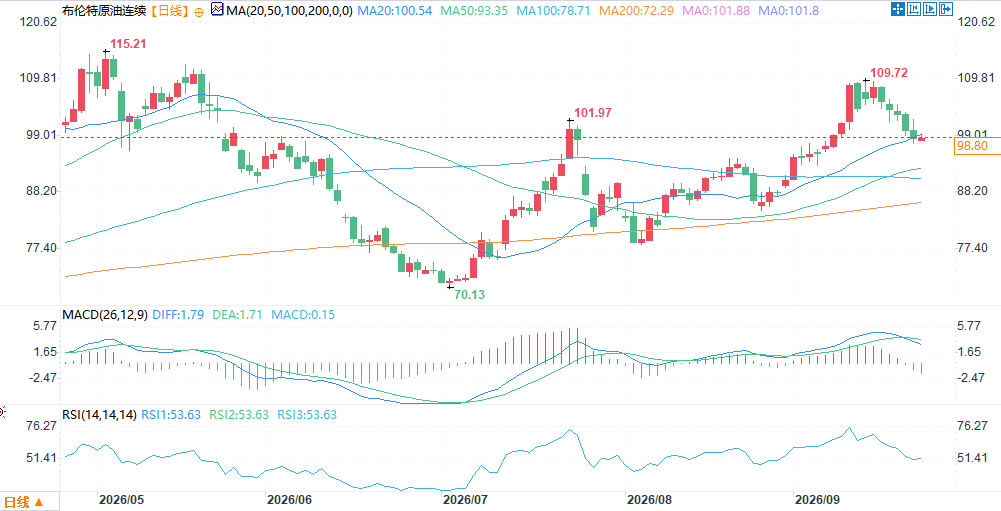 (Brent crude oil futures daily chart, source: EasyTrade) At 10:48 Beijing time, Brent crude oil futures were trading at $98.78 per barrel.
One round of indirect negotiations has been completed, and the mediation mechanism continues to operate.
Vitkov stated on social media that mediators shuttled between the US and Iranian delegations throughout the day, and the two sides had completed one round of discussions. Washington hopes this round of negotiations will prove constructive and promising. He indicated that the mediators will continue their work but did not provide details on the substantive content of the negotiations or a timetable for subsequent rounds. This update echoes earlier statements by US President Trump, who said earlier on Tuesday that US officials had met with the Iranian delegation for about three hours, describing the meeting as productive and anticipating another one soon. Trump expressed confidence in reaching a solution but also stated that a peace agreement would be reached after the US midterm elections in early November, warning that the US could destroy Iran without a deal. Trump also expressed a willingness to meet with Iranian President Pezechiyan, who arrived in New York on Tuesday for the UN General Assembly.Iran sets high bar conditions, and an agreement remains a distant prospect.
Tehran has set high bar for any agreement. Reportedly, Iran's conditions for resuming negotiations include: ending the war on all fronts, negotiating a timetable for Israel's complete withdrawal from southern Lebanon, unfreezing funds, lifting the US naval blockade and newly imposed sanctions, ending military threats, and oil waivers. Iranian media previously refuted reports that Iran might reopen the Strait of Hormuz within seven days if the US eased military pressure and lifted the blockade. Mediation efforts have recently expanded. Qatar and Pakistan have reportedly intervened, and Iran has reportedly requested China to play a greater role in bringing Washington and Tehran back to the negotiating table. The indirect form of Iran's long list of conditions suggests that an agreement remains a distant prospect, and therefore, the decline in oil prices is likely to be gradual and headline-driven rather than a one-sided drop.Lower oil prices are under pressure from both supply recovery and diplomatic progress.
Oil prices fell on diplomatic progress, extending a decline driven by improved supply. Brent crude settled around $99 a barrel on Tuesday after Saudi Arabia restarted its east-west pipeline and prepared to resume exports from the Red Sea port of Yanbu. Saudi crude traffic through the Strait of Hormuz has also picked up significantly in recent weeks. The pipeline, which had been closed since the drone attacks in mid-September, and with the Houthi rebels in Yemen continuing to claim attacks on Saudi targets, serve as a reminder that supply risks have not disappeared. Any sign of stalled negotiations or new Houthi attacks on Saudi infrastructure could quickly rebuild the risk premium. Refined products, particularly diesel, remain at record highs and are the most nervous segment of the market, likely to react less to diplomatic developments than crude oil.The market remains sensitive to headlines.
Analysts expect prices to remain sensitive to headlines. One analyst stated that crude oil is likely to remain range-bound until there is clear progress or a setback in US-Iran diplomacy. The next test will be whether mediators can narrow the gap between Washington's timeline and Tehran's conditions, and whether a second round of negotiations will follow quickly.Summarize
A round of indirect negotiations between the US and Iran was completed during the UN General Assembly, and the mediation mechanism continues to operate, but Iran's high-threshold conditions indicate that an agreement remains a distant prospect. The geopolitical risk premium is gradually weakening, but the downside is likely to be gradual and headline-driven rather than a one-sided decline. Refined oil products, especially diesel, remain the most nervous segment of the market, and their reaction to diplomatic progress may be less pronounced than that of crude oil. Going forward, attention should be paid to whether mediators can narrow the gap between the two sides, whether a second round of negotiations will proceed quickly, and whether Houthi attacks on Saudi infrastructure will reignite supply risks. If negotiations stall or attacks escalate, the risk premium could be rapidly rebuilt. (Brent crude oil futures daily chart, source: EasyTrade) At 10:48 Beijing time, Brent crude oil futures were trading at $98.78 per barrel.
- Risk Warning and Disclaimer
- The market involves risk, and trading may not be suitable for all investors. This article is for reference only and does not constitute personal investment advice, nor does it take into account certain users’ specific investment objectives, financial situation, or other needs. Any investment decisions made based on this information are at your own risk.