A strong dollar and expectations of a Fed rate hike are putting pressure on gold prices, which are expected to remain volatile.
2026-09-23 10:16:11
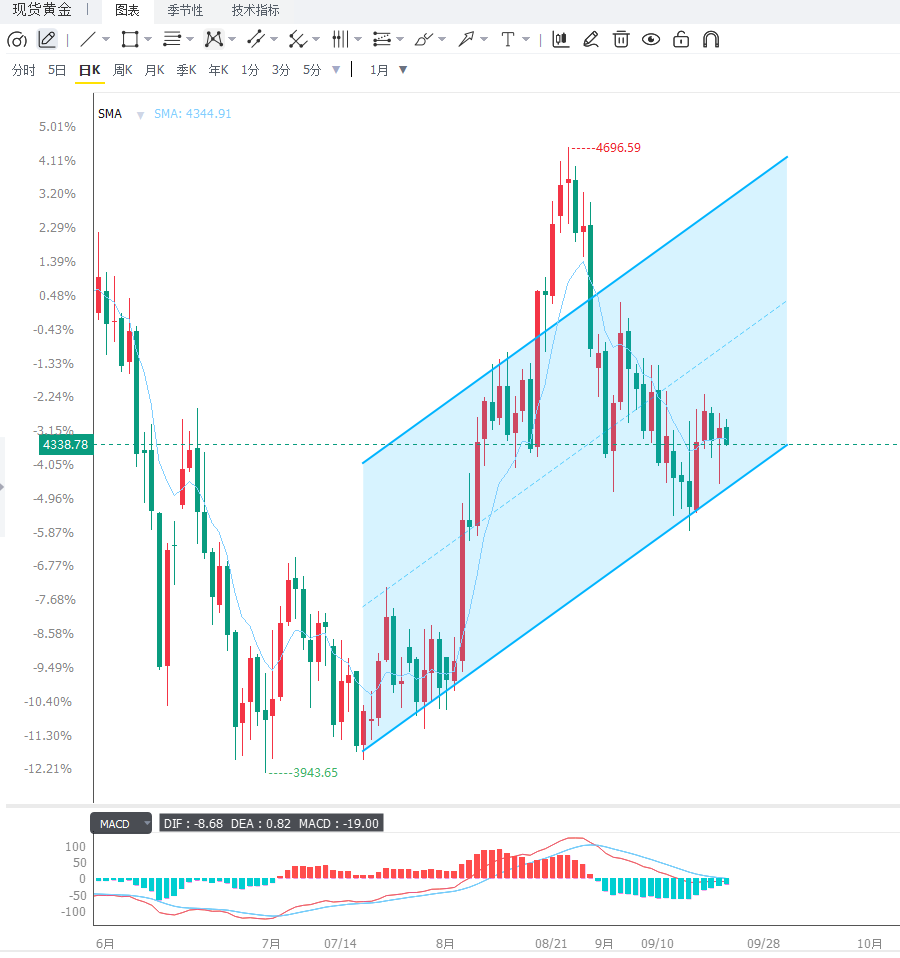
Spot gold rebounded in early Asian trading on Wednesday, with XAU/USD rising to around $4360 before falling back to around $4330. The rebound was mainly driven by rising expectations of easing tensions in the Middle East, as the market reassessed geopolitical risk premiums. Positive signals from the US regarding contact with Iranian representatives eased investor concerns about further escalation of the regional situation. However, gold's current rise remains constrained by the US interest rate environment, especially after the Federal Reserve recently signaled further tightening of monetary policy. Real interest rates and the dollar's performance may still limit the upside potential for gold prices.  The US stated that it held approximately three hours of talks with Iranian representatives and that the talks progressed well. Meanwhile, reports have emerged that Iran may reopen the Strait of Hormuz in the coming days, but this information has not been independently confirmed and is therefore more suitable as a reference for changes in market expectations than as a confirmed supply recovery. If the situation does indeed develop in a de-escalating direction, the additional demand for gold from safe-haven funds may gradually decrease. The expected recovery of Saudi Arabia's energy transportation system is also a focus of market attention. Market news indicates that Saudi Arabia may restart its east-west oil pipeline this week. If the relevant facilities recover smoothly, it will help alleviate the dependence of crude oil transportation on key maritime routes and reduce the risk of energy supply disruptions. For gold, this change has two implications: firstly, decreased geopolitical safe-haven demand will weaken gold's risk premium; secondly, if energy prices fall and inflationary pressures ease, it may also change the market's judgment on the future path of monetary policy. Compared to geopolitical factors, US monetary policy remains a crucial variable determining the medium-term direction of gold. The Federal Reserve raised its policy rate by 25 basis points last week and signaled that further rate hikes are possible. Against this backdrop, gold faces the issue of high holding costs for non-interest-bearing assets. When US Treasury yields remain high, gold's attractiveness relative to interest-bearing assets is typically suppressed. If subsequent US economic data continues to show resilient demand, and the energy price shock spreads further to other commodity sectors, the Federal Reserve may maintain a hawkish policy stance for an extended period, thus putting sustained pressure on gold prices. St. Louis Fed President Alberto Musaleem recently stated that against the backdrop of strong demand and expanding commodity price shocks, the Fed may still need to further raise interest rates to reduce inflationary pressures, and believes that taking action in advance may be more appropriate than waiting for inflation to spread further. These remarks further reinforce market focus on the continued high US interest rates, meaning that further gold price increases cannot solely rely on safe-haven demand; they also require the support of the US dollar and US Treasury yields. This indicates that the current gold market exhibits a relatively clear bullish-bearish divergence. In the short term, the easing of tensions in the Middle East, changes in the US dollar, and yield fluctuations will determine whether the gold price rebound can continue; in the medium term, official gold purchases and physical demand in Asia provide a more solid demand foundation for gold. If geopolitical risks further deteriorate while US interest rates remain high, gold may enter a prolonged period of consolidation at high levels. Conversely, if diplomatic processes falter or new supply risks push up energy prices, safe-haven demand may re-enter the market. The key focus going forward will be on US economic data, speeches by Federal Reserve officials, the US dollar index, and changes in US Treasury yields, while also monitoring the situation in the Middle East and global physical gold demand. For gold prices currently around $4360, the real key in the short term is not a rapid rise driven by a single news item, but whether a sustained price correction can be achieved given the continued pressure on interest rates. From a daily chart perspective, spot gold is currently trading above the 100-day simple moving average of $4315, maintaining a relatively positive overall structure for the time being. Gold prices are approaching the Bollinger Band middle line around $4390, which is the first technical resistance level that the current rebound needs to break through. If it can effectively hold above $4390, the short-term correction could open up further upside potential; the upper Bollinger Band, around $4565, can be considered a more distant technical resistance level. The 14-day RSI is around 50, in the neutral zone, indicating that neither bulls nor bears have yet established a clear unilateral advantage. The future direction will depend more on gold prices' reaction to key moving averages and Bollinger Band levels. On the downside, the 100-day moving average around $4315 forms the first important support level. If gold prices pull back but hold this area, the current rebound structure still has room to continue; a decisive break below this level would indicate that the recent bullish structure is weakening, and the market may further test the lower Bollinger Band around $4215. On the upside, if gold breaks through $4390 and holds, it has a chance to continue its recovery towards the upper Bollinger Band area around $4565. Looking at the 4-hour chart, gold's short-term momentum has recovered somewhat after rebounding from its lows, but the area around $4360 remains a key observation zone during this rebound. If the price can hold above $4360 and further break through $4390, short-term moving averages and momentum indicators may improve simultaneously, further confirming the rebound structure. However, if multiple attempts to break through $4390 fail, and the price falls back below $4315, this rebound may turn into a high-level correction, further testing the support around $4215. Currently, the overall technical picture shows a low-level correction, but until a key resistance level is broken, it should still be considered a rebound rather than a new one-sided upward trend.
  Editor's Summary: Gold is currently in a rebalancing phase between easing geopolitical risks and pressure on US interest rates. The easing signals from US-Iran talks have weakened some of the safe-haven premium, but the likelihood of the Federal Reserve maintaining a hawkish policy means that the dollar and yields remain significant constraints on gold price increases. Looking ahead, $4390 is a key resistance level for gold's short-term correction from a rebound, while $4315 is a crucial support level for maintaining the current structure. If gold prices break through and hold above $4390, the upside potential is likely to expand; if they fall below $4315, a further correction towards the $4215 area should be anticipated. The core of the future gold market will continue to revolve around geopolitical risks, the path of US interest rates, and changes in the dollar and real yields.
The US stated that it held approximately three hours of talks with Iranian representatives and that the talks progressed well. Meanwhile, reports have emerged that Iran may reopen the Strait of Hormuz in the coming days, but this information has not been independently confirmed and is therefore more suitable as a reference for changes in market expectations than as a confirmed supply recovery. If the situation does indeed develop in a de-escalating direction, the additional demand for gold from safe-haven funds may gradually decrease. The expected recovery of Saudi Arabia's energy transportation system is also a focus of market attention. Market news indicates that Saudi Arabia may restart its east-west oil pipeline this week. If the relevant facilities recover smoothly, it will help alleviate the dependence of crude oil transportation on key maritime routes and reduce the risk of energy supply disruptions. For gold, this change has two implications: firstly, decreased geopolitical safe-haven demand will weaken gold's risk premium; secondly, if energy prices fall and inflationary pressures ease, it may also change the market's judgment on the future path of monetary policy. Compared to geopolitical factors, US monetary policy remains a crucial variable determining the medium-term direction of gold. The Federal Reserve raised its policy rate by 25 basis points last week and signaled that further rate hikes are possible. Against this backdrop, gold faces the issue of high holding costs for non-interest-bearing assets. When US Treasury yields remain high, gold's attractiveness relative to interest-bearing assets is typically suppressed. If subsequent US economic data continues to show resilient demand, and the energy price shock spreads further to other commodity sectors, the Federal Reserve may maintain a hawkish policy stance for an extended period, thus putting sustained pressure on gold prices. St. Louis Fed President Alberto Musaleem recently stated that against the backdrop of strong demand and expanding commodity price shocks, the Fed may still need to further raise interest rates to reduce inflationary pressures, and believes that taking action in advance may be more appropriate than waiting for inflation to spread further. These remarks further reinforce market focus on the continued high US interest rates, meaning that further gold price increases cannot solely rely on safe-haven demand; they also require the support of the US dollar and US Treasury yields. This indicates that the current gold market exhibits a relatively clear bullish-bearish divergence. In the short term, the easing of tensions in the Middle East, changes in the US dollar, and yield fluctuations will determine whether the gold price rebound can continue; in the medium term, official gold purchases and physical demand in Asia provide a more solid demand foundation for gold. If geopolitical risks further deteriorate while US interest rates remain high, gold may enter a prolonged period of consolidation at high levels. Conversely, if diplomatic processes falter or new supply risks push up energy prices, safe-haven demand may re-enter the market. The key focus going forward will be on US economic data, speeches by Federal Reserve officials, the US dollar index, and changes in US Treasury yields, while also monitoring the situation in the Middle East and global physical gold demand. For gold prices currently around $4360, the real key in the short term is not a rapid rise driven by a single news item, but whether a sustained price correction can be achieved given the continued pressure on interest rates. From a daily chart perspective, spot gold is currently trading above the 100-day simple moving average of $4315, maintaining a relatively positive overall structure for the time being. Gold prices are approaching the Bollinger Band middle line around $4390, which is the first technical resistance level that the current rebound needs to break through. If it can effectively hold above $4390, the short-term correction could open up further upside potential; the upper Bollinger Band, around $4565, can be considered a more distant technical resistance level. The 14-day RSI is around 50, in the neutral zone, indicating that neither bulls nor bears have yet established a clear unilateral advantage. The future direction will depend more on gold prices' reaction to key moving averages and Bollinger Band levels. On the downside, the 100-day moving average around $4315 forms the first important support level. If gold prices pull back but hold this area, the current rebound structure still has room to continue; a decisive break below this level would indicate that the recent bullish structure is weakening, and the market may further test the lower Bollinger Band around $4215. On the upside, if gold breaks through $4390 and holds, it has a chance to continue its recovery towards the upper Bollinger Band area around $4565. Looking at the 4-hour chart, gold's short-term momentum has recovered somewhat after rebounding from its lows, but the area around $4360 remains a key observation zone during this rebound. If the price can hold above $4360 and further break through $4390, short-term moving averages and momentum indicators may improve simultaneously, further confirming the rebound structure. However, if multiple attempts to break through $4390 fail, and the price falls back below $4315, this rebound may turn into a high-level correction, further testing the support around $4215. Currently, the overall technical picture shows a low-level correction, but until a key resistance level is broken, it should still be considered a rebound rather than a new one-sided upward trend. Editor's Summary: Gold is currently in a rebalancing phase between easing geopolitical risks and pressure on US interest rates. The easing signals from US-Iran talks have weakened some of the safe-haven premium, but the likelihood of the Federal Reserve maintaining a hawkish policy means that the dollar and yields remain significant constraints on gold price increases. Looking ahead, $4390 is a key resistance level for gold's short-term correction from a rebound, while $4315 is a crucial support level for maintaining the current structure. If gold prices break through and hold above $4390, the upside potential is likely to expand; if they fall below $4315, a further correction towards the $4215 area should be anticipated. The core of the future gold market will continue to revolve around geopolitical risks, the path of US interest rates, and changes in the dollar and real yields.
- Risk Warning and Disclaimer
- The market involves risk, and trading may not be suitable for all investors. This article is for reference only and does not constitute personal investment advice, nor does it take into account certain users’ specific investment objectives, financial situation, or other needs. Any investment decisions made based on this information are at your own risk.