The UK's larger-than-expected fiscal deficit dragged down the pound, causing GBP/USD to fall continuously; be wary of a potential acceleration.
2026-09-23 15:24:11
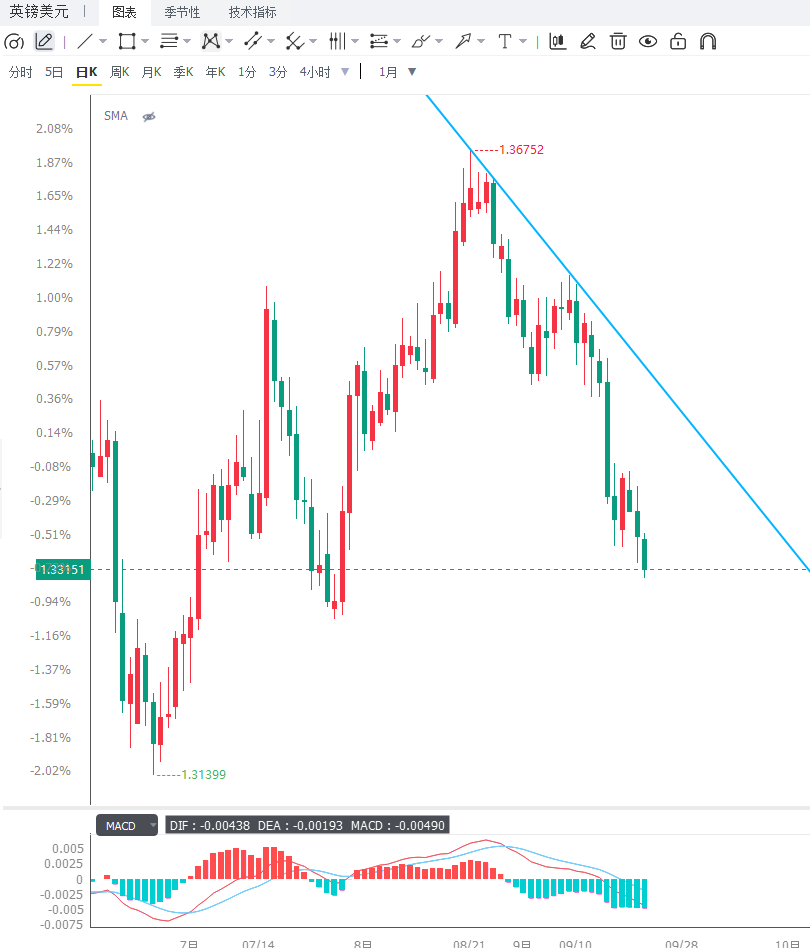
The pound continued to weaken against the dollar on Wednesday, falling back to around 1.3310 in early European trading. The main reasons for the pound's weakness stemmed from the deteriorating UK fiscal situation and the continued strength of the US dollar, both factors contributing to the downward pressure on GBP/USD. With the UK government's October budget announcement imminent, market attention has clearly intensified regarding fiscal space, government financing costs, and future tax and spending policies.  The latest data from the UK Office for National Statistics shows that net public sector borrowing reached £18.268 billion in August, an increase of approximately £2.9 billion compared to the same period in 2025, and the second-highest August level on record under non-inflation-adjusted terms. More notably, cumulative borrowing from the 2026/27 fiscal year to August reached £77.3 billion, £8.1 billion higher than the Office for Budget Responsibility's previous forecast. The better-than-expected fiscal data means the UK government faces more limited policy space in the upcoming budget. The market is currently particularly focused on how the government will balance fiscal rules, public spending, and potential tax increases. Chancellor of the Exchequer John Healy will announce his first budget on October 28th, and recent changes in government financing costs and the inflationary environment have become important variables influencing fiscal planning. The significant rise in UK government bond yields has further increased the pressure on government debt financing. In early September, the yield on 10-year UK government bonds rose to 5.294%, the highest level since 2007, reflecting the impact of changes in global energy prices, inflation, and financing conditions on the UK's fiscal environment. With borrowing costs remaining high, interest payments in the fiscal budget have become a significant factor in market assessments of the pound. However, the impact of UK fiscal data on the pound is not simply a one-way street. UK inflation remains above the Bank of England's 2% target, and changes in energy prices may continue to influence the future inflation path. The Bank of England previously maintained interest rates at 3.75% and faces pressure to reassess its future policy path due to energy price shocks. Higher UK interest rates theoretically provide interest rate differential support for the pound, but if high interest rates simultaneously exacerbate government financing pressures and weaken economic growth expectations, the support for the pound may be limited. Meanwhile, the policy environment for the US dollar remains strong. The Federal Reserve recently raised the target range for the federal funds rate by 25 basis points to 3.75%–4.00%, while policymakers continued to emphasize inflation risks. Boston Fed President Collins stated that the likelihood of inflation remaining significantly above 2% has increased, supporting the previous decision to raise interest rates. Such policy signals continue to drive market attention to the possibility of US interest rates remaining high for an extended period. The US dollar's interest rate advantage therefore becomes a significant source of pressure on GBP/USD. If US economic data continues to show resilience, the market may further increase its expectations that the Federal Reserve will maintain a restrictive policy, thereby driving the dollar stronger. Conversely, if economic data cools significantly, market expectations for further interest rate hikes will decline, and the dollar's strength may ease temporarily. Next, US PMI data will be a key short-term catalyst. The market will focus on whether manufacturing, services, and overall business activity continue to expand. If US economic activity is stronger than expected, it may further solidify the dollar's interest rate advantage; if the data weakens significantly, it may push the dollar down and provide some room for the pound to recover. In the UK, the market focus is gradually shifting from monetary policy to fiscal policy. With the October budget approaching, how the government addresses high borrowing costs, public spending pressures, and fiscal constraints will be a crucial variable affecting the pound's risk premium. The UK Office for National Statistics also pointed out that while cumulative borrowing to August was lower than the same period last year, it was still significantly higher than official forecasts, so the fiscal performance still needs further data verification. Overall, GBP/USD is currently affected by both UK fiscal uncertainty and US interest rate expectations. For the pound to reverse its weakness in the short term, it needs to see an easing of UK fiscal risks or the dollar being dragged down by weaker US economic data and lower interest rate expectations. Until these two factors show clear changes, the exchange rate is likely to remain weak and volatile. From a daily chart perspective, GBP/USD is currently trading around 1.3310, below the 100-day simple moving average at 1.3432 and the 20-day Bollinger Band middle line at 1.3475, while approaching the lower Bollinger Band at 1.3315. The overall technical structure remains bearish. The 14-day RSI has fallen to 30.8, approaching oversold territory, indicating concentrated selling pressure recently, but no clear trend reversal signal has yet formed. Until the price regains above 1.3432, any short-term rebound may still be seen as a weak correction. The first resistance level to watch is the 100-day moving average around 1.3432. A successful break above this level would target the Bollinger Band middle line around 1.3475; further up, the upper Bollinger Band around 1.3640. The 1.3315 level is currently the most immediate technical support. A decisive break below this level would indicate that the bears have expanded their downside potential, and subsequent support levels at lower levels should be monitored. On the 4-hour chart, GBP/USD remains in a downtrend, with prices repeatedly pressured by short-term moving averages, resulting in limited rebound strength. As the daily RSI is approaching oversold territory, a technical rebound is possible if the US PMI is weaker than expected or if the US dollar experiences profit-taking, initially testing the resistance around 1.3432. However, if the price continues to trade below 1.3432 and decisively breaks below 1.3315, the short-term downtrend may continue. The market should currently focus on whether 1.3315 can hold and whether 1.3432 can revert to support.
  Editor's Summary: UK public sector borrowing reached £18.268 billion in August, bringing the cumulative borrowing for the fiscal year to £77.3 billion, £8.1 billion higher than official forecasts. Fiscal pressure is becoming a significant pricing factor in the pound market. Meanwhile, the Federal Reserve maintains a hawkish policy stance, and the dollar's interest rate advantage continues to exert downward pressure on GBP/USD. Technically, 1.3315 is currently a key support level, while 1.3432 and 1.3475 constitute the main resistance levels that need to be broken during any rebound. Short-term movements will continue to be influenced by US PMI data, dollar interest rate expectations, and expectations surrounding the UK's October budget. If UK fiscal risks continue to escalate and US data remains resilient, the pound may remain weak; if dollar interest rate expectations ease while UK fiscal expectations improve, GBP/USD may have room for technical correction.
The latest data from the UK Office for National Statistics shows that net public sector borrowing reached £18.268 billion in August, an increase of approximately £2.9 billion compared to the same period in 2025, and the second-highest August level on record under non-inflation-adjusted terms. More notably, cumulative borrowing from the 2026/27 fiscal year to August reached £77.3 billion, £8.1 billion higher than the Office for Budget Responsibility's previous forecast. The better-than-expected fiscal data means the UK government faces more limited policy space in the upcoming budget. The market is currently particularly focused on how the government will balance fiscal rules, public spending, and potential tax increases. Chancellor of the Exchequer John Healy will announce his first budget on October 28th, and recent changes in government financing costs and the inflationary environment have become important variables influencing fiscal planning. The significant rise in UK government bond yields has further increased the pressure on government debt financing. In early September, the yield on 10-year UK government bonds rose to 5.294%, the highest level since 2007, reflecting the impact of changes in global energy prices, inflation, and financing conditions on the UK's fiscal environment. With borrowing costs remaining high, interest payments in the fiscal budget have become a significant factor in market assessments of the pound. However, the impact of UK fiscal data on the pound is not simply a one-way street. UK inflation remains above the Bank of England's 2% target, and changes in energy prices may continue to influence the future inflation path. The Bank of England previously maintained interest rates at 3.75% and faces pressure to reassess its future policy path due to energy price shocks. Higher UK interest rates theoretically provide interest rate differential support for the pound, but if high interest rates simultaneously exacerbate government financing pressures and weaken economic growth expectations, the support for the pound may be limited. Meanwhile, the policy environment for the US dollar remains strong. The Federal Reserve recently raised the target range for the federal funds rate by 25 basis points to 3.75%–4.00%, while policymakers continued to emphasize inflation risks. Boston Fed President Collins stated that the likelihood of inflation remaining significantly above 2% has increased, supporting the previous decision to raise interest rates. Such policy signals continue to drive market attention to the possibility of US interest rates remaining high for an extended period. The US dollar's interest rate advantage therefore becomes a significant source of pressure on GBP/USD. If US economic data continues to show resilience, the market may further increase its expectations that the Federal Reserve will maintain a restrictive policy, thereby driving the dollar stronger. Conversely, if economic data cools significantly, market expectations for further interest rate hikes will decline, and the dollar's strength may ease temporarily. Next, US PMI data will be a key short-term catalyst. The market will focus on whether manufacturing, services, and overall business activity continue to expand. If US economic activity is stronger than expected, it may further solidify the dollar's interest rate advantage; if the data weakens significantly, it may push the dollar down and provide some room for the pound to recover. In the UK, the market focus is gradually shifting from monetary policy to fiscal policy. With the October budget approaching, how the government addresses high borrowing costs, public spending pressures, and fiscal constraints will be a crucial variable affecting the pound's risk premium. The UK Office for National Statistics also pointed out that while cumulative borrowing to August was lower than the same period last year, it was still significantly higher than official forecasts, so the fiscal performance still needs further data verification. Overall, GBP/USD is currently affected by both UK fiscal uncertainty and US interest rate expectations. For the pound to reverse its weakness in the short term, it needs to see an easing of UK fiscal risks or the dollar being dragged down by weaker US economic data and lower interest rate expectations. Until these two factors show clear changes, the exchange rate is likely to remain weak and volatile. From a daily chart perspective, GBP/USD is currently trading around 1.3310, below the 100-day simple moving average at 1.3432 and the 20-day Bollinger Band middle line at 1.3475, while approaching the lower Bollinger Band at 1.3315. The overall technical structure remains bearish. The 14-day RSI has fallen to 30.8, approaching oversold territory, indicating concentrated selling pressure recently, but no clear trend reversal signal has yet formed. Until the price regains above 1.3432, any short-term rebound may still be seen as a weak correction. The first resistance level to watch is the 100-day moving average around 1.3432. A successful break above this level would target the Bollinger Band middle line around 1.3475; further up, the upper Bollinger Band around 1.3640. The 1.3315 level is currently the most immediate technical support. A decisive break below this level would indicate that the bears have expanded their downside potential, and subsequent support levels at lower levels should be monitored. On the 4-hour chart, GBP/USD remains in a downtrend, with prices repeatedly pressured by short-term moving averages, resulting in limited rebound strength. As the daily RSI is approaching oversold territory, a technical rebound is possible if the US PMI is weaker than expected or if the US dollar experiences profit-taking, initially testing the resistance around 1.3432. However, if the price continues to trade below 1.3432 and decisively breaks below 1.3315, the short-term downtrend may continue. The market should currently focus on whether 1.3315 can hold and whether 1.3432 can revert to support. Editor's Summary: UK public sector borrowing reached £18.268 billion in August, bringing the cumulative borrowing for the fiscal year to £77.3 billion, £8.1 billion higher than official forecasts. Fiscal pressure is becoming a significant pricing factor in the pound market. Meanwhile, the Federal Reserve maintains a hawkish policy stance, and the dollar's interest rate advantage continues to exert downward pressure on GBP/USD. Technically, 1.3315 is currently a key support level, while 1.3432 and 1.3475 constitute the main resistance levels that need to be broken during any rebound. Short-term movements will continue to be influenced by US PMI data, dollar interest rate expectations, and expectations surrounding the UK's October budget. If UK fiscal risks continue to escalate and US data remains resilient, the pound may remain weak; if dollar interest rate expectations ease while UK fiscal expectations improve, GBP/USD may have room for technical correction.
- Risk Warning and Disclaimer
- The market involves risk, and trading may not be suitable for all investors. This article is for reference only and does not constitute personal investment advice, nor does it take into account certain users’ specific investment objectives, financial situation, or other needs. Any investment decisions made based on this information are at your own risk.