Hawkish expectations from the Federal Reserve pushed the dollar index up to around 100.70, with the market focusing on the US PMI and the path of further interest rate hikes this year.
2026-09-23 15:28:11
The US dollar index continued to strengthen in Asian trading on Wednesday, rising to around 100.70, marking its third consecutive day of gains. The main support for the dollar recently remains the relatively hawkish policy expectations of the Federal Reserve. At its September meeting, the Fed raised the target range for the federal funds rate by 25 basis points to 3.75%–4.00% and continued to emphasize that inflation remains at a high level.  Changes in interest rate expectations have become the core driver of the recent dollar rebound. The market continues to bet on further rate hikes by the Federal Reserve this year, pushing the dollar index back above 100. Latest market data shows that investor pricing in another rate hike in December was as high as 89.2%, indicating strong market expectations that the Fed will maintain a restrictive policy stance. However, the dollar's rise is not entirely due to a unified expectation of further tightening within the Fed. Richmond Fed President Barkin recently stated that the US economy may be strengthening, with consumer spending and broader economic activity remaining resilient, while inflation remains a key concern for the Fed. He supported the previous 25-basis-point rate hike and believes that inflationary pressures are no longer limited to energy and tariff shocks. Barkin's remarks suggest that the Fed is currently more focused on the persistence of inflation and whether financial conditions are sufficiently restrictive. At the same time, his assessment of the labor market's overheating is relatively moderate, believing the job market is relatively balanced and consumption remains supportive. This means that the US economy is not currently showing clear signs of recession, but as long as inflation continues to exceed the target, the Fed may need to maintain relatively high interest rates. The inflation outlook also warrants attention. TD Securities' initial assessment of the September inflation path suggests that rising gasoline and food prices may continue to push up overall CPI, but core CPI growth may slow, with service inflation and supercore inflation showing a tendency to revert to their previous levels. This forecast may be adjusted based on subsequent data due to the significant volatility in items such as gasoline, hotels, and airfares. This inflation path implies that the future direction of the US dollar will increasingly depend on the interplay between "high overall inflation" and "gradually cooling core inflation." Boston Fed President Collins' recent signals have been relatively hawkish. She supported previous rate hikes and pointed out that the risk of inflation remaining significantly above the 2% target has increased, while also believing that policy rates need to remain somewhat constrained to ensure that inflation eventually returns to the target level. Such statements have reinforced market expectations that US interest rates will remain high for a longer period, thus continuing to provide interest rate differential support for the dollar. From an overall policy communication perspective, the Fed has not clearly shifted to easing. The September policy statement indicated that economic activity remained robust, productivity growth was strong, capital investment remained active, while inflation remained high. Therefore, the Fed further pushed inflation back towards the 2% target through rate hikes. Another recent support for the US dollar comes from the repricing of risks in global markets. Energy prices had previously risen significantly due to the situation in the Middle East and supply concerns, but recent news of easing regional tensions has pushed oil prices down. Lower oil prices help alleviate US inflationary pressures, but at the same time, they also reduce some of the support that energy costs provide for the dollar's safe-haven status. Therefore, the dollar is currently more reliant on interest rate expectations than simply on inflation trading driven by rising commodity prices. Going forward, US PMI data will be a crucial short-term catalyst. The market will focus on whether manufacturing and service sector activity continues to be resilient. If economic activity is stronger than expected, it may further reinforce the necessity for the Federal Reserve to maintain its restrictive policies; if the data is significantly weaker, the market may reassess the scope for further interest rate hikes this year, putting some pressure on the dollar's recent gains. On September 23, the S&P Global Manufacturing, Services, and Composite PMI preliminary readings are all key data points on the US economic calendar. Therefore, the dollar index is currently in a phase where both fundamentals and technicals are relatively strong, but after a short-term surge, it also faces some profit-taking pressure. As the RSI gradually approaches overbought territory, whether the US dollar can further open up upward space will depend on whether US economic data continues to validate the necessity of a high-interest-rate environment and whether Federal Reserve officials continue to release hawkish signals. From a daily chart perspective, the US dollar index is currently trading around 100.70, and the price has regained its position above the 9-day and 50-day exponential moving averages, maintaining a slightly bullish short-term trend. The 9-day EMA is around 100.15, and the 50-day EMA is around 99.80, forming a significant support area below. The 14-day RSI has risen to 67.72, approaching overbought levels, indicating a significant increase in bullish momentum, but also suggesting an increasing probability of consolidation or a technical pullback after further short-term gains. From a short-term perspective, the area around 100.70 has become a crucial price zone after the US dollar bulls regained control. If the US dollar can maintain its position above 100.70 and continue its upward momentum, the market will focus on the resistance near the previous high. Conversely, if weaker-than-expected PMI data causes the dollar to fall, the first support level to watch is the 9-day EMA around 100.15, and a break below that would target the 50-day EMA around 99.80. As long as the price continues to trade above both moving averages, the overall bullish structure remains intact. Looking at the 4-hour chart, the US dollar index has maintained a recent upward trend with short-term moving averages continuing to diverge upwards, indicating that short-term buying pressure still holds some advantage. However, with the RSI approaching high levels, simply chasing the rally is no longer advisable. If the price can effectively break through and hold above 100.70, the short-term bullish structure is likely to continue; if the US PMI is weaker than expected and triggers a decline in interest rate expectations, the dollar may first retrace to 100.15, and a further break below that could test the medium-term support around 99.80.
 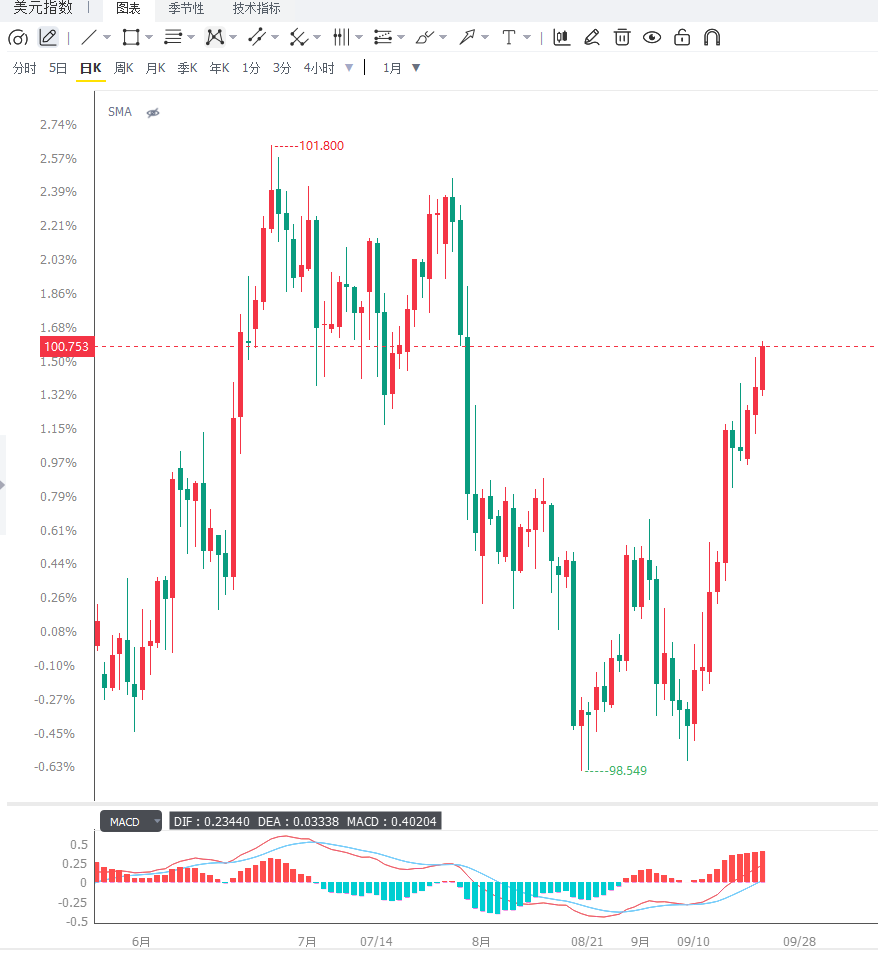 Editor's Summary: The US dollar index rose for the third consecutive trading day, primarily driven by expectations of a hawkish interest rate path from the Federal Reserve. Following the September rate hike, the Fed raised its policy rate to 3.75%-4.00%, while inflation remains above target, keeping the market focused on the possibility of further policy tightening this year. The dollar index has now climbed back above 100, with 100.15 and 99.80 forming key short-term support levels. The area above 100.70 is where further upward movement needs to be observed. However, the RSI approaching overbought levels suggests that upward momentum has been somewhat exhausted, and future price movements will depend more on further confirmation of interest rate expectations from US PMI data, inflation figures, and speeches by Fed officials. If economic data remains resilient, the dollar's strong performance at high levels may continue; however, if economic activity cools significantly, the dollar will face short-term downward pressure.
Changes in interest rate expectations have become the core driver of the recent dollar rebound. The market continues to bet on further rate hikes by the Federal Reserve this year, pushing the dollar index back above 100. Latest market data shows that investor pricing in another rate hike in December was as high as 89.2%, indicating strong market expectations that the Fed will maintain a restrictive policy stance. However, the dollar's rise is not entirely due to a unified expectation of further tightening within the Fed. Richmond Fed President Barkin recently stated that the US economy may be strengthening, with consumer spending and broader economic activity remaining resilient, while inflation remains a key concern for the Fed. He supported the previous 25-basis-point rate hike and believes that inflationary pressures are no longer limited to energy and tariff shocks. Barkin's remarks suggest that the Fed is currently more focused on the persistence of inflation and whether financial conditions are sufficiently restrictive. At the same time, his assessment of the labor market's overheating is relatively moderate, believing the job market is relatively balanced and consumption remains supportive. This means that the US economy is not currently showing clear signs of recession, but as long as inflation continues to exceed the target, the Fed may need to maintain relatively high interest rates. The inflation outlook also warrants attention. TD Securities' initial assessment of the September inflation path suggests that rising gasoline and food prices may continue to push up overall CPI, but core CPI growth may slow, with service inflation and supercore inflation showing a tendency to revert to their previous levels. This forecast may be adjusted based on subsequent data due to the significant volatility in items such as gasoline, hotels, and airfares. This inflation path implies that the future direction of the US dollar will increasingly depend on the interplay between "high overall inflation" and "gradually cooling core inflation." Boston Fed President Collins' recent signals have been relatively hawkish. She supported previous rate hikes and pointed out that the risk of inflation remaining significantly above the 2% target has increased, while also believing that policy rates need to remain somewhat constrained to ensure that inflation eventually returns to the target level. Such statements have reinforced market expectations that US interest rates will remain high for a longer period, thus continuing to provide interest rate differential support for the dollar. From an overall policy communication perspective, the Fed has not clearly shifted to easing. The September policy statement indicated that economic activity remained robust, productivity growth was strong, capital investment remained active, while inflation remained high. Therefore, the Fed further pushed inflation back towards the 2% target through rate hikes. Another recent support for the US dollar comes from the repricing of risks in global markets. Energy prices had previously risen significantly due to the situation in the Middle East and supply concerns, but recent news of easing regional tensions has pushed oil prices down. Lower oil prices help alleviate US inflationary pressures, but at the same time, they also reduce some of the support that energy costs provide for the dollar's safe-haven status. Therefore, the dollar is currently more reliant on interest rate expectations than simply on inflation trading driven by rising commodity prices. Going forward, US PMI data will be a crucial short-term catalyst. The market will focus on whether manufacturing and service sector activity continues to be resilient. If economic activity is stronger than expected, it may further reinforce the necessity for the Federal Reserve to maintain its restrictive policies; if the data is significantly weaker, the market may reassess the scope for further interest rate hikes this year, putting some pressure on the dollar's recent gains. On September 23, the S&P Global Manufacturing, Services, and Composite PMI preliminary readings are all key data points on the US economic calendar. Therefore, the dollar index is currently in a phase where both fundamentals and technicals are relatively strong, but after a short-term surge, it also faces some profit-taking pressure. As the RSI gradually approaches overbought territory, whether the US dollar can further open up upward space will depend on whether US economic data continues to validate the necessity of a high-interest-rate environment and whether Federal Reserve officials continue to release hawkish signals. From a daily chart perspective, the US dollar index is currently trading around 100.70, and the price has regained its position above the 9-day and 50-day exponential moving averages, maintaining a slightly bullish short-term trend. The 9-day EMA is around 100.15, and the 50-day EMA is around 99.80, forming a significant support area below. The 14-day RSI has risen to 67.72, approaching overbought levels, indicating a significant increase in bullish momentum, but also suggesting an increasing probability of consolidation or a technical pullback after further short-term gains. From a short-term perspective, the area around 100.70 has become a crucial price zone after the US dollar bulls regained control. If the US dollar can maintain its position above 100.70 and continue its upward momentum, the market will focus on the resistance near the previous high. Conversely, if weaker-than-expected PMI data causes the dollar to fall, the first support level to watch is the 9-day EMA around 100.15, and a break below that would target the 50-day EMA around 99.80. As long as the price continues to trade above both moving averages, the overall bullish structure remains intact. Looking at the 4-hour chart, the US dollar index has maintained a recent upward trend with short-term moving averages continuing to diverge upwards, indicating that short-term buying pressure still holds some advantage. However, with the RSI approaching high levels, simply chasing the rally is no longer advisable. If the price can effectively break through and hold above 100.70, the short-term bullish structure is likely to continue; if the US PMI is weaker than expected and triggers a decline in interest rate expectations, the dollar may first retrace to 100.15, and a further break below that could test the medium-term support around 99.80. Editor's Summary: The US dollar index rose for the third consecutive trading day, primarily driven by expectations of a hawkish interest rate path from the Federal Reserve. Following the September rate hike, the Fed raised its policy rate to 3.75%-4.00%, while inflation remains above target, keeping the market focused on the possibility of further policy tightening this year. The dollar index has now climbed back above 100, with 100.15 and 99.80 forming key short-term support levels. The area above 100.70 is where further upward movement needs to be observed. However, the RSI approaching overbought levels suggests that upward momentum has been somewhat exhausted, and future price movements will depend more on further confirmation of interest rate expectations from US PMI data, inflation figures, and speeches by Fed officials. If economic data remains resilient, the dollar's strong performance at high levels may continue; however, if economic activity cools significantly, the dollar will face short-term downward pressure.
- Risk Warning and Disclaimer
- The market involves risk, and trading may not be suitable for all investors. This article is for reference only and does not constitute personal investment advice, nor does it take into account certain users’ specific investment objectives, financial situation, or other needs. Any investment decisions made based on this information are at your own risk.